• The move to the new server is done. There are some software and database maintenance updates in process. This has us passing the hat around to help out. We appreciate any donations. Seriously, even a dollar helps. The payment page may be found here - https://www.audiokarma.org/support.html

The ADC P-Mount That Wanted to be Real

No, not mandatory. I'm only familiar with the SME III, and have no experience with the II Improved, but in any case, I see no advantage in using the Integra's weights unless somehow the arm won't balance without them. As I recall, the effective mass of the II Improved, while not as low as the III, is still pretty low, so the advantage of the lighter Integra may not make much of an audible difference. But I figure, why add mass to an arm that doesn't need it? This is one of the reasons I wanted the XT body, which is roughly half the mass of the curved-arm Integra. That, and it allows me to use my XLM/VLM/QLM/Q styli in my close-n-play p-mount tables.

Speaking of which, it could be time to start a separate thread about the SME and curved-arm Integra.
 
Last edited:
No, not mandatory. I'm only familiar with the SME III, and have no experience with the II Improved, but in any case, I see no advantage in using the Integra's weights unless somehow the arm won't balance without them. As I recall, the effective mass of the II Improved, while not as low as the III, is still pretty low, so the advantage of the lighter Integra may not make much of an audible difference. But I figure, why add mass to an arm that doesn't need it? This is one of the reasons I wanted the XT body, which is roughly half the mass of the curved-arm Integra.

Speaking of which, it could be time to start a separate thread about the SME and curved-arm Integra.

Thanks...makes sense to me. I'm not sure I have enough to say about the combo yet for a new thread - but I'll do so if I discover anything interesting!
 
If you do, I'll be among the first to jump in with my limited SME knowledge!
 
Be a cheapskate like me and get Gary's 4108-DET. [UPDATE: no longer made in Japan]
 
Last edited:
A few updates, which I saw were needed after revisiting some of my recent posts:

It may be obvious, but I want to emphasize that rubber softeners like Rawn Re-Grip are not a miracle sure-cure for the sonic consequences of rubber storage hardening. Sometimes the only cure is to pop out the cantilever [we're talking ADCs here] and transplant it to another similar stylus with fresh rubber. Rubber softeners/restorers/rejuvenators often make great improvements, but there are no guarantees.
...the under-mass Rivertone one...
...The height profile doesn't fit p-mount adapters...
It suddenly occurred to me to put these two things together. It's just possible that ADC realized its mistake in making the XTs too tall to fit in adapters, and produced a small number of 'corrected' bodies which were also underweight-- in other words, designed expressly to be used in adapters. Maybe there was an accessory weight for normal p-mount use. Crazy, yes, but when has that stopped cartridge companies, especially when they've discovered they've made an expensive mistake? In the end, I think they simply said "scruit!" (a relative of "duit" and "tuit") and placed that phone call to Azden.

Meanwhile, tVOM currently has a very few 108-DETs in stock, made toward the end when ADC moved production to Japan. No Omni-Pivot and no carbon-fiber-reinforced grip, but good sound.
 
Last edited:
I checked his site for stock before I posted Monday evening, but the handful of 108-DETs he had is gone.
The 109-DET is a QLM 36 Mk II, which could be handy if you have an old Mk II body that needs feeding, and it would be okay in the Integra XT p-mount too, but it's not exactly cheap.
 
Last edited:
It suddenly occurred to me to put these two things together. It's just possible that ADC realized its mistake in making the XTs too tall to fit in adapters, and produced a small number of 'corrected' bodies which were also underweight-- in other words, designed expressly to be used in adapters. Maybe there was an accessory weight for normal p-mount use. Crazy, yes, but when has that stopped cartridge companies, especially when they've discovered they've made an expensive mistake? In the end, I think they simply said "scruit!", a relative of "duit" and "tuit", and placed that phone call to Azden.

I don't think this is the case. The height of a cartridge (from the plug upwards) was never part of the T4P standard. T4P cartridges were made in different heights, and also the adapters. Manufacturers didn't seem to have problems with making adapters to match the height of their cartridges. Some short p-mount cartridges will fit in any adapter from any other manufacturer; some tall cartridges (such as Grado, who no longer offer p-mount adapters) are hard to find an adapter that will fit.

That said, the only ADC branded p-mount adapters I have seen say "ADC PSX-A" on the top, and appear to have been made to match the later PSX line. The underweight, badly-put-together ADC XT cartridge I bought in sealed Rivertone packaging did not come with an adapter nor an accessory weight.

The reversed channels seems a more likely reason. I wonder if they overlooked the fact that p-mounts have a set pin out for the plug, and they couldn't instruct their customers as to which wire to attach to which pin as they did for their 1/2 inch models. On the other hand, the set pin out would have been an issue when ADC designed the Integra cartridges....
 
I was casting about for possible reasons to explain the mere existence of the Rivertone mystery cartridge. I don't think we'll ever know for sure. I do think the standard covered height, not that it makes any difference now. And yes, the PSX-A was meant for the PSX/SER carts. Interesting about the Grados-- thanks for that note.
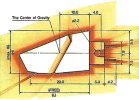
17a.jpg T4P_Specification (large)_01a.jpg
 
Last edited:
Thanks for that image; I don't think I'd seen it before. From what I know of T4P specs, the measurements are in millimeters, since the mounting face tip distance is 2cm. I'd seen a T4P standard distance from the plug down to the tip (missing from this diagram) but not for the cartridge body itself.

The standard MM Tenhnics body as pictured measures 8mm from hole center to the top, so I'm taking the 8.5mm measurement as a max value. On the low end, a Shure M92E measured 6mm. My Grado Silver measured over 9mm, and the Rivertone Frankenstein-ADC is a touch shorter at 9mm, but I could trim back a little melted plastic to get it to 8.5mm without too much trouble. It isn't even from side to side across the top; a trim would help its lopsided pointy little head.
 
That trim job you mention might just be possible for the more official body, bless its even-pointier little head.

All of which just goes to show what I tell the kids: "Welcome to AnalogLand, where there are no standards [a comic exaggeration] and consistency is unknown, or an obscene joke. Abandon all hope, ye who enter here!"
Or words to that effect.

The PSX-A adapter is one of the lowest, if not the lowest. It's in my opinion a very astute design for something that could be considered, and often is, a necessary evil. Which is why it's worth the effort to see if the manufacturer of one's turntable ever made a p-mount headshell for it. A surprising number did, including Yamaha and Pioneer. Not a huge number, but like I say, it's at least worth a look to see if you can avoid using an adapter. I use a Yamaha shell on my tables that use the ADC-type straight arm, and Pioneer made a shell for the PL-2/4/5/7/8/9 polymer graphite arm.
 
Last edited:
The dedicated Integra XT p-mount adapter finally shows itself in the flesh. Yes, made to fit the XT and nothing else. Mine is almost certainly not complete, since the p-mount terminals simply stick out the back, requiring the owner to crimp his existing headshell wires over the much thinner pins. I'll add photos to this post later tonight.

Not the best photo under the directly-overhead light at the desk, but you get the idea: the forward slant in the side of the adapter matches the forward slant of the front edge or flange of the plastic terminal block on the cartridge. No logos, numbers, color dots or any identifying marks molded into or printed on the adapter. But at least we know ADC made one.

WP_20170121_00_05_51_Pro-a.jpg
 
Last edited:
Here's a slightly better view, showing that the "roof" of the adapter is hollowed out to fit the high "brow ridge" on top of the terminal block. You have to tilt the cartridge to slip it into the adapter. It's a snug fit. Another good reason to avoid adapters!
The stylus is an XT-II, with a round-shank nude (not diasa) 3x7 elliptical.

ADC XT-II with dedicated adapter.jpg
 
Last edited:
14 wXLM-III-a.jpg
Showing that if you have an Integra XT body, you don't need an XT stylus-- the RXM-II and RXM-III (pictured) Integra styli are of course an exact match electrically and will track at 1.25g just fine. Of course, you can also use a stylus meant for a ZLM Improved, if you can find one.
 
Last edited:
View attachment 1081964
Showing that if you have an XT body, you don't need an XT stylus-- the RXM-II and RXM-III (pictured) Integra styli are an exact match electrically and will track at 1.25g just fine. Of course, you can also use a stylus meant for a ZLM Improved, if you can find one.

I had to shave down the top of mine to get it to fit in the adapter. It's a 'dead' cart - the volume is extremely low (not to mention the L/R channel problem), but the sound quality is right up there with the old style line contact and up AT's (mine has an XT-III on it). I'd love to find another one of these carts but the chances are extremely slim :(
 
Here's a slightly better view, showing that the "roof" of the adapter is hollowed out to fit the high "brow ridge" on top of the terminal block. You have to tilt the cartridge to slip it into the adapter. It's a snug fit.
The stylus is an XT-II, with a round-shank nude (not diasa) 3x7 elliptical.

View attachment 855387

Grado's have the same problem - too high.
 
Here's a slightly better view, showing that the "roof" of the adapter is hollowed out to fit the high "brow ridge" on top of the terminal block. You have to tilt the cartridge to slip it into the adapter. It's a snug fit.
The stylus is an XT-II, with a round-shank nude (not diasa) 3x7 elliptical.

View attachment 855387
Here's a slightly better view, showing that the "roof" of the adapter is hollowed out to fit the high "brow ridge" on top of the terminal block. You have to tilt the cartridge to slip it into the adapter. It's a snug fit.
The stylus is an XT-II, with a round-shank nude (not diasa) 3x7 elliptical.

View attachment 855387

I have a couple of p-mount adapters that are bigger than the 'typical' ones given with AT's and Shure's - they'll work wioth this cart and even a Grado with no mod's necessary. I just haven't changed mine over yet (I have someone else do it because my fingers and eye's just ain't what they used to be).
 
Finally found an image from the 1983 issue of Stereo Review's annual directory showing what was undoubtedly an ADC-supplied illustration/rendering announcing the then-new Integra XT p-mount cart, and it looks just like the drawing from the Pfanstiehl catalog I posted earlier:
ADC XT p-mount cartridge- inaccurate sketch from 1980 Pfanstiehl catalog.jpg Integra XT phantom, SR Directory 1983.jpg
I wonder if any of these were actually produced? [Jeez, talk about a bad fit in an adapter..] This is another example of a project that was freighted with a fraughtness. The prototype in the illustration had obviously reached a stage of late development before it was hurriedly (we know this because of the channel swap goof) axed and replaced with something almost-but-not-quite exactly unlike it, namely the PSX/SER models.
 
Last edited:
Back
Top Bottom