• The move to the new server is done. There are some software and database maintenance updates in process. This has us passing the hat around to help out. We appreciate any donations. Seriously, even a dollar helps. The payment page may be found here - https://www.audiokarma.org/support.html

The McIntosh Clinic Story

I missed my one and only chance to meet Dave. Custom Audio in Little Rock knew that I owned an MX110 and MC240 and suggested that I bring them in to have them checked free at the upcoming McIntosh clinic. I don't remember why exactly, but I didn't make it. Afterwards, I learned that the clinics had been forever cancelled.

Looking back on this, it's really quite amazing that it went on for as long as it did. Even though I never did attend a Mc clinic, it's stuff like the clinics that has forever cemented my loyalty to the brand.
 
Acc to the book, the final clinic was held late December 1991 in Oregon.

I think his final years were spent writing manuals as he had done for a time decades before.
 
Acc to the book, the final clinic was held late December 1991 in Oregon.

I think his final years were spent writing manuals as he had done for a time decades before.
It must have been kind of lonely not mingling with all the Mac owners.
 
Last edited:
It must have been depressing for him not mingling with with all the Mac owners.

After 20 continuous years on the go, I'm sure the relative calm came as a welcome relief. Most assistants burned out in 5 years or less, acc to DOB.
 
Last edited:
After attending one as a consumer in 1974, then hosting 7 or 8 of them (after '78) I am curious what you all think you might have missed or do miss when they were stopped?
 
Some years the ratio was 10% or more for non-Mac owners. The best years were when the 250, 2505, 2100 and 2105 had established them selves. Most of the 3500's and 2300's were sold to commercial customers in our case. People who owned Scott, Dynaco, Fisher, Sherwood, etc got real uncomfortable when there amps reached over 7% at half power above 10 KHZ, even with new tubes. I know I did with my Scotts. Citations and Marantz models came very close to to spec, and very few traded up unless they needed more power. Audio research amps had their own problems, like high frequency oscillations that could destroy tweeters. And when an output tube failed there were usually a bunch of components to go with the tube. Mac amps you usually just plugged in a new tube and you were back in operation. I went to 3 or 4 Mac clinics as a customer, and maybe 6 as a participant. Drawing curves, setting and taking down test benches, and hefting larger amps. I really hated 2300's at the time. It rarely happened, but once in a while we would get an amp where the owner didn't know the ratings so I would have to research the unit, and that was before the internet. Davie knew 99% + of them, as he had seen most of them before. We used to get some rare Japanese and European models, because of the large military base in town. It was at my second Clinic, when I bought my MA230 and MR-67.
 
Very good idea Ryan !

I did it in France during years and met a lot of MC INTOSH owner's ! I keep a very good "souvenir" of these times ......Never had a chance to met David during all my trip in USA ....

I wish to AC to see some unknow MC INTOSH customers if still possible in USA !
 
Some years the ratio was 10% or more for non-Mac owners. The best years were when the 250, 2505, 2100 and 2105 had established them selves.

People who owned Scott, Dynaco, Fisher, Sherwood, etc got real uncomfortable when there amps reached over 7% at half power above 10 kHz..

We used to get some rare Japanese and European models, because of the large military base in town. It was at my second Clinic, when I bought my MA230 and MR-67.

I took a Japanese made Concord receiver to a McIntosh Clinic at Soundco (42.138389°, -72.546956°) in 1973 at the age of 15, unaware of chuckles and smirks from other customers.

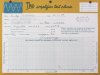
Still have the STA-35 McIntosh Clinic data sheet from 1973.
Clinic_Concord_73.jpg
The distortion at both LOW and HIGH end of audio band ramped-up significantly!


Was able to find the Amplifier Clinic data sheets for the system in the late 70's.

Here's the C-26 preamp - 1978
C26_Clinic_data_sheet.jpg
Not bad at all: 0.03 - 0.04% THD

That means these units were bought I'd say, between summer 1977 and summer 1978.

It's difficult to remember a date like that if no sales docs are available


Here's the DA-A10 poweramp
- 1978
Clinic_Mitsubishi_78.jpg
Soundco had closed by then. :(

The components are seen in the 1980 college dorm (40.796286°, -77.867209°) photo in the recent `Really nice C26´ thread. Notice general clinic data sheet with no Mc labeling. Tests were done at Del Padre in Springfield (42.113118°, -72.577364°).

Yep.. that was my college gear. :beerchug:

-Gregory
 
Last edited:
Does anyone remember Dave's associate, Oscar? (I can't remember his last name). He seemed to be on hand for a while.
 
Do today's local Mac service centers offer a for pay clinic? Just a bench test to see if its in spec..(at a set rate) Even if you have to drop it off.
 
Oscar was very cool. I met Dave and him at a clinic. They replaced the volume control on my c28 for free.
That newly installed volume control still works perfectly 25 years later.

Yeap, I saw (or watched) Dave smoke an Mc amp at a clinic on Roosevelt Ave once. That unit was sent to Binghamton for free service.

Dave replaced a part in another Mc amp on-site. It made spec and passed the test soon after. I was hanging out that day, my dad worked in the Purchasing Department back down the hall to the right. One summer I was hired to do some wall and display painting in the store. It was more than 40 years ago.

Another date marker: Tim the `hippy´ sales guy (long hair, shirt and tie) used to play ELP, "From the Beginning" cut on the Trilogy LP as a demo for the MC 2105.
http://www.roger-russell.com/amplif1.htm#mc2105

https://en.wikipedia.org/wiki/From_the_Beginning_(song)


Sorry for being repetitive, but we NEED reference dates. :thumbsup:
 
Last edited:
Oscar was our factory rep (MI. OH. and western PA I believe). He did a couple of clinics with us when DOB was not available.

I believe most old school Mac dealers would arrange a complimentary test for their local client. Often, if the dealer decided not to send their kid to Harvard but invest in the correct test gear, that was done right there on the sales floor.

You have to remember that back in the day, the test equipment cost the same as a year at Harvard, and if you did turntables the correct way, the Wild microscope would cover the second year. This often caused much dealer discomfort.
 
Thinking of it for the past couple weeks, can't say for sure if I ever saw Dave O'Brien at a Clinic.

There's no DO'B initials on the test sheet, and cannot recall any `photographic memory´ of it. We're talkin' 43 years ago. Can remember the test bench was set-up in front windows of the store, which you can see from the Street View in Google Earth today.

2095-Soundco.jpg
Soundco has been gone for 40 years.

The Sound Room was to the LEFT of the entrance. There were several Big reel-to-reel tape decks in the display area to the RIGHT which was well lit, with other products like KLH and cheapy Concord stuff, extending to the RED arrow, behind which were the offices. Stockrooms took up most of the square footage for sure.

The far left window was blocked and the room dark except for accent lights.

All the better to view Mc front panels and MPI's! :thumbsup:
 
Last edited:
Thanks for posting this gem.

Hope you don't mind my taking the liberty of pasting the actual report for posterity should one day the link go dead.


"If you are like most audiophiles you have probably wondered about the cumulative results of the Marantz and McIntosh Amplifier Test Clinics which are often hosted by local hi-fi retail dealers. And if you are like myself you have probably wondered what the clinics really tell us.

The Marantz and McIntosh amplifier clinics are free to the consumer, and everyone is invited to bring in their unit to be tested. Both amplifier test-clinics are geared primarily to give you the harmonic distortion produced by your unit from 20-20,000 Hz. at the manufacturer's rated full RMS power. Usually there is a long line of units to be tested, and most clinics have at least two technicians, one to plot the graph while the other performs the tests. Receivers, integrated amplifiers, and preamplifiers are tested at the clinics but generally only the amplifier section of a unit is measured. High quality test equipment is used by both clinics to insure accurate results.

I decided to collect the results of the test-clinics from some of the dealers in the Boston area that had hosted a clinic. The test results I collected cover four separate clinics of which three were sponsored by McIntosh. The results include the years from 1969-72, and include over 237 amplifiers and receivers representing a total of thirty-four manufacturers. (I did not include preamplifiers in the results because all the units tested performed excellently in the categories I established.)

To organize the data I arbitrarily had to limit myself to ranking only those manufacturers that had at least four or more units tested. I divided the results of the HD into three categories: Category I - included units tested with less than one percent HD from 20-20,000 Hz. at the manufacturer’s rated full RMS power. Category II - included those units with less than two percent, and Category III - included those units with greater than two percent HD.

Numbers were assigned to the categories in order to establish a ranking of the units. Six points, the highest possible, was given to the units that fell in Category I, four points to Category II and two points for Category III, the lowest possible score.

What do the results tell us? The results are a good indication of how a manufacturer will rate his amplifier's power output. As can be seen from the list, it is easy to identify those manufacturers that tend to rate their units conservatively, like McIntosh, or which manufacturers tend to overstate their units. The results indicate that there is a drastic need to adopt a uniform standard of rating amplifiers at least in their power handling ability. The results may be some indication of reliability but to a smaller degree. Most of the units brought to the clinics by their owners were at least two years old. The results do tell us that the top five manufacturers were still holding their original specifications after several years. For example, one of the McIntosh units tested was fifteen-years old!

The results tell us also that an AR amplifier rated at fifty watt RMS/channel by its manufacturer is not the same as a Fisher rated by its manufacturer at the same RMS power. An AR fifty watt RMS/channel amplifier could conceivably turn into a Fisher seventy watt RMS/channel model by merely swapping advertising departments. It is interesting to note that Fisher which is among the lowest in rank is also the world's largest manufacturer of high quality stereo equipment according to Avery Fisher, founder of Fisher Radio.

The top five manufacturers, or those manufacturers which tend to rate their product most conservatively in order are: McIntosh, Marantz, Heath, AR, and Sony. The lowest seven or those manufacturers which tend to 'stretch' their power output in order are: Scott, Dynaco, Lafayette, Eico, Realistic, Fisher, and Bogen.

If you buy a McIntosh amplifier your chances are probably one hundred percent that it will meet its manufacturer's specifications. And if your unit falls among the top five your chances are at least seventy-five percent that it will test in Category I. If you are the owner of a Bogen the chances of it meeting its manufacturer's stated full RMS power output from 20-20,000 Hz at less than one percent HD are probably nil. And if your unit falls in Category III, or the lowest seven ranked, the chances of it falling in the under one percent HD department are about 1.3 percent. Of course these figures are only applicable to the 237 units tested covering only thirty-four manufacturers. Generalizations to other units not included in these four specific clinics may not be applicable."

By Alvin M. Foster
Founder of the Boston Audio Society

amplifier_ratings.gif
 
wineries 1.jpeg wineries.jpeg Mac charts.jpeg Mac charts 3.jpeg Mac charts 2.jpeg Here are some charts you can study. The 240 chart was sent to Marantz by a former employee who started his own business and couldn't believe a 240 was that much better than an a 8B. Marantz wrote back and said the chart reflected the normal performance of a MC 240. You'll see a chart of my 2505. There a chart for my one of my Scott integrated amps. before and after new tubes. That's the day I bought a MA 230. Included are two of the charts on my matched pair of 275's. There is the sheet Audio Classics supplied after repairing the C-34.
 
Last edited:
Back
Top Bottom