• The move to the new server is done. There are some software and database maintenance updates in process. This has us passing the hat around to help out. We appreciate any donations. Seriously, even a dollar helps. The payment page may be found here - https://www.audiokarma.org/support.html

The Official SOTA Turntable Thread

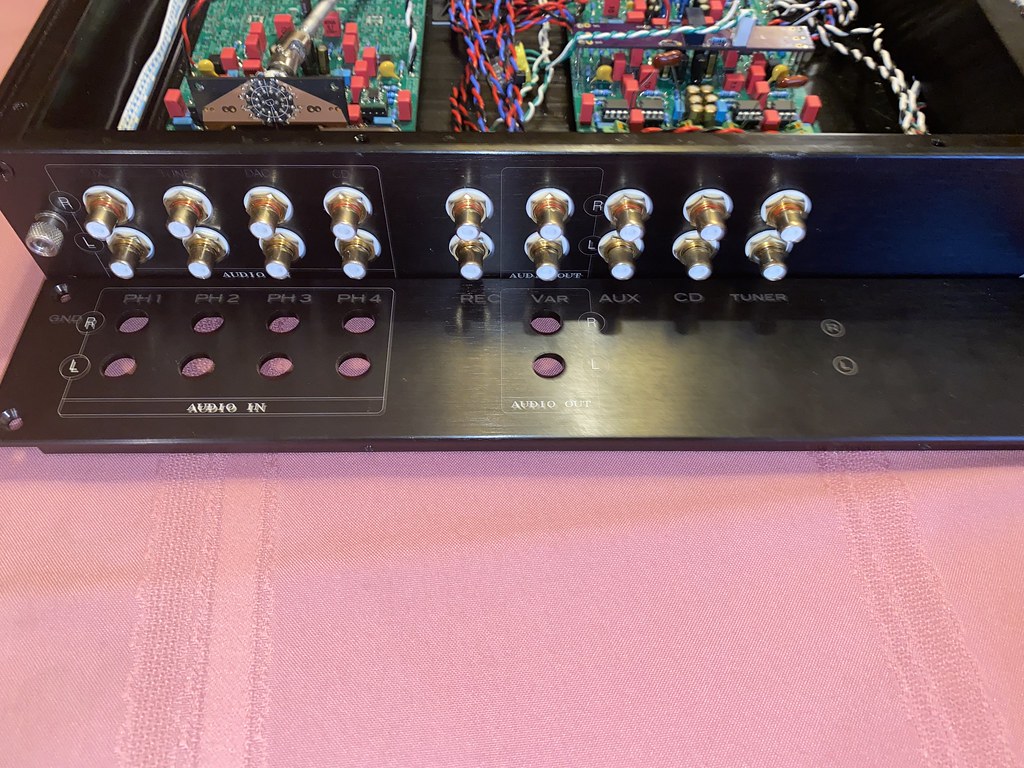
SOTA will have pre-production samples of the Pyx phono stage at CAF. I just received 10 pcs first article of the production PCBs for QC testing this week, but I don't have access to the production metal work. I have a picture of the early prototype from June of this year; the metal work is a bit rough as it was machined by hand but should give you an idea of the final version.

FYI, it sounds amazing; it is one of the quietest and most detailed phono-preamps I've heard. Unlike the Schiit Mani-2, the Pyx has a power switch with 4 second delay relays so there is no speaker thump at power up. Wyn is responsible for the circuit design and I did the PCB CAD work. The Pyx uses a hybrid active-passive RIAA network that has some distinct advantages over passive only or active only RIAA. The RIAA section uses 1% caps and 0.1% resistors that provide exceptional flatness of the RIAA response (±0.05dB) with excellent matching between R & L. The rest of the circuit uses 1% resistors throughout.

View attachment 2711240

View attachment 2711241


Yep, us DIYrs know all about the sound of Wyn's design!!

here are a couple of my full pre amp builds, the DIY version has a line stage built onto the board as well. So for all intensive purposes these could be SOTA prototypes ;) lol

51740096191_247c52e241_b.jpg


Athanasios
 
Ours have box joints. We worked our way right up the ladder from V1 to v3.2. It's a very, very nice piece and were indebted to Wyn for his patience and persistence. I may have been Wyn's first headache.
DSC_0001 (17).JPG
 
Last edited:
Only Wyns? ;) lol

Athanasios
More of a challenge than a headache. I was happy to help.
It's all part of life's rich pageant.

I'll let you know what the final list prices of the Pyxi and Acrux are when they're finalized, and the dealers that are handling the units if and when I find out.
 
I read just one show report on the Steve Hoffman forum that referenced the new Palmer/SOTA phono preamps but it was glowing for the Pyxi. I don't recall seeing in earlier posts that the Acrux was there too.

"Also, SOTA had a new phono preamp for $300 that was amazing. They switched it out with their $2,500 preamp and I couldn't detect much, if any difference. This low-cost preamp could be a game changer for a lot of people."​
Thanks for the heads up. I noted that it was indeed said that there wasn't much audible difference between the "$300 and the $2500 units".
I've tried commenting but the comments are in moderation.
 
Last edited:
I read just one show report on the Steve Hoffman forum that referenced the new Palmer/SOTA phono preamps but it was glowing for the Pyxi. I don't recall seeing in earlier posts that the Acrux was there too.

"Also, SOTA had a new phono preamp for $300 that was amazing. They switched it out with their $2,500 preamp and I couldn't detect much, if any difference. This low-cost preamp could be a game changer for a lot of people."​
The Acrux was clearly visible in the video from CAF that they posted on their Facebook page.
 
I am helping a friend refurbish a SOTA Sapphire Series V table. It has the Jelco/Sumiko SA-250ST tonearm. The table uses one of those Premier PIB-1 external terminals for the phono interconnects.

We’re getting noise out of the left channel and have determined it’s coming from the tonearm. The tonearm leads are pretty worn out, and I think it’s time for the tonearm to be rewired.

So, here are my questions:

ONE: Do I really need that Premier PIB-1 external terminal? I’m tempted to stop using it and just run the phono interconnects from the tonearm to the phono preamp.

TWO: how hard is it to remove this tonearm? I’m guessing that removing the three screws at the base of the tonearm on the armboard should do it. But I’ve never worked on a SOTA so I thought I’d ask before I take apart something I can’t put back together.

THREE: anybody ever rewire one of these arms? Is there anything in particular I should be concerned about?

Thanks in advance for any info. I’m including some pictures for reference, but they aren’t mine; I found them earlier in the thread.

tonearm.jpeg DIN port.jpeg External connector.jpg
 
I am helping a friend refurbish a SOTA Sapphire Series V table. It has the Jelco/Sumiko SA-250ST tonearm. The table uses one of those Premier PIB-1 external terminals for the phono interconnects.

We’re getting noise out of the left channel and have determined it’s coming from the tonearm. The tonearm leads are pretty worn out, and I think it’s time for the tonearm to be rewired.

So, here are my questions:

ONE: Do I really need that Premier PIB-1 external terminal? I’m tempted to stop using it and just run the phono interconnects from the tonearm to the phono preamp.

TWO: how hard is it to remove this tonearm? I’m guessing that removing the three screws at the base of the tonearm on the armboard should do it. But I’ve never worked on a SOTA so I thought I’d ask before I take apart something I can’t put back together.

THREE: anybody ever rewire one of these arms? Is there anything in particular I should be concerned about?

Thanks in advance for any info. I’m including some pictures for reference, but they aren’t mine; I found them earlier in the thread.

View attachment 2720009 View attachment 2720010 View attachment 2720012
Just saw this.
Agree with one and two and can't help you with three. Seeing how long ago this was posted, I expect you have done it all anyway.
 
I am helping a friend refurbish a SOTA Sapphire Series V table. It has the Jelco/Sumiko SA-250ST tonearm. The table uses one of those Premier PIB-1 external terminals for the phono interconnects.

We’re getting noise out of the left channel and have determined it’s coming from the tonearm. The tonearm leads are pretty worn out, and I think it’s time for the tonearm to be rewired.

So, here are my questions:

ONE: Do I really need that Premier PIB-1 external terminal? I’m tempted to stop using it and just run the phono interconnects from the tonearm to the phono preamp.

TWO: how hard is it to remove this tonearm? I’m guessing that removing the three screws at the base of the tonearm on the armboard should do it. But I’ve never worked on a SOTA so I thought I’d ask before I take apart something I can’t put back together.

THREE: anybody ever rewire one of these arms? Is there anything in particular I should be concerned about?

Thanks in advance for any info. I’m including some pictures for reference, but they aren’t mine; I found them earlier in the thread.

View attachment 2720009 View attachment 2720010 View attachment 2720012
Hi
1. You don’t need the PIB box. Many people want them, so your won’t have any problem selling it;
2. Yes, 3 screws. If it doesn’t come out easy, remove the whole armboard, you’ll see it’s bolts, also three;
3. Don’t know anything about the re-wiring of that arm.
 
Unless I am seeing it wrong - it looks like the PID female connector is the opposite side from the tonearm. If it is- I would move it closer to the tonearm.
 
Unless I am seeing it wrong - it looks like the PID female connector is the opposite side from the tonearm. If it is- I would move it closer to the tonearm.


No, I think thats the power input socket on the TT .

Athanasios
 
I am helping a friend refurbish a SOTA Sapphire Series V table. It has the Jelco/Sumiko SA-250ST tonearm. The table uses one of those Premier PIB-1 external terminals for the phono interconnects.

We’re getting noise out of the left channel and have determined it’s coming from the tonearm. The tonearm leads are pretty worn out, and I think it’s time for the tonearm to be rewired.

So, here are my questions:

ONE: Do I really need that Premier PIB-1 external terminal? I’m tempted to stop using it and just run the phono interconnects from the tonearm to the phono preamp.

TWO: how hard is it to remove this tonearm? I’m guessing that removing the three screws at the base of the tonearm on the armboard should do it. But I’ve never worked on a SOTA so I thought I’d ask before I take apart something I can’t put back together.

THREE: anybody ever rewire one of these arms? Is there anything in particular I should be concerned about?

Thanks in advance for any info. I’m including some pictures for reference, but they aren’t mine; I found them earlier in the thread.

View attachment 2720009 View attachment 2720010 View attachment 2720012
The arm is a Sumiko FT-3 arm. Same as mine. Get rid of the Pib box and use a tonearm cable that plugs directly into the bottom of the tonearm.
 
Last edited:
People who play records always talk about the tactile ritual of the experience. I think my favorite part of that ritual is actually pulling the record off of my Sota Star Sapphire platter after the record side ends. With the vacuum hold down is turned off, there's still that residual suction holding the record to the platter and its a similar sensation to when you pull a plunger up from a sink drain. There's a slight thwack sound/feel that let's you know that the record was one with the platter.
 
The SOTA Pyxi $300 MC/MM phono stage has been released and should be available for sale on their web site.

No sales link yet but I bet an email will got you one.

here is the blog link
https://sotaturntables.com/company-news/sota-pyxi-phonostage/

Sota Turntables has always been known for suspension turntables that are capable of performing in environments that are not friendly to most turntables. In the past Sota did make speakers for a short stint as well as a phonostage. We get a lot of first time turntable people that need phonostages and we have always made suggestions that are decent for the entry level price. These options were always units that would be ok for a while at entry level but would require upgrading later if a low output cartridge was chosen, or if more detail extraction was the goal.


In 2018 we made a first phono stage with Bill Carlin of Phoenix Engineering that was fantastic, but was not ready for production. Bill suggested we work with Wyn Palmer if we could convince him to work on a design because he is the guru of high feedback phonostages and has proven designs. Bill made the introduction in 2020 to Sota and after some discussion/coercion Wyn agreed that he would indeed help us with a Wyn Palmer designed phonostage.


The design intent was set as a sub $500.00 unit that would compete with phonostages up to $1500.00. The Sota unit that Wyn agreed to design was intended to be ultra low distortion, very low noise, and with a very flat RIAA curve response. It would also be easy to manufacture and produce, and would be suitable for both MC and MM cartridges. Now this sounds simple in theory and everyone states their opinion is that their phonostage is better because of this or that. However, designers have a different view from marketing and I love to get design projects working with people that view the obvious from a different perspective.


Wyn brought a lifetime of design concept not only from theory, but from listening as an avid audiophile himself. Bill listens to vinyl only and loves the world of audio from a very personal perspective as he builds every device in his system. To bring these two minds together and let me view Wyn and Bill’s design work from start to finish was an incredible experience for me. Viewing the ongoing design discussions helped me to understand one key thing that has been my greatest learning from this project.


Having a flat RIAA curve and ultra low distortion phonostage in actual production (that is qualified at the end of the design) allows me to understand what other components are doing rather than having to change out cartridges to try and get rid of a bloat or glare that is occurring in the sonics. To know that the phonostage is doing what it is supposed to do without adding a smear in some sonic register lets me relax to another level and enjoy what is on the album. I can’t tell you how many mistakes I’ve made over the course of 20-30 years thinking that whatever was bothering me was my speakers, preamplifier, amplifier, cables, or cartridge when now I can easily hear that it was my phonostage adding, taking away, or adding smear to the soundstage.


We tested this against many phonostages that cost $150.00-$24,000.00 within a variety of environments with as many types of equipment as possible. The Pyxi phonostage (named for its size), rose through the ranks and the amount of clarity that was brought to every test was apparent. This is due to the fact that Wyn is a stickler for what he coins “total neutrality”.

We all hear the term “it’s so quiet”, but when you experience what Wyn designed as “total neutrality” it’s amazing to experience.


When we tested in public at some events we would lie and say it was a 2-3 thousand dollar phonostage so people would not judge the Pyxi as a “cheap” device and then couldn’t possibly compete with the phonostage they were comparing against. At Capital Audio Fest many people sat down in our room and listened to entire sides of albums and would come back to just listen. Ultra low distortion/total neutrality does not mean difficult to listen to, or harsh in any way. It means the signal is not being added to with any distortion that then comes through the sound chain after the phonostage.


I now hear what many phonostages “add” to the sonics after experiencing the Pyxi as far as distortion and coloration are concerned and I am no longer going to participate in this approach, and the main reason is my pocketbook. I believe I’ve spent money chasing what was clearly my phonostage coloration and smearing of my sound system. The Pyxi can bring you the detail without coloration, or smearing of the soundstage and for an incredible price point that just can not be beat.


We use US based manufacturing for everything board related on the Pyxi. The extrusion is the only thing that is not made in the United States. This is Sota’s first foray back into the phonostage market and we are happy with the end results.


We will be shipping shortly as we are doing final QC procedures and assembly now. More technical information will be on our web page shortly, with owners manuals and setting information. For those interested, we were running at 47k at the Capital Audio Fest with the Grado cartridge on the Sota Quasar turntable.


I would like to say thank you to everyone that helped in the listening tests. These listening sessions were a labor of love for many, but do take time.


Your feedback was invaluable and we appreciate the support.


Keep on Spinning,


Christan

PS: Here’s some of the final Prototype pictures.

DSC00060-300x113.jpg


DSC00064-300x144.jpg


DSC00065-300x170.jpg
 
Thanks!
I'm not much into the subjective stuff as you know, and some of the rhetoric is blushingly over the top, but that's how Christan feels about it, and he is a notable part of the Audiophile community where such things are par for the course.
We'll see what happens going forward.
Interesting times, to be sure...
 
Back
Top Bottom