• The move to the new server is done. There are some software and database maintenance updates in process. This has us passing the hat around to help out. We appreciate any donations. Seriously, even a dollar helps. The payment page may be found here - https://www.audiokarma.org/support.html

The Official Well Tempered Audio Thread

Mister Pig

Pigamus Maximus
So on AK we have threads for SOTA, VPI, and Technics. Figured we could use one about the innovative and unusual Well Tempered Audio.

So whether your WT is from the original company, or the Transparent Audio era, or the latest generation with the golf ball....well share your table here.

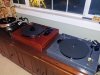
I have a Well Tempered Reference with an Ikeda 9 Rex Kiwami cartridge. Its a pretty nice table.

20191226_204325.jpg 20200105_192827.jpg 20191226_204403.jpg
 
Register to hide this ad
Something that might interest you about the origins of firebaugh's table

from stereophile

Firebaugh: I didn't plan to sell it. Originally, I just thought I'd try making an arm for myself. Sort of as an intellectual exercise. At the time, I had not the slightest idea of what was going on in a tonearm. But in 1977 a guy named Poul Ladegaard from the Brüel & Kjaer Company in Denmark wrote what I think is a landmark article entitled "The Audible Effects of Mechanical Resonances in Turntables." B&K had this fabulous instrumentation system using Fast Fourier Transform analysis and parallel processing and all that kind of stuff. Actually, I think the main reason they published the paper was to show off the capability of their test instruments, but they were obviously also interested in doing basic research about audio.

I read that paper, and I had the feeling I thoroughly understood what the fundamental issue in a tonearm and a turntable is—stability. It started me wondering about the stability of the arm I was using then.

Holt: Which was?

Firebaugh: I had one of the original AR 'tables, which I had bought back in the dark ages. So I hooked up a high-gain wideband amplifier to my 'scope, and tried to figure out a way of measuring how stable the arm was.

B&K had used impulse testing, but I had to figure out what to use to induce impulses to the arm. The technique I eventually came up with is to straighten out a paper clip and use it to tap on the arm at various places.

Holt: That's a technique I've been using for years, except that I listen to what happens instead of watching it on a 'scope! Put the stylus in a stationary groove and tap on the arm. A poor one will go CLICK; a good one will go CLUNK.
 
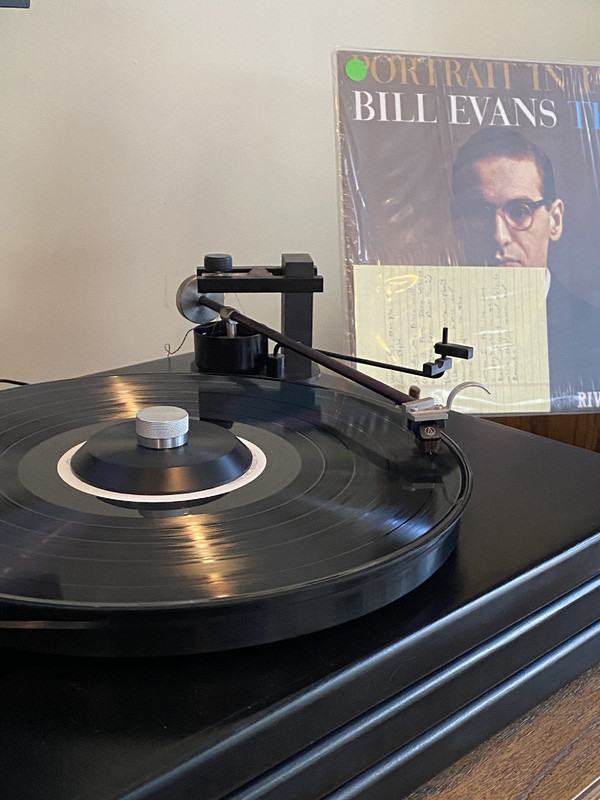
Mine is new to me and actually was inspired by Mr. Pigs glowing review of his Reference. I have been working my way up through the tt world taking apart and reconstructing tables and learning. I was reading Mr. Pigs posts and scanning Craigslist (I do every day) where all of the sudden, there was a Classic in great shape for sale and very close to me, by a seller I had bought from before, for a price that was as low as I had seen. I took that as a sign from the audio gods.
This is my first serious table and I can tell you this. The little AT VM95SH cart I installed has never sounded better. This has me wondering about better carts and different sound. My wallet is in trouble.
The arm is very simple but requires patience to set up. I started my set up with a little healthy fear but am finding that well thought out adjustments yield the intended result. That may sound like an odd statement for those used to mechanical adjustments (like me). The monofilament and silicon suspension however make it a bit different. Once you understand the design philosophy it’s a piece of cake.
Here’s a pic I took during set up.
That clamp doesn’t work well. Looking for a good one.

A55686-A9-6-FBF-4019-8081-5-B7-B567-F50-E0.jpg
 
Last edited:
Ok, there's one thing I need to know. WTF is the use of the golf ball, what is it for and what does it do? I apologize for my ignorance but, I have been wondering this for years, and I hope someone could explain it to me... in layman's terms.
 
LOL
I’m definitely a layman.
All it is, is a device that is part of and hanging down from the tone arm and suspended in a really viscous silicon fluid. It kind of acts as a keel does for a sailboat, it stabilizes the boat. Any vibration is damped by and I guess dispersed into the fluid. The new arms dampers are formed like a golf ball I assume because as the dimples in a golf ball have an effect on its flight, so there is an effect from the fluid.
In our older versions the golf ball is a puck with two larger holes.
Mr. Pig prolly could give you a heck of a lot more precise info if you get interested.
Hope that does it for you.
 
Last edited:
I have an original Well Tempered Turntable and Well Tempered Arm, with the upgraded black damped platter. Love love love it. Have used it steadily since 1990s. Began with a vdH MM-1 cartridge, then AT150, Grado woody Platinum, then once I discovered Dynavector in 1999 or 2000, went fairly quickly up the chain from 10x4 > 20X > XX-1 > Te Kaitora Rua. No desire to change anything now. The arm is fussy to set up but once it is there, everything stays put. Sounds wonderful and has good timing. (Rest of system: Sugden CDMaster integrated CD player, Pioneer RT-707, Audiomat Phono 1 phono stage, Audiomat Opéra Référence integrated amp (EL-34s, push-pull), J. M. Reynaud Cantabile speakers, Transparent Reference cabling throughout. Listen mostly to acoustic small-combo jazz, chamber music, Brasilian bossa nova, folk, some orchestral, almost no rock. Room 15 x 24 feet.)
 
Thanks for all the damping info Barncats. That’s fun.
I’m aware of the hockey puck shaped clamp. Also emailed Mr. Denson at the company. He is not aware of any nos parts around for the older tables. So radar is out.
 
Thank you @Masonavenut, I appreciate you taking the time. It's apparent to me that whoever invented this turntable must have been a golf nut.

I can't say if Firebaugh is a golfer or not, but its an elegant solution to his design. Think about it, with the golf ball immersed part way there is a small area for interface between the fluid and the bottom of the pivot assembly, the golf ball. But the closer you get to the center of the ball, the surface area and dampening factor expands dramatically. Couple with it that you can buy a golf ball, that is very inert, for a dollar or two...well its the perfect part for the job.

The earlier tables have a paddle assembly, which is what mine does, and it does the job of anchoring the pivot point in the silicone and transferring vibration to the silicone bath. A very nifty design that has inspired other hanging thread unipivot arms.

The WT is a fine arm in terms of performance. A bit challenging to set up, but worth the effort once you get the hang of it. Not for the novice I would say, but not an insurmountable challenge to a person with good set up skills and a bit of patience.

Cheers
Mister Pig
 
Thank you @Mister Pig, you have always come at the right time to give us your wisdom. I have always enjoyed your contribution to AK. On a side note, many moons ago I recall you having an AR XA IIRC. How long did you have the table and why you decided to part with it. You had a gorgeous AR.
 
One thing I especially respect about the WTT is the design of the platter bearing. As he did with so many other aspects of the design of this turntable and arm, Firebaugh stepped back and approached the bearing problem with a fresh and unconventional eye. He looked at the traditional bearing scheme and saw that if you allow enough tolerance for the shaft to rotate freely inside the sleeve of the bearing, then that very freedom of play allows for the shaft to be unstable on a microscopic level. He once described it as being akin to a drunk in a phone booth! :-)

The bearing of the WTT depends on the belt to make it all work. Indeed, if you remove the belt, the whole platter tilts to the right, toward the tonearm! Seems utterly unstable. Yet, with the belt fitted, it is perfectly stable. The shaft goes into a substantially larger cylindrical hole. Inside this bearing well are pairs of Delrin-covered nubbins. (Delrin is an inherently slippery engineering plastic.) The nubbins are on the side of the well closer to the motor and away from the tonearm. The well is filled with silicone lubricant. As the platter shaft rotates, it is held against the nubbins by simple belt pressure. Also the bottom of the shaft is supported by another Delrin nubbin — upward-facing, and set off-center, so that as the shaft rotates the bottom of it is constantly refreshed with new fluid. (If the nubbin were centered below the shaft, the centermost point would have less or no lubricant present.) As a result, all of the energy is transferred to rotation and none is lost in the microscopic movements made by traditional bearings.

When Firebaugh was making the first group of turntables, he kept measuring them for speed stability, and found that one turntable was consistently better than the rest. How could that be? he then noticed that on this particular turntable, he had put a twist (inadvertently!) into the belt as he ran it from platter circumference over to motor pulley. Something about this twist meant that as the belt left the small diameter of the pulley and moved toward the large diameter of the platter, it kept the speed steadier. Although this was a complete accident (a bit like Charles Goodyear dropping rubber onto the woodstove), from the moment on, WT Labs recommended that owners put a single twist into the belt.

I hope my verbal description makes sense. I have the owner's manual with the drawings buried away somewhere and can try to find it. But cannot do it right now.
 
Thank you @Mister Pig, you have always come at the right time to give us your wisdom. I have always enjoyed your contribution to AK. On a side note, many moons ago I recall you having an AR XA IIRC. How long did you have the table and why you decided to part with it. You had a gorgeous AR.

I get to see and listen to my AR whenever I want, as its at a friends house about 10 miles away. It is a beautiful table, and I loved its looks. The thing is I need VTA adjustment to run the cartridges I have, and the AR XA does not have that. I got tired of using shims, and decided to use arms that met my needs. My friend needed a good table, so I helped him out.

I really do wish I had another that looked like that and had VTA adjustment on the arm. Just not possible with that AR XA configuration. But it is an excellent table in its own right.

Cheers
Mister Pig
 
I've been an admirer from afar of WTT's. One time one showed up locally on CL at a good price, but alas, I was a poor student (again). I still have them on my radar and would really like to pick one up one of these days.

One thing I'd like to see in this thread is a brief history with relevant models. Pros and cons of each model? Things to watch for? Anyone here considers themselves and aficionado?
 
I was doing the photography and graphic design for Transparent Audio all through the 1980s and 1990s, so saw a lot of the Well Tempered stuff. It was designed by Bill Firebaugh, but manufactured and distributed by Transparent.

The original WTT/WTA had a square motor, a white acrylic platter with a small (maybe 1 inch diameter) screw-down record clamp, a stainless steel arm with a single mounting point for the cartridge, and a cantilevered black rig for holding up the arm when it was at rest. The plinth was made from three slabs of MDF, with sheets of foam sandwiched in between, satin black finish. This original model eventually became the "Classic" (although with round motor).

When I say square motor, I mean that there was a square cutout in the plinth, and into that you tucked the motor, which is free-standing on its own set of feet, and is mounted to a slab of lead (12 lbs as I recall) to help drink up vibrations. This is the turntable that I have and use daily. Somewhere around 1990, they changed over to boring a large hole inside the plinth and dropping a motor into that, mounted on a circular hunk of lead.

Around that time, the line expanded to include three models: the WTRP (Well Tempered Record Player) was aimed at a budget-conscious user, with smaller and less massy plinth, simplified arm, but same principles. The Reference had a plinth made from Corian countertop material, and a more sophisticated system for adjusting damping in the arm "bearing" trough. The original continued on in the middle, and as I said, eventually became the Classic.

Along the way, the platter went from white acrylic to the black damped platter, which had a clamp similar in a appearance to a hockey puck (although smaller than a real puck).

Another improvement was the arm. This went from a stainless-steel tube to carbon fiber, and the headshell had an angled profile with two mounting holes. The original arm had only a single mounting point — a longish slot through which a single screw could be run down into the cartridge. With the carbon fiber arm came a new armrest that is a black pillar with a U-shaped holder at the top.

Through the 90s the Well Tempered line had these three models, then sometime in late 1990s the whole setup was sold to George Stanwick of Stanalog, who was also importer of van den Hul. At that point I lost contact with WT.

But meanwhile Bill Firebaugh got actively involved in designing some new decks (with the clever golf ball bearing and such) and ever since then, these have been distributed by Mike Pranka in St. Louis, who is also the importer of Dynavector. A fine person and really solid distributor.

That's a brief and sorta accurate (no footnotes! could be errors in here!) overview of Well Tempered from 1980s to end of 90s. I had no contact with the new WT Lab, just have admired it from seeing Mike Pranka's website. (Mike also races a vintage Alfa GTV by the way.)

 
Back
Top Bottom