

You are using an out of date browser. It may not display this or other websites correctly.
You should upgrade or use an alternative browser.
You should upgrade or use an alternative browser.
The resurrection of Fisher 400 SN27949P
- Thread starter audiodon
- Start date

audiodon
Addicted Member
Chapter 8: final steps and impressions
In the estimation of this author, a few things were missing from this Fisher 400 and had to be done before a thorough evaluation could be performed or before putting it into daily service.
1. A thermistor was placed between the fuse (pick either lead) and one (pick either) of the primary windings into the power transformer. Thermisters keep a spark from arcing in the switch at turn-on, extending the life of the on/off switch integrated into the volume control. The Thermister part is an STM-CL70, though metalbone ships a CL60 with his Fisher on/off switch. The author has heard lots of arguments about sizing the thermister to current draw and how thermisters rob current from the unit and on and on, and realistically, for the author, not having to replace the on/off switch is important so a thermister will be used.
2. Since EH 7868s are used as outputs, and the grid resistors were still at 330k, the author found the output tubes to be drawing from 60ma to 110ma across the 10 ohm resistors between cathode and ground. The author believes that a 10 ohm resistor is placed between pin 3 on the output tubes and ground. After changing the four grid resistors to 200k from a stash of resistors supplied by a Mr. McShane, the author did find that the bias was cooled, but not cooled enough to drop into the author's comfort zone of between 16 and 45 ma. Tubes were matched most closely by pairs, and then the author changed the 15 ohm bar resistor R138 to 27 ohms. That increased the bias. Dropping that resistor to 10 ohms cooled everything right down and that 7868 that had been drawing over 100ma dropped down to below 45ma. The range was 28ma to 43ma between all four tubes, with each pair closely matched. Acceptable.
3. The tube complement is as follows:
Before:
V7 and V8 United Electronics 12AX7A (Japan - look like later Mullard box plate and very possibly early Matsushitas)
V9 Sylvania JAN green letter 12AX7A
V10 Sylvania JAN 5751
V9 and V10 make up the two tube line stage and are most critical for the aux and tape mon inputs.
V11 Syl JAN 12AX7A
V12 Syl JAN 5751
V11 and V12 are the phase inverters. The author recommends two strong evenly matched strong tubes in these positions.
After:
V7 and V8 Sylvania green lettering long box plate 12AX7s.
V9 and V10 Sylvania green lettering long box plate 5751s.
V11 and V12 United Electronics 12AX7A (Japan - look like later Mullard box plate and very possibly early Matsushitas) They even flash like Mullards on startup.
V100 and V102 in the MPX unit: GE 12AT7. Great for keeping the tuner tight on a station and keep it from drifting.
V101 Tele/Fisher long smooth plate 12AX7 (for that tele tone for FM).
The unit was then turned up to full line voltage and left to run overnight.
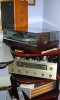
The next day dear reader, the newly resuscitated Fisher 400 #27949P was put into the author's office system as pictured in the thumbnails.
The listening test is after approximately 80 hours of use; plenty of time for the mystery capacitors to ripen and the system's sound to firm up.
The overall tone is good, dear reader, with a slight thinness in the lower bass and a kind of soft, unextended treble. The author has decided that the output coupling caps will be changed to .1uf 600V or .1uf 450V 716P Sprage orange drop caps, which provide a more voluptuous bass and more extended treble. The treble is there, but seems a bit soft. Not attenuated exactly, but smeared. Fisher 400 SN27949P is otherwise determined to be resurrected and a presentable unit.
Admittedly, yours truly knows this unit is going into a kid's system, and will not be critically listened to, but kids love bass. So putting coupling caps in the outputs that will smooth and extend the bass will be noticed. More expensive caps than 716Ps would smooth the sound out even more, but it will probably be years, dear reader, before the speakers and source equipment will be anywhere near good enough for the quality of coupling caps beyond orange drops to matter for the recipient.
Next up, dear reader, impressions with the orange drops will be forthcoming in a week or so. The orange drops will require a suitable burn-in time; a minimum of 20 hours is required for them to ripen.
Additionally, the author requests your forebearance before attempting the restoration of the cabinet. Note the pictures of the cabinet. Restoration is possible, dear reader, but as the yuletide approaches, yours truly expects to be quite busy with things other than glue, clamps, wood planes, sanders, and spray bottles.
In the estimation of this author, a few things were missing from this Fisher 400 and had to be done before a thorough evaluation could be performed or before putting it into daily service.
1. A thermistor was placed between the fuse (pick either lead) and one (pick either) of the primary windings into the power transformer. Thermisters keep a spark from arcing in the switch at turn-on, extending the life of the on/off switch integrated into the volume control. The Thermister part is an STM-CL70, though metalbone ships a CL60 with his Fisher on/off switch. The author has heard lots of arguments about sizing the thermister to current draw and how thermisters rob current from the unit and on and on, and realistically, for the author, not having to replace the on/off switch is important so a thermister will be used.
2. Since EH 7868s are used as outputs, and the grid resistors were still at 330k, the author found the output tubes to be drawing from 60ma to 110ma across the 10 ohm resistors between cathode and ground. The author believes that a 10 ohm resistor is placed between pin 3 on the output tubes and ground. After changing the four grid resistors to 200k from a stash of resistors supplied by a Mr. McShane, the author did find that the bias was cooled, but not cooled enough to drop into the author's comfort zone of between 16 and 45 ma. Tubes were matched most closely by pairs, and then the author changed the 15 ohm bar resistor R138 to 27 ohms. That increased the bias. Dropping that resistor to 10 ohms cooled everything right down and that 7868 that had been drawing over 100ma dropped down to below 45ma. The range was 28ma to 43ma between all four tubes, with each pair closely matched. Acceptable.
3. The tube complement is as follows:
Before:
V7 and V8 United Electronics 12AX7A (Japan - look like later Mullard box plate and very possibly early Matsushitas)
V9 Sylvania JAN green letter 12AX7A
V10 Sylvania JAN 5751
V9 and V10 make up the two tube line stage and are most critical for the aux and tape mon inputs.
V11 Syl JAN 12AX7A
V12 Syl JAN 5751
V11 and V12 are the phase inverters. The author recommends two strong evenly matched strong tubes in these positions.
After:
V7 and V8 Sylvania green lettering long box plate 12AX7s.
V9 and V10 Sylvania green lettering long box plate 5751s.
V11 and V12 United Electronics 12AX7A (Japan - look like later Mullard box plate and very possibly early Matsushitas) They even flash like Mullards on startup.
V100 and V102 in the MPX unit: GE 12AT7. Great for keeping the tuner tight on a station and keep it from drifting.
V101 Tele/Fisher long smooth plate 12AX7 (for that tele tone for FM).
The unit was then turned up to full line voltage and left to run overnight.
The next day dear reader, the newly resuscitated Fisher 400 #27949P was put into the author's office system as pictured in the thumbnails.
The listening test is after approximately 80 hours of use; plenty of time for the mystery capacitors to ripen and the system's sound to firm up.
The overall tone is good, dear reader, with a slight thinness in the lower bass and a kind of soft, unextended treble. The author has decided that the output coupling caps will be changed to .1uf 600V or .1uf 450V 716P Sprage orange drop caps, which provide a more voluptuous bass and more extended treble. The treble is there, but seems a bit soft. Not attenuated exactly, but smeared. Fisher 400 SN27949P is otherwise determined to be resurrected and a presentable unit.
Admittedly, yours truly knows this unit is going into a kid's system, and will not be critically listened to, but kids love bass. So putting coupling caps in the outputs that will smooth and extend the bass will be noticed. More expensive caps than 716Ps would smooth the sound out even more, but it will probably be years, dear reader, before the speakers and source equipment will be anywhere near good enough for the quality of coupling caps beyond orange drops to matter for the recipient.
Next up, dear reader, impressions with the orange drops will be forthcoming in a week or so. The orange drops will require a suitable burn-in time; a minimum of 20 hours is required for them to ripen.
Additionally, the author requests your forebearance before attempting the restoration of the cabinet. Note the pictures of the cabinet. Restoration is possible, dear reader, but as the yuletide approaches, yours truly expects to be quite busy with things other than glue, clamps, wood planes, sanders, and spray bottles.
Attachments


Last edited:


dc270
Now Off the Reservation
Having just finishing restoring my 500B I can only half appreciate what marvel you are accomplishing here with a really broken unit that this was...twice over!! More to that is you writting style that keep me (and others) intrigued enough to keep coming back for out daily requisite update of your brand of repair information! Tolstoy would be elated to follow you tale of whoa and wisdoms.
While it gladdens me to know the eventual ending will be that this Fisher 400 will once be enjoyed by all- it saddens me about the state of affairs under which it happened. Obvious carelessness and lack of professional or personal pride is the typical of our youth it seems. While I would delight myself and probably others in selling and sharing my work on speakers and electronics- I am halted by the simple fact of the gross mis-handling of those packages-even with my best packing efforts.
None the less I am inspired by your restoration efforts here- so when I do see those "parts only" posting I am very tempted to take them on just knowing and reading about your success. While I never thought as I got older that becoming more bold would occur as well, you are certainly in part an inspiration to that!
DC
While it gladdens me to know the eventual ending will be that this Fisher 400 will once be enjoyed by all- it saddens me about the state of affairs under which it happened. Obvious carelessness and lack of professional or personal pride is the typical of our youth it seems. While I would delight myself and probably others in selling and sharing my work on speakers and electronics- I am halted by the simple fact of the gross mis-handling of those packages-even with my best packing efforts.
None the less I am inspired by your restoration efforts here- so when I do see those "parts only" posting I am very tempted to take them on just knowing and reading about your success. While I never thought as I got older that becoming more bold would occur as well, you are certainly in part an inspiration to that!
DC

gdanner
Member
Don,
Bravissimo! You are the bard of tubes. Great suspense, story-telling and detail on the project. Let us know what your daughter thinks of the finished product. I rebuilt my first Fisher for my son and he loves it. I also rebuilt a Fender Twin Reverb silver face for him. Two other projects were a Fender strat relic and a total refinish of a 335 style Harmony hollow body from 1969. The pleasure of seeing the enjoyment through your child's eyes (regardless of their age) is priceless.
Fred
Bravissimo! You are the bard of tubes. Great suspense, story-telling and detail on the project. Let us know what your daughter thinks of the finished product. I rebuilt my first Fisher for my son and he loves it. I also rebuilt a Fender Twin Reverb silver face for him. Two other projects were a Fender strat relic and a total refinish of a 335 style Harmony hollow body from 1969. The pleasure of seeing the enjoyment through your child's eyes (regardless of their age) is priceless.
Fred

Jailtime
Standin' on a corner
Very nice, 12AX7 notes of great value. I will keep this in mind when I go to tube out my 400 after it is restored. And, knowledgeable author, you seem to know coupling caps well. Could you tell me the sound characteristics of Auricaps in the 400, maybe compare to Russian PIOs? I think the time has come to start rebuilding my 400, the 500C will have to wait, it also is the nicer of the two Fishers.
audiodon
Addicted Member
My finest 400 has auricaps in the phono section, the line section and as output coupling caps. They're all .1uf. Cost well over $100. The 400 volters aren't too expensive, but the 600 volters are close to $20 a pop.
Again, worth it only if your upstream and downstream gear can appreciate the difference. If not, a waste of money.
I have a quad of K40Y PIOs, but haven't had an opportunity to use them yet. Just recently came into a quad of Jensen copper PIO, so I'll be trying those out someday.
For me, the new Teflon auricaps are highly intriguing. That being said, I wouldn't put them in a Fisher receiver. I think auricaps are at the hairy edge of optimization of these receivers. I might put the Teflons in that Citation V amp I bought though.
:scratch2:
Again, worth it only if your upstream and downstream gear can appreciate the difference. If not, a waste of money.
I have a quad of K40Y PIOs, but haven't had an opportunity to use them yet. Just recently came into a quad of Jensen copper PIO, so I'll be trying those out someday.
For me, the new Teflon auricaps are highly intriguing. That being said, I wouldn't put them in a Fisher receiver. I think auricaps are at the hairy edge of optimization of these receivers. I might put the Teflons in that Citation V amp I bought though.
:scratch2:
Last edited:
audiodon
Addicted Member
Chapter 9: Coupling Cap Replacement Report
Dear reader, yours truly suggested that it could be some time before new coupling caps could be installed and could ripen in circuit. Some idle time last evening afforded your technician and scribe the opportunity to put some Sprague 716P orange drop caps in place of the Fisher Doc choices.
You may recall that the author felt that the coupling caps in Fisher 400 SN27949P were not up to the standard that the author uses in evaluating components, that the bass was non-authoritive and the treble was present but smeared, and not crisp.
Yours truly believes that he may be in the wrong business. The right business to be in might be boutique coupling caps for audio tweakers. According to this lengthy, instructive and useful dissertation on the subject, which the author rates highly along with Joe's tube lore, http://www.enjoythemusic.com/diy/0708/capacitor1.htm, Sprague orange drops were not even worth a mention. At $2 to $3 a pop they couldn't be any good . . . could they? Do they have a reputation based on old information and the boutiquers have superceded them by an impossible to pass margin?
Well, they're not pretty, they don't have fancy leads, they're cumbersome to install, and, within 24 hours of being installed in 27949P, they sound lovely! This amp sounds like magic now. That being said, there are better caps, but your equipment better be very good or you won't ever notice the difference except in the lack of heft retained in your wallet.
Yours truly believes that his boutique caps will stay on the top shelf for premium pieces along with his cognac, champagne, the best tequila, the finest gin, and the most select port. For everyday consumption this time of year, dear friends, a heavy porter with a caramel snap, authoritive bass, PRAT, well contained treble in a hint of orange drop will do.
The author installed .047uf 400 V caps in two positions in the line stage, and also in two positions in the phono stage. Also, yours truly installed .1uf 400V in two positions going to the output tubes from the phase inverters, and installed .1uf 600V in two positions going to the output tubes from the phase inverters.
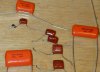
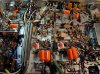
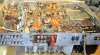
These capacitors are considerably larger than the ones they replaced. There is not a correlation between size and quality per se, but size is a consideration when using caps in tight spots. For example, the .1uf Sprague Orange Drops are too large to be used in a Fisher integrated amp like the KX-200. There's not enough room under the chassis and the leads are too inflexible. See the thumbnails for further information.
While disassembled, yours truly installed some Pomona banana receptacles with retaining washers in place of the output screws. Since these are 8/32, yours truly removed the capture screws, drilled out the holes and tapped them with an 8/32 tap. The retaining washer between receptacle and the Fisher is key because the thread ends before the banana receptales can be turned down tightly.
After testing all inputs and running our charge all night on the workbench connected to an antenna and speakers, it was moved back into the office system today.
Listening to Plant/Krauss's Raising Sand was a pleasure. For the uninitiated, this 180G vinyl release from 2008 presents an odd sonic landscape. The kick drum is a tubby huge drum from a 1930s trap drum set, probably 44 inches or larger in diameter, and vintage instruments are used through and through. Without careful listening, one might think this a sloppy thrown together recording. In truth it is a carefully crafted vintage sonic landscape achieved with the highest caliber of musicians and equipment.
On the Fisher, it was just lovely. By the way, the CD is too heavily compressed to show the magic of this dynamic two disk 180g vinyl set. It just sounds boomy and fat. Find the vinyl version. If you can't find it and it's too expensive to buy from your usual online mill, PM me and I'll find you one and ship it. Newbury comics carries it locally and it's $18.99.
Supporting equipment:
Thorens TD320 with AT440ML cartridge. Heavily tweaked.
Audio research interconnects.
Fisher 400 SN27949P
Nordost Blue Heaven speaker wire
Spendor SP1/5 minimonitors (a 6" and a Vifa tweeter) on 36" stands.
Hsu STF-1 subwoofer run from the RCA center channel out
Cambridge Audio Azur 840C upsampling CD player
My copy of KD Lang's Ingenue on CD was rich and ripe. Honestly, dear reader, yours truly does not want to leave his desk for dinner, but wishes to keep his head, so this chapter will end.
Dear reader, yours truly suggested that it could be some time before new coupling caps could be installed and could ripen in circuit. Some idle time last evening afforded your technician and scribe the opportunity to put some Sprague 716P orange drop caps in place of the Fisher Doc choices.
You may recall that the author felt that the coupling caps in Fisher 400 SN27949P were not up to the standard that the author uses in evaluating components, that the bass was non-authoritive and the treble was present but smeared, and not crisp.
Yours truly believes that he may be in the wrong business. The right business to be in might be boutique coupling caps for audio tweakers. According to this lengthy, instructive and useful dissertation on the subject, which the author rates highly along with Joe's tube lore, http://www.enjoythemusic.com/diy/0708/capacitor1.htm, Sprague orange drops were not even worth a mention. At $2 to $3 a pop they couldn't be any good . . . could they? Do they have a reputation based on old information and the boutiquers have superceded them by an impossible to pass margin?
Well, they're not pretty, they don't have fancy leads, they're cumbersome to install, and, within 24 hours of being installed in 27949P, they sound lovely! This amp sounds like magic now. That being said, there are better caps, but your equipment better be very good or you won't ever notice the difference except in the lack of heft retained in your wallet.
Yours truly believes that his boutique caps will stay on the top shelf for premium pieces along with his cognac, champagne, the best tequila, the finest gin, and the most select port. For everyday consumption this time of year, dear friends, a heavy porter with a caramel snap, authoritive bass, PRAT, well contained treble in a hint of orange drop will do.
The author installed .047uf 400 V caps in two positions in the line stage, and also in two positions in the phono stage. Also, yours truly installed .1uf 400V in two positions going to the output tubes from the phase inverters, and installed .1uf 600V in two positions going to the output tubes from the phase inverters.
These capacitors are considerably larger than the ones they replaced. There is not a correlation between size and quality per se, but size is a consideration when using caps in tight spots. For example, the .1uf Sprague Orange Drops are too large to be used in a Fisher integrated amp like the KX-200. There's not enough room under the chassis and the leads are too inflexible. See the thumbnails for further information.
While disassembled, yours truly installed some Pomona banana receptacles with retaining washers in place of the output screws. Since these are 8/32, yours truly removed the capture screws, drilled out the holes and tapped them with an 8/32 tap. The retaining washer between receptacle and the Fisher is key because the thread ends before the banana receptales can be turned down tightly.
After testing all inputs and running our charge all night on the workbench connected to an antenna and speakers, it was moved back into the office system today.
Listening to Plant/Krauss's Raising Sand was a pleasure. For the uninitiated, this 180G vinyl release from 2008 presents an odd sonic landscape. The kick drum is a tubby huge drum from a 1930s trap drum set, probably 44 inches or larger in diameter, and vintage instruments are used through and through. Without careful listening, one might think this a sloppy thrown together recording. In truth it is a carefully crafted vintage sonic landscape achieved with the highest caliber of musicians and equipment.
On the Fisher, it was just lovely. By the way, the CD is too heavily compressed to show the magic of this dynamic two disk 180g vinyl set. It just sounds boomy and fat. Find the vinyl version. If you can't find it and it's too expensive to buy from your usual online mill, PM me and I'll find you one and ship it. Newbury comics carries it locally and it's $18.99.
Supporting equipment:
Thorens TD320 with AT440ML cartridge. Heavily tweaked.
Audio research interconnects.
Fisher 400 SN27949P
Nordost Blue Heaven speaker wire
Spendor SP1/5 minimonitors (a 6" and a Vifa tweeter) on 36" stands.
Hsu STF-1 subwoofer run from the RCA center channel out
Cambridge Audio Azur 840C upsampling CD player
My copy of KD Lang's Ingenue on CD was rich and ripe. Honestly, dear reader, yours truly does not want to leave his desk for dinner, but wishes to keep his head, so this chapter will end.
Attachments
Last edited:
Jailtime
Standin' on a corner
Once again, the 400 looks wonderful! What did you use for the bias caps? Good tips on the coupling caps, I might go with the PIOs or orange drops in the 400. I know that I like the PIOs, they are in my 800C. Maybe save the Auricaps for my really nice 500C. One thing for sure, this thread makes me want to get started on my 400.

jaymanaa
RIP 1961-2018
The seller thinks you're doing some fine work and he's glad said Fisher 400 SN27949P has been saved from being parted out.
The guy sitting in his basement in Kansas wonders why we are talking in the third person.

The guy sitting in his basement in Kansas wonders why we are talking in the third person.
He's a Gemini.
What's your excuse?


The guy sitting in his basement in Kansas wonders why we are talking in the third person.
The Dude abides.

audiodon
Addicted Member
Dear reader,
As an appendix to chapter 9, after actually listening to the tuner, the author has gone back and removed the capacitors in the mpx unit and replaced them with .047 Sprague Orange Drop 716Ps.
Those Illinois caps just don't pass muster for yours truly.
Now it sounds considerably better on FM. The graininess is gone and the tunes are smooth and extended.
This unit will soon be going into gift mode to the oldest daughter. The author doesn't know if opening this large and heavy package will elicit a yay or a groan that it's not an Ipod Touch 64Gig. Time will tell.
audiodon657
As an appendix to chapter 9, after actually listening to the tuner, the author has gone back and removed the capacitors in the mpx unit and replaced them with .047 Sprague Orange Drop 716Ps.
Those Illinois caps just don't pass muster for yours truly.
Now it sounds considerably better on FM. The graininess is gone and the tunes are smooth and extended.
This unit will soon be going into gift mode to the oldest daughter. The author doesn't know if opening this large and heavy package will elicit a yay or a groan that it's not an Ipod Touch 64Gig. Time will tell.
audiodon657
Attachments

steph_gaynor
Well-Known Member
a most engaging story
Amazing & wonderful work. A true resurrection -- which brings us more into Mary Shelley territory (Frankenstein) than Jane Austen.
I hope your daughter is psyched about her xmas present. What speakers will it be driving? What is her main source? an ipod? a cd player? the computer?
Looking forward to the next chapter.
happy holidays,
Stephanie
Amazing & wonderful work. A true resurrection -- which brings us more into Mary Shelley territory (Frankenstein) than Jane Austen.
I hope your daughter is psyched about her xmas present. What speakers will it be driving? What is her main source? an ipod? a cd player? the computer?
Looking forward to the next chapter.
happy holidays,
Stephanie

audiodon
Addicted Member
I get mine at tubesandmore.
http://www.tubesandmore.com/
http://www.tubesandmore.com/
audiodon
Addicted Member
Stephanie,
Thanks. I'd thought of that too. As I originally designed the idea I was thinking more of overworked and tired zombie delivery people, but as I resurrected the item, I thought of Frankenstein too. The thing is that it's not a monster and has no reason to feel anguish and shame. For that reason, I refrained from characterizing the resurrected as a beast.
audiodon
Thanks. I'd thought of that too. As I originally designed the idea I was thinking more of overworked and tired zombie delivery people, but as I resurrected the item, I thought of Frankenstein too. The thing is that it's not a monster and has no reason to feel anguish and shame. For that reason, I refrained from characterizing the resurrected as a beast.
audiodon