

You are using an out of date browser. It may not display this or other websites correctly.
You should upgrade or use an alternative browser.
You should upgrade or use an alternative browser.
The vintage engines thread
- Thread starter Adam
- Start date


Greg B.
AK Donor
OvenMaster said:I personally think all the small-block "mouse" motors were pretty much my favorites. Cheap to hot rod, cheap to fix, simple and pretty much unburstable. I owned a 283 in my '63 Impala coupe and we had a 305 in our '79 Impala wagon that outlasted the body and frame... 180,000 miles and never burnt oil, never overheated, never failed to start.
Tom
I or my family have had a number of cars with the Chevy SB and every one of them failed to impress. Clattery lifters, bad oil seals, etc etc. Never understood why it was so revered other than being so commonplace.
The one engine I haven't seem mentioned here much is the later Olds Rocket V-8, either the big-block 425/455 or the smaller 330/350/403. Those things were GMs best V-8 engine in those years. Durable as can be, with superior metallurgy to the SB Chevy and lots of power.
bowtie427ss
Lunatic Member
Did you mean "CROSS RAM"?Chrysler 413 with ram induction:
I think you're referring to the two piece, dual 4 barrel intake manifold/s that actually located the carbs practically on top of the inner fenders.
The carb on the left fed the right side of the motor and vice versa, one of the coolest intake setups ever!
The runners actually interlace............... and talk about throttle linkage spanning the width of the engine compartment.:yes:
either the big-block 425/455 or the smaller 330/350/403. Those things were GMs best V-8 engine in those years.
The 455SD surely ranks in the top of the musclemotor class for me.:thmbsp:
My 72 jeep commando uses the TH400 and so did the 73. I think either in 74-75 they switched to the Chrysler trans.
My '77 CJ-7 had a TH400, and the 258 inline six didn't make a whole lot more horsepower than the tranny requires for operation, i could literally increase my top speed 5mph by loosening the fan/alt belt! (big tires of course)
FWIW, pretty sure my Jeep manual said it could be equipped with either the torqueflite 727, or turbo-hydro 400 in '77. My CJ was "quadra trac" equipped, i wonder if that had any influence which tranny they used. The TH 400 was a poor choice for the 110HP 258 in the CJ, TH400 requires about 48 horsepower to run. I'm sure jeep chose it for it's nice low 1st and 2nd gear ratios and ruggedness, overkill in a CJ IMO.
Dual water pumps, 221cid, and 85hp - 1935
Isn't that the powerplant that took Bonnie and Clyde straight to hell?
Please help me with this next one as i only have vague memories of it. 1964 Pontiac Tempest i think, it was what i'd call a "slant 4" literally looked like half a V8 and i do believe the head was just that. Drivetrain was ultra unique as attached to the rear of the motor was a shallow bell housing and a torque tube feeding an automatic transaxle with, i think, independent suspension.
Anybody familiar with this car and what powered it?

rickr15
Super Member
bowtie427ss said:Please help me with this next one as i only have vague memories of it. 1964 Pontiac Tempest i think, it was what i'd call a "slant 4" literally looked like half a V8 and i do believe the head was just that. Drivetrain was ultra unique as attached to the rear of the motor was a shallow bell housing and a torque tube feeding an automatic transaxle with, i think, independent suspension.
Anybody familiar with this car and what powered it?
I work with a guy who has a 63 Wagon with the torque tube and transaxle set up. If your really curious I can get you all the details. If I remember right the engine is half of a 389 kind of like the Intenational slant 4's that were half of a 304.

timoteus
Dnt thnk twice its alrght
472/500 Cadillac.
The block has a very high nickel content and so it is not unusual to pull one apart that has 100,000 miles and find little cylinder wear. Because the block is so strong the cylinder walls don't have to be as thick. This means you can use stock parts and build a 400 hp, 550 ft/lb motor that weighs only 50 pounds more than a 350 Chevy.
You can have it built for cruising your land yacht, boats, street racing, RV/Towing, or even make a blown alky caddy dragster.
The block has a very high nickel content and so it is not unusual to pull one apart that has 100,000 miles and find little cylinder wear. Because the block is so strong the cylinder walls don't have to be as thick. This means you can use stock parts and build a 400 hp, 550 ft/lb motor that weighs only 50 pounds more than a 350 Chevy.
You can have it built for cruising your land yacht, boats, street racing, RV/Towing, or even make a blown alky caddy dragster.
bowtie427ss
Lunatic Member
The higher nickel content also resists rust, Chevy cast code numbers in their blocks that denote high nickel.

There was a Tempest model that had the transmission in the back but I don't remember what powered it. The 1/2 V8 does sound familure though. Pontiac also had an overhead cam 6 cylinder engine. The cam turned on bearing surfaces in the valve cover.bowtie427ss said:Please help me with this next one as i only have vague memories of it. 1964 Pontiac Tempest i think, it was what i'd call a "slant 4" literally looked like half a V8 and i do believe the head was just that. Drivetrain was ultra unique as attached to the rear of the motor was a shallow bell housing and a torque tube feeding an automatic transaxle with, i think, independent suspension.
Anybody familiar with this car and what powered it?
- Pete
bowtie427ss
I think you just got the year wrong. Lookee here:
http://www.canadiandriver.com/articles/bv/tempest.htm
One of my highschool buddy's sister had a '62 like that.
Bob
I think you just got the year wrong. Lookee here:
http://www.canadiandriver.com/articles/bv/tempest.htm
One of my highschool buddy's sister had a '62 like that.
Bob

PakProtector
AK member
hey-Hey!!!,
Of the old Chrysler Hemi's, the 392 is my favourite. I got a '57 300C shortly after HS for its engine. Special valve coves to clear the jam-nuts on the rockers. It went into a '55 St.Regis coupe I got from its original owner's estate. Out with the 331 and 2-spd auto, and in with the 300C engine, and a 5 spd.manual...
The 426 wedge motors were slightly more evolved than the 413's. Available with long or short rams, and while equipped with looong, high-lift cams the full strength set of valve springs went in a box in the trunk. Break in was to be done at lower pressure.
For all that, it was not so rare that my neighbor's stock car firing up on Monday morning and taking him to work with no trouble would evoke a fit of jealous rage... Modern stuff is so much easier to deal with... though it could be said it lacks a Soul.
cheers,
Douglas
Of the old Chrysler Hemi's, the 392 is my favourite. I got a '57 300C shortly after HS for its engine. Special valve coves to clear the jam-nuts on the rockers. It went into a '55 St.Regis coupe I got from its original owner's estate. Out with the 331 and 2-spd auto, and in with the 300C engine, and a 5 spd.manual...
The 426 wedge motors were slightly more evolved than the 413's. Available with long or short rams, and while equipped with looong, high-lift cams the full strength set of valve springs went in a box in the trunk. Break in was to be done at lower pressure.
For all that, it was not so rare that my neighbor's stock car firing up on Monday morning and taking him to work with no trouble would evoke a fit of jealous rage... Modern stuff is so much easier to deal with...
though it could be said it lacks a Soul.cheers,
Douglas

Daniel33
Member
someone said, "For me it is the venerable old VW 1600 CC Type I (old beetle/bus) Boxer engine. A great place to learn about engines - 185 lbs and have seen them produce 400 HP. Probably one of the easiest engines to modify in the world."
I agree, I went to an autocross yesterday and saw an old beetle beat the crap out of itself, and get pretty good times (though it can't quite compete with the WRX Sti's and the Evos). May not have been the same VW engine, but despite the fact that you may have to rebuild them every 80K miles or so, you can remove them relatively easily and there are tons of parts for these things even though they're almost 50 years old.
I'd hate to sway the thread in a slightly different direction, but I have to say that the worst engine I have ever had was a V6 in an `81 Volvo 264 (engine B28-F, I think). It was the result of a joint project with Volvo, Fiat, Renualt, and Peugeot. All aluminum, supposed to be light weight and therefor easier on the fuel economy. Except that it was a total piece of you know what. Some people that have delt with this engine swear up and down about it's reliability, and others agree with me that any car with this engine ought to be shoved off a cliff. I always had problems with this thing until one day it just gave up on life. Apparently DeLoreans had this same exact engine...
Best engine thus far, my 92 Honda Accord LX. Reading about all of these old, solid, monuments to American motoring I'm left to assume I'm laughed at? it's okay, no offense taken! I have 253,000 miles and going... It currently leaks oil, but other than that one particular problem and the fact that every part under the hood is a headache to access, it's reliable as a mother. I bought it two years ago with 114K miles on it, if that tells you anything about how and how much I drive it...
...But I can't wait to get rid of it so I can buy a BMW 2002!!
I agree, I went to an autocross yesterday and saw an old beetle beat the crap out of itself, and get pretty good times (though it can't quite compete with the WRX Sti's and the Evos). May not have been the same VW engine, but despite the fact that you may have to rebuild them every 80K miles or so, you can remove them relatively easily and there are tons of parts for these things even though they're almost 50 years old.
I'd hate to sway the thread in a slightly different direction, but I have to say that the worst engine I have ever had was a V6 in an `81 Volvo 264 (engine B28-F, I think). It was the result of a joint project with Volvo, Fiat, Renualt, and Peugeot. All aluminum, supposed to be light weight and therefor easier on the fuel economy. Except that it was a total piece of you know what. Some people that have delt with this engine swear up and down about it's reliability, and others agree with me that any car with this engine ought to be shoved off a cliff. I always had problems with this thing until one day it just gave up on life. Apparently DeLoreans had this same exact engine...
Best engine thus far, my 92 Honda Accord LX. Reading about all of these old, solid, monuments to American motoring I'm left to assume I'm laughed at? it's okay, no offense taken! I have 253,000 miles and going... It currently leaks oil, but other than that one particular problem and the fact that every part under the hood is a headache to access, it's reliable as a mother. I bought it two years ago with 114K miles on it, if that tells you anything about how and how much I drive it...
...But I can't wait to get rid of it so I can buy a BMW 2002!!

DaWoofer
Super Member
AMC used a big mix from the big 3. I understand the block is the same as the Ford 360 with the timing backwards. I loved those old wagoneers. They would go places and shame many a monster truck in hillclimbs.rickr15 said:Find a 360 or 401 from a wagoneer. Direct bolt in swap instant power upgrade. It's all the same basic motor only bore and stroke change.
DaWoofer
Super Member
I loved the one in my 74 Z. Man what a nice car, I was a senior in high school and every Friday night...slow_jazz said:My favorite was the L-88 Chevrolet V-8 350 cubic inch engine. Used TRW pistons from the factory, four-bolt main bearings, easy to work on, all it needed was a decent camshaft to really bring out the power. They used them in Corvette's and Z-28 Camaro's.
PakProtector
AK member
hey-Hey!!!,
My all time favourite vintage piston engine hails from the WWII avaition industry. The twin crank, H-block, 24 cylinder Napier Sabre. Their later variants made 3500 HP at ~4000 rpm at around 2 bar of boost... Sleeve valves instead of the usual poppet made the machine work a bit troublesome.
They provided the Hawker Tempest enough speed to run down the German pulse ram-jets. No modern engine even comes close.
cheers,
Douglas
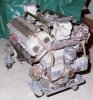
My all time favourite vintage piston engine hails from the WWII avaition industry. The twin crank, H-block, 24 cylinder Napier Sabre. Their later variants made 3500 HP at ~4000 rpm at around 2 bar of boost...
Sleeve valves instead of the usual poppet made the machine work a bit troublesome.They provided the Hawker Tempest enough speed to run down the German pulse ram-jets. No modern engine even comes close.
cheers,
Douglas



Sandy G
Retired Member
Lessee...Bonnie & Clyde were killed in either a '33 or '34 Ford, it would have been the 221 V-8, altho you could still get a 4-cyl in a '33 Ford. Henry HATED 6-cylinders, because of the ill-fated Model K of 1906-07, & because of the Chevy 6 that knocked his beloved Model T out of 1st place. He only reluctantly offered a 6 in his cars starting in 1941. There was a TINY "60" hp V-8 Ford of 136 cubic inches in 1937-40. They were supposed to go in a smaller line of domestic cars, & in European Fords, but the domestic line never panned out. They really were too small for domestic use, people thrashed them unmercifully, & they didn't hold up too well. They are rarely seen today at all.
bowtie427ss
Lunatic Member
I have a mild obsession with Lister/Petter stationary diesel engines.
They work to pump water and generate electricity in a lotta remote and 3rd world areas. It's a very old design, but these engines often run nonstop for literally years without breakdown or malfunction.
Here's a clip of a chinese built Lister clone:
http://www.youtube.com/watch?v=3a6RZFHyIdQ
They work to pump water and generate electricity in a lotta remote and 3rd world areas. It's a very old design, but these engines often run nonstop for literally years without breakdown or malfunction.
Here's a clip of a chinese built Lister clone:
http://www.youtube.com/watch?v=3a6RZFHyIdQ

philo426
Super Member
Speaking of Vega engines...I have heard it said the GM execs intentionally refused to alllow steel liners in the alumminum vega cylinders so that they would wear-out quickly and leak oil.They arrogantly wanted the public to believe that small cars were no good and they would then continue to buy GMs oversized gas hogs.I don't know if these rumors are true but I do know that VEgas would have rust on the showroom floor.(My dad worked at the Lordstown plant and noticed that the steel was heavily rusted before being fed into the pressses.)Allowed the Japanese to gain a foothold that has snowballed!

Mark W.
Nut house of the Universe
Well I'll throw in a real classic one that helped change the world.
the Willys 134L Go Devil 4cyl Making 60bhp at 4000rpm. Origionally designed and built for the 1928 Willys autos and continuously refined until 1940 when the US Army chose it to power they new 1/4ton Scout vehicle we all now know as the Jeep. The engine continued in developement after the war and in 1953 became an F head with the intake valve in the head and the exhaust value still in the block this engine continued into the 70's being the base offerings in later Jeeps. Not bad some 40+ years in production and being one of the weapons said to have stopped the Germans in WWII.
Mine is a 1948 134L one of the most common civilian editions of the engine since more 48 CJ-2A jeeps were sold then Willys jeeps in any other year the 134L was offered. Mine is the nicer of the two vaiants with timeing gears. It will hopefully get completely rebuilt this summer if I make enough over time.
the Willys 134L Go Devil 4cyl Making 60bhp at 4000rpm. Origionally designed and built for the 1928 Willys autos and continuously refined until 1940 when the US Army chose it to power they new 1/4ton Scout vehicle we all now know as the Jeep. The engine continued in developement after the war and in 1953 became an F head with the intake valve in the head and the exhaust value still in the block this engine continued into the 70's being the base offerings in later Jeeps. Not bad some 40+ years in production and being one of the weapons said to have stopped the Germans in WWII.
Mine is a 1948 134L one of the most common civilian editions of the engine since more 48 CJ-2A jeeps were sold then Willys jeeps in any other year the 134L was offered. Mine is the nicer of the two vaiants with timeing gears. It will hopefully get completely rebuilt this summer if I make enough over time.