• The move to the new server is done. There are some software and database maintenance updates in process. This has us passing the hat around to help out. We appreciate any donations. Seriously, even a dollar helps. The payment page may be found here - https://www.audiokarma.org/support.html

This is Wild (to me anyway -- you guys I'm sure already know)

Parallax982

Super Member
That Rotel turntable I was posting about a couple of weeks back is up and running. Managed to get some good cleaning fluid and a brush and some of the cheap LPs I picked up at Goodwill sound surprisingly good.

Tonight I decided to find the same album on Qobuz and stream them back to back. Of course the stream had no pops or clicks and in some sense sounded perfectly. But when I switched to the table, despite the imperfections, there was something intangible and particularly appealing. Maybe it's just my imagination (because it is subtle) but I don't think so.

Experienced something similar when I compared YouTube Music to Qobuz. Went for the Qobuz subscription because I could hear the improvement in quality with lossless, but it wasn't uniformly superior. There was a different quality with a set of tradeoffs. Subtle ones but clearly real.

I'm experiencing something similar except that, surprising to me, I like whatever this is and the crackling (still running old records, cleaner but still not ideal) isn't really bothering me. I don't have words for the difference. It's not exactly warmer or richer. Maybe realer (more real if you prefer) in some way.
 
Register to hide this ad
That Rotel turntable I was posting about a couple of weeks back is up and running
We expected that. We spent 7 pages getting that part done.

But when I switched to the table, despite the imperfections, there was something intangible and particularly appealing
As I stated, the record is musically better than the technically better digital sources, whatever musically means. It has been spoken of as having more depth to the sound field, a more organic sound? What is that? Grass fed? But folks that hear my system prefer the record. It just has this Je ne sais quoi that makes folks prefer it.

Welcome back to the enjoyment of licorice pizzas.
 
Last edited:
We expected that. We spent 7 pages getting that part done.


As I stated, the record is musically better than the technically better digital sources, whatever musically means. It has been spoken of as having more depth to the sound field, a more organic sound? What is that? Grass fed? But folks that hear my system prefer the record. It just has this Je ne sais quoi that makes folks prefer it.

Welcome back
Thanks Shadow. I asked ChatGPT and it said a lossless stream is, in a sense, perfect, like polished glass, and that can sound sterile. Whereas the tiny imperfections in a record give it colorization. From the cartridge, from the groove, even the rumble. It said that those small cues can lend a tactile, human feel that gives a sense of being in the room with the artists. But it's highly dependent on the recordings. I've been listening to old classical and jazz albums, which lend themselves well to vinyl. It said that a poorly recorded pop session might be compromised on both vinyl and streaming. Or might sound better, at least to some, in one format or the other. So it's not as simple as "streaming bad, vinyl good".

It is weird, having to flip the record. I was once very used that this. But it's been so many years. Now I'm spoiled by streams that run essentially forever.
 
Excited by the textures in the grooves, the phono cartridge generates brand new electricity carrying a near perfect facsimile of what was inscribed in the groove.

Understanding this unique process, it is no surprise to me that vinyl usually sounds better than reconstituted digital files.

There are some more recent digital recordings that, played back at sufficient resolution, deliver an equally valid (if quite distinct) high-fidelity presentation - but typically well mastered LPs sound superior to our ears. Even guests to the home and their children can hear the difference.

That said, we wouldn't want to be limited to the well recorded vinyl music catalog of pre-1990, nor be restricted to just post-2010 hi-res digital outings, so we are very thankful that we can run hi-res digital and high-fidelity analog - side by side.

Especially given that 1990s is probably our favourite music decade - this covers our bases nicely.
 
Last edited:
Listening to a analog signal from a cartridge is going to be more pleasing to the ear then a digital signal. Not all cartridges were created equally.. I remember how much more attenuated the highs were when I went from some linier tracking turn table I had in the 80s to the Grace cartridge that was installed on my Denon a few years later.. so it is not just analog to digital that changes the sound, it is also the cartridge. After years of wanting cleaner sound with no clicks and pops.. and wanting all my music on a tiny chip like the data cards on Star Trek. We got there and now I am now back to enjoying the LPs again.. just have to recap the turntable and hope that fixes the intermittent loss of tracking.. tech is not always better.. plug it into a Tube Mono Block and even the digital gets better!
 
Producers and artists of the past spent a lot of time and money using the equipment and technology available to them to make their music sound the best it could on the equipment consumers were actually using. Nobody was thinking, “How is this going to sound when it's digitally remastered 55 years from now?”

IMO, when you play an original vinyl pressing, you're hearing the music and decisions that were made for the time it was produced. I'm not saying vinyl didn't have limitations, of course it did, and engineers had to work around those limitations. But every format has limitations.

That's part of the appeal of vinyl to me. Not... vinyl is superior to digital, it's that you're hearing a version of the recording that was actually created and mastered for the time it came from.
 
Excited by the textures in the grooves, the phono cartridge generates brand new electricity carrying a near perfect facsimile of what was inscribed in the groove.

Understanding this unique process, it is no surprise to me that vinyl usually sounds better than reconstituted digital files.

There are some more recent digital recordings that, played back at sufficient resolution, deliver an equally valid (if quite distinct) high-fidelity presentation - but typically well mastered LPs sound superior to our ears. Even guests to the home and their children can hear the difference.

That said, we wouldn't want to be limited to the well recorded vinyl music catalog of pre-1990, nor be restricted to just post-2010 hi-res digital outings, so we are very thankful that we can run hi-res digital and high-fidelity analog - side by side.

Especially given that 1990s is probably our favourite music decade - this covers our bases nicely.
There is no such thing as brand new electricty. Energy can neither be created or destroyed only changed.The generator interface converts the movement of the stylus into electricity.
 
there was something intangible and particularly appealing.

my take on it;


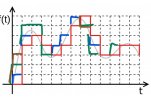
analog is a smooth sine wave. digital is not.

digital recreates it as best it can but think of digital as a grid of 1s and 0s. either on or off.

so the gray sine wave can be seen digitally as the red line. or the red and blue line or the red and brown and blue line or any combination of those lines.

it is impossible to recreate an analog sine wave digitally. they can make the grid smaller(over sampling) but it is still "a blocky sine wave.

that is the difference that you hear.

Annotation 2026-09-03 103956.jpg
 
I'll throw my 2 cents in and maybe create a conundrum of sorts......I like vinyl, and I like digital. However, I have found that combining both formats, in some cases, makes for a real "stumper!" Here's what I'm talking about......often when we listen to that favorite music on a cd or streaming, we are hearing a "remastered" version of it and hence our ears (because of our brain!!!) say: "Hold it right there!!!! This ain't right!!!" And we (I ) don't prefer it much.....Then, we get our mits on a really well-done SACD (or DVD-Audio for those who remember that dinosaur) or even CD where there was no remastering done, just a transfer from the analog source to the digital format and the music sounds......well, it just sounds "right!"

Being one who likes to not be limited to listening to my home system (good car systems, camper systems etc.) I came up with the idea that transfers done of my favorite music from the vinyl, analog records using a pretty high resolution (think 96kHz/24bit) recording process should be very satisfying and staying true to the original recordings unfettered with the re-mastering process and I was correct! Now, friends will come over, friends whose listening skills I regard very highly, and they are hard pressed to distinguish between the record and the 96/24 recordings in blind listening experiments (we have a lot of fun doing this by the way!!). So, for me anyhow, to say it's the difference between vinyl or digital formats is not quite the issue but rather how the digital reproduction was arrived at......and, I know, when I'm recording the record digitally I'm also recording all the related artifacts of the vinyl which makes it sound like, well....... vinyl, of course. So it doesn't always have to be an either or thing so long as it is satisfying (and passes your brain's filters as "real")!!!

As I said, my 2 cents.....carry on amigos
 
my take on it;


analog is a smooth sine wave. digital is not.

digital recreates it as best it can but think of digital as a grid of 1s and 0s. either on or off.

so the gray sine wave can be seen digitally as the red line. or the red and blue line or the red and brown and blue line or any combination of those lines.

it is impossible to recreate an analog sine wave digitally. they can make the grid smaller(over sampling) but it is still "a blocky sine wave.

that is the difference that you hear.

View attachment 3829320
Wow! That's a really good proposition sir! While it may not match what I'm thinking goes on, it is certainly as good an explanation as I've seen.....except, “Red is gray and yellow is white, but we decide which is right / and which is an illusion” ;):beerchug:
 
There's another thread that discusses this in depth -- can't remember which one or I'd provide a link.

From that discussion, I think the difference is more due how they mastered LP's back in the day versus how they master CD's (and digital streams) for the past couple decades, than it is about performance capabilities of the medium itself. For recent CD's (past few decades) there has been far more compression used during the "mastering" process (the final tweak on sound of the 2-channel result of mixing) for CD's to get louder overall sound. This is pushed as much by the artists (according to posts in that other thread) as it is by the record companies to make their songs stand out on radio (or streaming).

All of the above was new to me -- I never thought of the mastering differences -- so I'm the last guy to be talking about it -- but I think it makes sense. Digital recordings can be awful, or they can be absolutely brilliant. I've heard plenty of ones that didn't sound good, but also plenty of digital recordings that sound amazing -- so I don't think the digital medium is at fault (except when done poorly).
 
Last edited:
i still remember that poem :thumbsup:
Moody Blues, Days Of Future Past (1967 as I remember). "The Day Begins," just a very, very beautiful piece in my estimation!
I don't think the digital medium is at fault (except when done poorly).
I agree with you! I've heard many, many CDs that sounded excellent to my ears and when you take it to the next level (SACD and DVD-A as I was mentioning earlier) it gets even better but that's just my opinion.
 
This thread led to a whole discussion. Noticed that my post requesting information on record cleaning devices is gone. Perhaps it was posted in the wrong place. What is the right place for that sort of discussion?
 
There is no such thing as brand new electricty. Energy can neither be created or destroyed only changed.The generator interface converts the movement of the stylus into electricity.

I think we can agree that there was no electricity before the stylus moved.

In reality, we are in agreement.

The point is, the electrons are not sourced from another existing - potentially polluted - appliance.
 
...Being one who likes to not be limited to listening to my home system (good car systems, camper systems etc.) I came up with the idea that transfers done of my favorite music from the vinyl, analog records using a pretty high resolution (think 96kHz/24bit) recording process should be very satisfying and staying true to the original recordings unfettered with the re-mastering process and I was correct! Now, friends will come over, friends whose listening skills I regard very highly, and they are hard pressed to distinguish between the record and the 96/24 recordings in blind listening experiments (we have a lot of fun doing this by the way!!)...

How interesting, Fishead. :thumbsup:

I've often thought of doing this myself, as many of our best sounding LPs never appeared in digital format. Mostly old stuff from the late 1950s - early 1960s - back when they did not mess with anything and simply recorded it.

(96kHz is a very nice choice for this purpose, BTW...)

My question is: Are you doing this yourself and if so, exactly what do you use to record your LPs at 24/96?
 
This thread led to a whole discussion. Noticed that my post requesting information on record cleaning devices is gone. Perhaps it was posted in the wrong place. What is the right place for that sort of discussion?

I think this thread's title and your opening post set the topic... How amazed you are that despite its sins, vinyl still sounds better to your ears.

Others - myself included - have simply followed your lead.
 
Back
Top Bottom