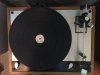
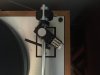
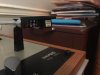
JDG, please post pictures of the entire arm, headshell, and turntable so we know more about what your are working with. Take pictures from the top, and then from the side of the tonearm.
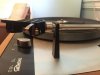
If the tonearm, headshell, cartridge and counterweight were all correct and original, and settings were correct, with the VTF wheel set at 0, the arm should easily be balanced level in the vertical plane with the counterweight nowhere near the back end of its mount. Then the VTF (vertical tracking force) is dialed in with the wheel alone. See the picture of this stock TD160 with TP16 arm and TP-60 headshell:
there should be a knurled end knob on the back end of the counterweight mounting rod. If yours is missing, that may account for lack of weight in the back of the arm, needing the black circular counterweight to be back too far. Also, if there is, for some odd reason, additional weight in the headshell or the cartridge is mounted way, way forward, that would need additional weight or distance on the back of the tonearm to compensate.
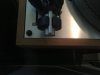
Here is the picture you posted of your tonearm gimbal in your first posts about turntable repairs:
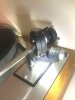
Note the fact that the magnetic anti-skate mechanism is not in-line with the gimbal which is set at an angle like in the top pic - it has become detached from the gimbal base and swung back towards the rear. It may be possible to set it back - someone else may know how to put it back to its normal position.
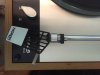
You also mentioned you have missing set screws - the only set screws are two on the metal lockring that the tonearm gimbal cylindrical base mounts to - those screws set the static height of the gimbal housing, bearings, and hence the tonearm pivot point and tonearm height relative to the platter and record. If these set screws are missing, the gimbal falls down to its lowest setting - this is too low for the typical setting of the cueing bar (another set screw) at its lowest point and will cause the cartridge/headshell end to point upwards and allow very little downward travel for the cartridge and stylus. Here's how it should look:
You should be able to find small set screws at Home Depot, Lowes, a well stocked hardware shop, or a hobby shop that sells RC cars or slot cars.
In any case, the process is to put a record on top of the mat and platter (be sure the platter mat is not super thick, 5mm is probably the thickest to use). If the cartridge and headshell are mounted properly, placing the stylus on the resting (and not spinning record) should have a level tonearm. If not, the gimbal base should be raised and locked when the gimbal is high enough to level the tonearm. (when you get more interested, you can adjust vertical tracking angle (VTA) by additional raising or lowering of the gimbal relative to the stylus).
Once the tonearm is level, then take the arm off the record, set it between the mat and tonearm rest so its free, then set the anti-skate and VTF wheel to 0 each. then adjust the counterweight so that the tonearm floats without resting on the cue bar. The tonearm should easily be lifted or let go without falling - it if feels like there is significant resistance in the vertical plane, the bearings are too tight, which can contribute to needing much more tracking force or poor tracking. Once the tonearm is level, then VTF is dialed in, and then anti-skate is dialed in if needed.
This also assumes that your table base is level, and that your suspension is free (the shipping screws are loose and not engaged underneath), and the suspension is correctly set, and the platter is also level and not bouncing when spinning. A small light plastic level of about 6 inches is easily sourced from HD/Lowes and helps with set up. A spirit bubble level is also useful in that regard for both the top plate of the base, the platter, and even the headshell.
Sorry for the long winded post. The TLC given to Thorens TT setup is paid back in spades by a properly working TT.