• The move to the new server is done. There are some software and database maintenance updates in process. This has us passing the hat around to help out. We appreciate any donations. Seriously, even a dollar helps. The payment page may be found here - https://www.audiokarma.org/support.html

Thorens TD-165 Belt Noise

avantbored

Active Member
Hi all, Bought a new belt for my TD-165 from VinylNirvana. The platter gets up to speed more quickly now, but when running on 33, I hear a hiss that I don't when I switch to 45.

The problem seems to happen when I move from 45 -> 33. You can see in the video below that, when I reset the belt, and start in 33, the noise is not (as) present. However, starting from 45, then moving to 33, produces the noise on 33 (at the end of the video).

Is this just a new belt situation, that will gradually disappear once the belt stretches a bit? Or should I do something else, like clean the sub-platter where the belt makes contact? I have already cleaned the spot where the belt runs around the motor and the white spinner (sorry, don't know the technical term for this yet).


UPDATE #1:

Someone at the "Thorens TD-160" Facebook group asked some good questions.

"1) did you check the same bit with the belt removed? 2) are you sure the belt run free and don’t touch the fork?"

1) There is a bit of a rumble without the belt, but not the hissing. 2) This reproduces the sound -- I see that when the sound is present, the belt is rubbing against the underside of the pulley (fork). Pressing my finger down on the belt lowers it. But how do I keep it from jumping up?


I think I just noticed a new problem. The fork does not fully lower by operating the switch alone -- I had to pop it down with my finger in 33 to get it fully lowered. Now the platter knocks and rumbles as it starts up.
 
Last edited:
Register to hide this ad
OK, the motor's white spinner is call the pulley. So once in a while clean with IPA (isopropyl alcohol) the belt; the pulley and the sub platter edges. Now it could be that your suspension needs to be adjusted to correct that as well. Step one; make sure your turntable sits 100% leveled. Step two; make sure your platter is 100% leveled as well with a 5 to 8 mm gap (or about) from the top plate.

Maybe you'll need to re-adjust the suspension of the springs. From your video it seems that the belt doesn't go all the way up on the the pulley by switching to 33 rpm. Is that correct ? To verify that better you need to put the platter upside down on the sub platter in order to view what's going on then with the weight of the platter on ! And if you can do a video showing what is happening then there.
 
[...] Step two; make sure your platter is 100% leveled as well with a 5 to 8 mm gap (or about) from the top plate.

Do you mean the edge of the metal platter to the plinth?

Maybe you'll need to re-adjust the suspension of the springs. From your video it seems that the belt doesn't go all the way up on the the pulley by switching to 33 rpm. Is that correct ? To verify that better you need to put the platter upside down on the sub platter in order to view what's going on then with the weight of the platter on ! And if you can do a video showing what is happening then there.

The belt goes up fine on 45rpm. But it does not go all the way down on 33rpm (I have to press the fork down to rest on the felt pad; the belt then runs down as it should).
 
Do you mean the edge of the metal platter to the plinth?

Yes, the bottom edge of the alloy platter and the aluminium top-plate that covers the chassis of the turntable. Though the plinth (laminated wood looking alike) is hopefully align to the top-plate.

The belt goes up fine on 45rpm. But it does not go all the way down on 33rpm (I have to press the fork down to rest on the felt pad; the belt then runs down as it should).

Ah OK, so first clean them bits with IPA if you've not done that yet. Try again and tell us how it goes with the alloy platter upside down on black resin the sub-platter.
 
Yes, the bottom edge of the alloy platter and the aluminium top-plate that covers the chassis of the turntable. Though the plinth (laminated wood looking alike) is hopefully align to the top-plate.


Ah OK, so first clean them bits with IPA if you've not done that yet. Try again and tell us how it goes with the alloy platter upside down on black resin the sub-platter.


Gotcha. I haven't measured it yet, because it's difficult with the calipers that I have. EDIT: It's about 6mm.

Below is a video of the knowing with the platter upside down on the sub-platter.


Here's a video of the fork issue I was describing in my first post.

 
Last edited:
OK, could you do this first video with speed changes and view on the pulley and fork in action ? And 6mm gap is fine.

Now indeed on the second video without the platter on, the fork doesn't fall down completely to hold up the belt some.

To seek into that I'll need to look under my TD160 'E' hood how the mechanism operates and could be readjusted if ever.

Knowing that some bend the fork to "correct" that, but I don't really like the idea.
 
Below is a video of the knowing with the platter upside down on the sub-platter.


It is obvious in this video the belt rides very low on the sub-platter at 45 RPM. It means that when you swap to 33 RPM the belt cannot slide further down the sub-platter and is impeded by the deck so the belt-guide lever cannot smoothly lower to it's 33 lowest position. You're going to have to do some suspension tuning to mitigate this. The sub-chassis is simply too high. It needs to sink down a few more mm. Alternatively, if the pulley had sunk on the motor spindle - you'd get the same effect. You may want to try and raise it a few mm up on the spindle but it requires care as to not bend the delicate motor spindle.
 
Thought about that also but with a 6mm gap between the platter an top plate it's hardly a too tight suspension issue to have the sub-platter 'hanging' too high. FWIW that second clip here below with the upside down platter runs at 33rpm and not 45rpm. As shown the 'fork' though should indeed sit further down when switched to the 33rpm position. That's what 'avantbored' points out that produces that belt rubbing noise. So I've checked my fork resting down on 33rpm an it's "kissing" the chassis on my TD160 'E'. Maybe his 'speed' switch mechanism underneath the chassis needs some re-adjusting...
 
Thought about that also but with a 6mm gap between the platter an top plate it's hardly a too tight suspension issue to have the sub-platter 'hanging' too high. FWIW that second clip here below with the upside down platter runs at 33rpm and not 45rpm. As shown the 'fork' though should indeed sit further down when switched to the 33rpm position. That's what 'avantbored' points out that produces that belt rubbing noise. So I've checked my fork resting down on 33rpm an it's "kissing" the chassis on my TD160 'E'. Maybe his 'speed' switch mechanism underneath the chassis needs some re-adjusting...

Conversing with helpful comments on the FB group also pointed to this adjustment strategy. [-However, the videos I've seen of the TD-160 and TD-165 show a different form/speed control arm than mine, if I recall correctly.

I've got a huge batch of papers to grade coming this weekend, so if I get some time today, I'll open up the backboard again and verify, take some pictures, and a video perhaps. Based on the videos shared with me, the recommended adjustments wouldn't work on my deck.


EDIT & UPDATE: As a noob to the Thorens world, I confirmed that the speed control arm is indeed the same as on the videos mentioned above.

However, the problem those videos describe is not the issue I have.


I've isolated two problems, possibly related, but my growing knowledge about these TTs is still nascent.

1. Stuck Fork Mechanism.

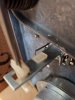
As described above, toggling between 45rpm and 33rpm first produced the rubbing noise with the new belt. I found that, while moving from 45 --> 33, the fork fails to fully lower and touch the felt pad on the aluminum sub-platter. This is a shot underneath that shows the position of the brace (?) when the table is in 33rpm, with the fork stuck (click for detailed view).

IMG_20200605_161430.jpg


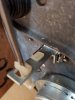
Pressing the fork down on the sub-platter eliminates the rubbing noise. The photo below shows the position of the brace (?) after.

IMG_20200605_161409.jpg

You can see it rests more closely to the plastic piece.


Here is a video of me starting the table in 45, switching to neutral, then to 33. I then push the fork down.


2. Knocking, Jostling on Start-Up

I think this is a secondary issue that has risen since I purchased the OEM belt from VinylNirvana. On the old belt, the platter and tonearm did not jostle. The video below shows the tonearm and sub-platter knocking & jostling on start up.


Despite these problems, the RPM app on my phone reports the table spinning at both the correct speeds, with wow & flutter between 0.2 and 0.3. The table gets up to speed more quickly now and maintains a stable playing speed in long listening sessions. I've adjusted azimuth, but this produces no change on problems 1 or 2.

The bounce, however, is only around 4 seconds. Is problem 2, "Knocking, Jostling on Start-Up," largely a suspension issue?
 
Last edited:
The whole TD14X and TD16X speed switch mechanic is the same. Check this, it shows you what I meant that needs readjusting.


About the 'jerky' start up with your new VN belt it implies too much belt grip on the sub platter shaking-up your whole sub-chassis tremble.

Either the belt is too tight (that I doubt) or it needs some slip help (talc)
 

It is obvious in this video the belt rides very low on the sub-platter at 45 RPM. It means that when you swap to 33 RPM the belt cannot slide further down the sub-platter and is impeded by the deck so the belt-guide lever cannot smoothly lower to it's 33 lowest position. You're going to have to do some suspension tuning to mitigate this. The sub-chassis is simply too high. It needs to sink down a few more mm. Alternatively, if the pulley had sunk on the motor spindle - you'd get the same effect. You may want to try and raise it a few mm up on the spindle but it requires care as to not bend the delicate motor spindle.

Tom hit the nail on the head. Your suspension needs adjusting and leveling. From your last video, it looks like the tone arm platform is riding too high. Perhaps it's the angle of your video but the left side of the platform nearest the platter appears to be slightly higher.

There appears to be some sort of modification made to the platform in the form of an adjustment knob? If that's the case, then someone has been under there mucking things up.

It's not the belt. The new belt is just telling you there's suspension adjustments to be made. After all, they came from the factory with new belts and no issues.

Since it's EOY for you (my wife is also a teacher), I know the drill. Waiting until things settle down is a good thing in order to really spend some time with it.

All the necessary Thorens adjustments and tweaks can be found here: https://www.theanalogdept.com/thorens_dept_.htm

The 165 is a wonderful table with a higher mass tonearm that will allow you to venture into the world of LOMC's. Love it and it will love you back. I've had mine for 43 yrs.and it hasn't yet convinced me that I need to upgrade it.

Enjoy your new Summer project!
 
If that's the case, then someone has been under there mucking things up.
Yes, it looks like it. It may explain the TD-150 round 110V motor and the no clutch pulley which could further explain the sub-platter jostling on start-up. It may be one of those rare early 165 'special' with the left over round motors too but the motor azimuth screw definitely looks like it's been played with before. The washer doesn't look stock. The belt is stock and dandy fine and exerts the right tension. The old one was worn loose. It would be a shame ruining it if it rubs on the deck or belt guard. This needs to be addressed. There's no need for talc anywhere with a new belt. The arm is a TP-11 Mk-I (11g eff. mass) - hardly a high mass tonearm. There's also no need to go on AK and quote advise from facebook. If we wanted to hear facebook opinions - we'd go there ourselves.
 
Last edited:
Yes, it looks like it. It may explain the TD-150 round 110V motor and the no clutch pulley which could further explains the sub-platter jostling on start-up. The motor azimuth screw definitely looks like it's been played with before and the washer doesn't look stock. The belt is stock and dandy fine and exerts the right tension. The old one was worn loose. It would be a shame ruining it if it rubs on the deck. There's no need for talc anywhere. The arm is a TP-11 Mk-I (11g eff. mass) - hardly a high mass tonearm. There's also no need to go on AK and quote advise from facebook. If we wanted to hear facebook opinions - we'd go there ourselves.

1. Inclusion of the FB Thorens' Group comments overlap with a lot of what has been said here, and it was provided to give everyone's helpful comments more context into my issue. I thank you for your attention to this and your resources.

2. Before everyone's contributions here helped me isolate that "Problem 2" above is a suspension issue, I adjusted the azimuth myself. Before, it was covered in that blue sealant I've read about.

3. Is my motor not stock?

Tom hit the nail on the head. Your suspension needs adjusting and leveling. From your last video, it looks like the tone arm platform is riding too high. Perhaps it's the angle of your video but the left side of the platform nearest the platter appears to be slightly higher.

There appears to be some sort of modification made to the platform in the form of an adjustment knob? If that's the case, then someone has been under there mucking things up.

1. From my eye, the tonearm platform looks level; it could be the angle of the video. The table itself is level, square in the middle of my bubble lever, though I have not measured the tonearm platform.

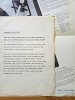
You're right, there is an adjustment knob. I've attached pictures of the provenance documents the previous owner provided; it is in function an auto-shut off, but it's loud and abrupt, so I've disabled it. It doesn't touch the motor at all, just the dampener.

IMG_20200606_101348.jpg

I am a total newbie to adjusting suspensions, as I've read before. And while the instructions from The Analog Dept. are thorough, it feels like it's addressed to an audience of more attuned (no pun intended) enthusiasts. For example, I have questions like:

1. How do I rest this table upside down so I put pressure on the tonearm?
2. Am I looking for tight or loose suspension, since Tom above points out I may need to increase or decrease the platter/platform gap?
3. By running the table with this issue, am I risking some permanent damage? As noted above, after the jostling, it's running fine.


Ryan[/QUOTE]
 
Is my motor not stock?
It's hard to tell. Some very few early TD-165 came stock with left over round motor. The vast majority had the later triangular variant. The round motors are not a problem, they're rather robust. The motor pulley, however, is a different issue. Other variants had clutched pulleys that could sustain the start-up tension and dissipate it by idling on a felt pad. This mitigated the jostling which is really just some excess energy dissipating. Most TD-165 variants omitted the clutch to lower production cost - but some still had it.

The TD-165 also has softer, more compliant springs in conjunction with the lighter resin platter. It's a different, more finicky suspension than the previous TD-160. As such, the jostling will be hard to get rid of b/c the belt is just right. It may go away on it's own as the belt settles in a few weeks of use. The motor spindle azimuth screw could be used to fine tune the tension of a belt - but this should be done carefully as it may lead to a myriad of other issues. It requires some loosening of the other two screws to allow the spring under the adjustment screw to extend/decompress and tilt the motor. Consider the jostling a none issue for a while - at least until the belt swooshing on the belt guide is resolved.

About that... With all those nice graphic demo's - the key video is still missing. Instead of doing a FB owner's opinion poll, let us diagnose this properly. Take a video like the first with the platter upside down on the sub-platter - but move the camera to the left and display the pulley, the belt path and the sub-platter all at once while gradually sweeping through all speeds, so that the interaction is visible. That will be real helpful.

EDIT: The resin part is the black sub-platter of course. My KB slip.
 
Last edited:
It's hard to tell. Some very few early TD-165 came stock with left over round motor. The vast majority had the later triangular variant. The round motors are not a problem, they're rather robust. The motor pulley, however, is a different issue. Other variants had clutched pulleys that could sustain the start-up tension and dissipate it by idling on a felt pad. This mitigated the jostling which is really just some excess energy dissipating. Most TD-165 variants omitted the clutch to lower production cost - but some still had it.

I see. Thanks for this info. The belt guard does rest on a felt pad, though I gather this isn't what you call the clutch.

The TD-165 also has softer, more compliant springs in conjunction with the lighter resin platter. It's a different, more finicky suspension than the previous TD-160. As such, the jostling will be hard to get rid of b/c the belt is just right. It may go away on it's own as the belt settles in a few weeks of use. The motor spindle azimuth screw could be used to fine tune the tension of a belt - but this should be done carefully as it may lead to a myriad of other issues. It requires some loosening of the other two screws to allow the spring under the adjustment screw to extend/decompress and tilt the motor. Consider the jostling a none issue for a while - at least until the belt swooshing on the belt guard is resolved.

Okay, great -- this is something not indicated in the Thorens FB group. I don't have that blue sealant paint handy, so I will put some more nail polish remover on the adjustment screw later today.

About that... With all those nice graphic demo's - the key video is still missing. Instead of doing a FB owner's opinion poll, let us diagnose this properly. Take a video like the first with the platter upside down on the sub-platter - but move the camera to the left and display the pulley, the belt path and the sub-platter all at once while gradually sweeping through all speeds, so that the interaction is visible. That will be real helpful.

Ah, yes, I see how this would help you help me. I will take it after I get through some more papers.
 
Use this for orientations. There's no 'fork'. The pulley guard post protects the pulley from the being banged by the platter. It's also the 3rd motor mounting screw together with the other blue loctite covered screw and the motor pulley (and spindle) azimuth adjustment screw. The belt guide is just the "U" shaped part of the lever.

XpPQsEG.jpg
 
Use this for orientations. There's no 'fork'. The pulley guard post protects the pulley from the being banged by the platter. It's also the 3rd motor mounting screw together with the other blue loctite covered screw and the motor pulley (and spindle) azimuth adjustment screw. The belt guide is just the "U" shaped part of the lever.

XpPQsEG.jpg

So, here's the video Tom requested.

On the video, you can see that the belt sticks/stutters when switching between the speeds and start up.


Thanks for the input!
 
Alright. Thank you for that video. It sheds a different light on the issue. It looks like the belt position on the sub-platter is OK and the problem is after-all with the belt guide lever control mechanism. It could be a rod adjustment, a loose switch assembly or some loose spring under there. I need to open up one of my TD's to investigate and refresh my memory. Let me get back to you on this one.
 
I've revisited my TD-160 speed change mechanism and it acts smooth from 45 to 33 and vice verse - passing through a neutral zone in between the two ends of the white nylon stopper at the end of the speed change connector rod. A wire "S" shaped spring guides the lever when it's pushed/pulled by the nylon stopper. Your issue may be as simple as a misplaced wire spring. But before tackling it:
  • Can you run the same test as with the last video w/o the top platter at all (no need for a video) and verify the same lever behavior (i.e. having to force it down to complete the move to the 33 RPM position)?
  • Can you take a picture of the assembly under the 33/0/45 knob? It could be plastic or brass. If it's plastic - it's connected to the chassis with a couple or 3 screws. Can you verify they are all in place and that the assembly doesn't feel lose when you swap speeds? You can put your fingers on it and move the speed knob around, trying to feel for loose, shaky motion of the assembly. If it's brass - you'd notice what looks like a sharp edge at the end of an oval. Make sure that edge doesn't run into the plinth and that's it's free to turn both ways.
  • When did you play with the azimuth screw? Was that before the belt guide lever started acting up - or in a reaction to it?
 
I've revisited my TD-160 speed change mechanism and it acts smooth from 45 to 33 and vice verse - passing through a neutral zone in between the two ends of the white nylon stopper at the end of the speed change connector rod. A wire "S" shaped spring guides the lever when it's pushed/pulled by the nylon stopper. Your issue may be as simple as a misplaced wire spring. But before tackling it:
  • Can you run the same test as with the last video w/o the top platter at all (no need for a video) and verify the same lever behavior (i.e. having to force it down to complete the move to the 33 RPM position)?
  • Can you take a picture of the assembly under the 33/0/45 knob? It could be plastic or brass. If it's plastic - it's connected to the chassis with a couple or 3 screws. Can you verify they are all in place and that the assembly doesn't feel lose when you swap speeds? You can put your fingers on it and move the speed knob around, trying to feel for loose, shaky motion of the assembly. If it's brass - you'd notice what looks like a sharp edge at the end of an oval. Make sure that edge doesn't run into the plinth and that's it's free to turn both ways.
  • When did you play with the azimuth screw? Was that before the belt guide lever started acting up - or in a reaction to it?

Is that "S"-shaped spring at the rear or the front of the clutch rod? I should've checked this already but I've already put the backboard back on.
I included some pictures of what I think might be the "S"-shaped spring in the "1. Stuck Fork Mechanism" description above.

Though you didn't ask for a video, I made one. Here it is below.


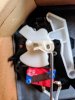
2. Here's the photo of the assembly. It's plastic.

IMG_20200606_194914.jpg

3. Playing with the azimuth was in response to my noticing the guide lever acting up. I didn't know this could be an issue until after I bought the table, put a new cart on, and installed the new drive belt. The problem could have been present with the old belt but not cause an issue. I could test this, as I still have the old belt.
 
Back
Top Bottom