• The move to the new server is done. There are some software and database maintenance updates in process. This has us passing the hat around to help out. We appreciate any donations. Seriously, even a dollar helps. The payment page may be found here - https://www.audiokarma.org/support.html

Thorens TD150, TD150 MkII or TD160?

OldPolishGuy

Active Member
In my quest to accumulate a system that I wanted back in the day, back then I was considering the Thorens TD150. Went to the audio store I usually shopped at and they were out of the Thorens. So I bought a Phillips GA212 instead. Nice table but after all these years I still like the Thorens. Currently I'm using a Technics SL23 that I requisitioned from my wife's old system. But, which one to buy, the 150, 150MkII or 160? Your input would be helpful. OPG.
 
Register to hide this ad
Depends how much work you want to put into it. I think that the 150 is the best if you plan on swapping out the original arm. The TP13 is an okay arm, but the bearings haven't aged well. The TD 160's TP16 generally doesn't have this issue. It is also much easier to switch out the armboard on the 150 than the 160, and I think the subchassis is a superior design on the 150 as well. As far as I know the differences between the TD150 and 150 II are not too significant - it's a slightly different tonearm design, and a different on/off switch. Plus I think you get cuing on the II, which is always nice. The ball ('Kugel') arm design is cool looking, but the vertical pivot bearings are soft and wear easily.

Another secret with Thorens decks is that the TD165 and 166 are great decks which tend to be undervalued because people prefer would prefer a 160. The differences between them are fairly insignificant in terms of performance, and I think the simplified tonearm on the 165 is superior for its simplicity over the TP16. IIRC the MSRP on the TD165 in the mid-70s was $180, compared to $215 for a TD160.
 
IIRC the 165 also had a different sub platter and potentially a different bearing? I can't remember, whether or not those were significant, I have no clue. Also, the 165 had an auto lift feature too.
 
Yup - though the 166 was semi auto I think, not the 165.

Full list of differences between the 160 and 165 includes:
-165 has the motor from the 150, with a plastic clutch less pulley more like the 150. Bit slower on startup than the 160.
- plastic sub platter vs zinc alloy on the 160. Not sure the difference here as both were rated at the same wow and flutter specs.
- later 166 models had a 7mm bearing vs the earlier 10mm on the 165, 160, and 150.
- 165 arm has a simpler counterweight, no spring to set tracking force, and string rather than a magnetic antiskate.
- 160s usually had a real wood veneer on the plinth, vs vinyl on the 165. Top plate is more durable as well.

I should add that this is true for the 70s models, and that I’m less familiar with the later iterations of the TD160 and 166. The functional or audible differences between the models are fairly insignificant - if you doubt me there is a VinylNirvana video with much the same conclusion offering a comparison of the two as well.
 
so far as I understand the various changes in the 160 models were really just about the arm and some minor cosmetic differences. The later TP-16 arm had a wand that took the place of most of the arm tube plus the headshell and it was lower mass as a result. None of that is a real concern if you plan to change the arm.

The 160 Super has some extra damping material on the sub-chassis in some spots and a few other small differences. They also didn't include an arm so no arm lift knob.
 
I could think of worse decisions to have to make :) You would be very happy with any of them, I'm sure. All I can offer is that I can vouch for the TD160 mk1 with original TP16 arm. If you can find one fully serviced and ready to go I don't think you will be disappointed. Bigger, heavier plinth than 150s. I've never had a one issue with mine. Outfitted with MC cart, it sounds excellent to my ears. Cuing is a nice to have.
 
Take some of the model info in this thread with a grain of salt...refer to Vinyl Engine and The Analog Dept for more factual info.

To the point of the OP, all three are excellent tables, but as someone pointed out, the arm on the 150 (MKI) has not aged well.

D
 
What is the current state of motor availability for any of these models? I needed a motor a while back for a TD-160 project and I lucked out in finding another poster here at AK who sold me one from an old TD model that he cannibalized. Barring that help I would have struggled to find a serviceable motor for less than $200+USD. That would be my only concern with vintage Thorens models at this point. I'm listening to a TD-145 right now, and parts have been no problem (in my experience) except for motors.
 
Using a tweaked Thorens TD-160 with Jelco TS-550S MKII tonearm. Sounds awesome! :music: Can't go wrong with a vintage Thorens!

thrns jlc.JPG
 
Yup - though the 166 was semi auto I think, not the 165.

Full list of differences between the 160 and 165 includes:
-165 has the motor from the 150, with a plastic clutch less pulley more like the 150. Bit slower on startup than the 160.
- plastic sub platter vs zinc alloy on the 160. Not sure the difference here as both were rated at the same wow and flutter specs.
- later 166 models had a 7mm bearing vs the earlier 10mm on the 165, 160, and 150.
- 165 arm has a simpler counterweight, no spring to set tracking force, and string rather than a magnetic antiskate.
- 160s usually had a real wood veneer on the plinth, vs vinyl on the 165. Top plate is more durable as well.

I should add that this is true for the 70s models, and that I’m less familiar with the later iterations of the TD160 and 166. The functional or audible differences between the models are fairly insignificant - if you doubt me there is a VinylNirvana video with much the same conclusion offering a comparison of the two as well.

We all wish, but if only it was that "simple" to tell all the TD14x & TD16x (not the TD150) models with their 'own' built in spcifications, things would prove to be too easy maybe. What seems at stake that could explain all the different versions variation of a same model to make it more complicated is the continous in line production of the most popular models through the decades.

Going through the changes from the alloy to the resin sub-platter, larger shaft bearing, captive ball to single point (1972)... That and maybe the stock quantity of 'old' componenents and the export models. The exceptions are so numerous to tell upfront what's in every TD14x & TD16x models. Even though these as you imply bring only small changes in the playback performance.

In my quest to accumulate a system that I wanted back in the day, back then I was considering the Thorens TD150. Went to the audio store I usually shopped at and they were out of the Thorens. So I bought a Phillips GA212 instead. Nice table but after all these years I still like the Thorens. Currently I'm using a Technics SL23 that I requisitioned from my wife's old system. But, which one to buy, the 150, 150MkII or 160? Your input would be helpful. OPG.

Well I still own my sole turntable ; a TD160 'E' (rare early eighties model) that has no better interest or commercial value to audiophile I believe. It came to m with a SME3009 tonearm. Once I ventured into it to tweak it I noticed all had seriously tweaked in. Went on a long journey on a tight budget to make it a dragster of a turntable.

What is most commonly seen by many as less appealing like the resin sub-platter, the single point bearing or the TD14x/16x single piece cast alloy sub-chassis in empirical comparison and after theorical analysis is not a necessary a disadvantage. In some situation on the contrary even. The TD150 looks better but for the rest only ifferent.

The Thorens tonearms effective mass for your carts and it being manual or with semi or full automatic functions options might prove more decisive in regard of your needs and or preferences. A weakness on all those Thorens are their base plate. Better without any or with a thicker one. Mind you that the TP62 (on TD145 MKII) wand/headshell is best to avoid.
 
What is the current state of motor availability for any of these models? I needed a motor a while back for a TD-160 project and I lucked out in finding another poster here at AK who sold me one from an old TD model that he cannibalized. Barring that help I would have struggled to find a serviceable motor for less than $200+USD. That would be my only concern with vintage Thorens models at this point. I'm listening to a TD-145 right now, and parts have been no problem (in my experience) except for motors.

unknown but is motor failure really an issue on these? There is the thrust bearing thing but that can be resolved without much trouble.
 
We all wish, but if only it was that "simple" to tell all the TD14x & TD16x (not the TD150) models with their 'own' built in spcifications, things would prove to be too easy maybe. What seems at stake that could explain all the different versions variation of a same model to make it more complicated is the continous in line production of the most popular models through the decades.

Yup, I did simplify some aspects of the post above. The bearing is usually 10mm on the 165, and the subplatter is usually plastic - though I suspect that ones with metal subplatters may have been swapped from 160s at some point in their lifetime.


unknown but is motor failure really an issue on these? There is the thrust bearing thing but that can be resolved without much trouble.

Motor failure is less of an issue than bent spindles from the platter banging against the exposed pulley. The motor protection rod added mid-production is one solution to this, but replacement motors are typically scarce and expensive. There is a method to replace bent axles, but it's a royal PITA.
 
bent motors makes sense. My 160 has the post.

not surprised they are scarce. So little in one of these tables to really break that they probably don't get parted out all that often.
 
Motor failure is less of an issue than bent spindles from the platter banging against the exposed pulley. The motor protection rod added mid-production is one solution to this, but replacement motors are typically scarce and expensive. There is a method to replace bent axles, but it's a royal PITA.

Yes, bent spindles is a pretty common issue, another is worn out bearings. Both make a clicking sound from the motor.

A bent spindle doesn't need to be a disaster. It can be adjusted into shape without replacement - I've done it on several motors. The trick is doing the adjustment by hand, using a dial indicator capable of measuring 1/1000 mm. After massaging the excentricity of the spindle below 0,05mm the error is less than that in the pulley. Of course, there always is a risk of the bearings being damaged too from the same impact that bent the spindle, or perhaps even damaging them oneself while fixing it. But normally it works.

And worn bearings can be fixed with a nylon/delrin contraption with an adjusting screw that lifts the entire spindle up some tenth of a mm. Can be found at that aution site, and is much better than tossing the clicking motor.

But apart from that, it is probably cheaper to buy a complete TD1xx and take its motor than to just buy one spare.
 
A bent spindle doesn't need to be a disaster. It can be adjusted into shape without replacement - I've done it on several motors. The trick is doing the adjustment by hand, using a dial indicator capable of measuring 1/1000 mm. After massaging the excentricity of the spindle below 0,05mm the error is less than that in the pulley. Of course, there always is a risk of the bearings being damaged too from the same impact that bent the spindle, or perhaps even damaging them oneself while fixing it. But normally it works.

Curious which model motor you are discussing. I am working on a 150 with a bent shaft which I could not for the life of me straighten in the face of the 'give' which the plastic bushings inside offer. I currently have the whole thing apart and am in the process of replacing the entire steel shaft, which, to be honest, appears to be easier than it sounds.
 
Curious which model motor you are discussing. I am working on a 150 with a bent shaft which I could not for the life of me straighten in the face of the 'give' which the plastic bushings inside offer. I currently have the whole thing apart and am in the process of replacing the entire steel shaft, which, to be honest, appears to be easier than it sounds.

I've done it on all the three vintage typ motors, the 150 without the clutch, 160 with it, and 126, which has a thicker spindle which makes the adjustment a bit more demanding. (The 320 generation seems all have the same thick spindle). All I do is to turn the spindle by hand from beneath with the indicator at top, mark out the largest error, and push with my thumbs (with the clutch removed, of course). The spindle doesn't budge easily, and it takes several attempts to get an adjustment of a tenth of a mm, but it can be done on all of these three motors. Push, measure, repeat until you get below the 0,05 mm error - better that is more or less futile since the pulley has worse tolerances anyhow.

On the other hand you got me curious on the replacement of the spindle. How do you do that, and where do you get your replacement parts?

But I must add I also have an old 150 motor around with a dent in the plastic bushings and damaged bearings that I haven't even tried to fix.
 
As to the OP's original question: each and every one of the vintage Thorenses would be an upgrade from what you have. The arms on the TD-150 models are much better than their reputation, with some caveats. The mk I doesn't have any antiskating, which I think is a problem. Both have sensitive vertical bearings, consisting of a thin "pin" into the ball retaining ring. That pin has been known to been damaged on some arms - broken or bent, which isn't what you want, and it is difficult to see before you have taken the bearings apart. But if they are intact, the arms are in fact pretty nice. The vertical bearings should be taken apart, thoroughly cleaned from old dust, and the bowl and the pin should ideally be polished. No oil. After that an adjustment of the bearings. Remove the rubber bushings at the screws where the arm is mounted at the board, and it all should be OK.

The arms on the later models normally don't need much of adjustment, although their vertical bearings always are slower to react than the td-150 ones. Watch out for broken anti skating mounts on the cheaper arms with the weight-on-nylon-string antiskating. They have a habit of breaking and going missing. And the auto-stop mechanisms on the td145 and such are finicky to get right, if there is some problem with them. Also, the mechanism for the auto-stop makes it impossible to adjust VTA by adjusting the height of the tonearm pillar as on the manual versions. The td150 arms can't be adjusted for VTA apart with extra spacers under the arm mount.

Personally, I don't care much for the later carbon fiber versions of the arms, preferring the higher mass vintage models which give much more options when choosing between cartridges. With the low mass arms you are limited to the few remaining high compliance carts, while the higher mass ones can manage more or less anything. I would avoid the highest compliance carts with those arms, though. Not because of the often misunderstood resonance frequencies, but because of the slow-to-react vertical bearings.
 
Last edited:
The td150 arms can't be adjusted for VTA apart with extra spacers under the arm mount
The pillar goes up and down the armboard mount hole with just the turn of a couple of collar set screws and if that's not enough to make spacers redundant, it sports the TP-50 headshell, which is actually the only Thorens headshell with adjustable VTA.
 
The pillar goes up and down the armboard mount hole with just the turn of a couple of collar set screws and if that's not enough, it sports the TP-50 headshell, which is actually the only Thorens headshell with adjustable VTA.

Sorry - my mistake. Of course you are right!
 
I've done it on all the three vintage typ motors, the 150 without the clutch, 160 with it, and 126, which has a thicker spindle which makes the adjustment a bit more demanding. (The 320 generation seems all have the same thick spindle). All I do is to turn the spindle by hand from beneath with the indicator at top, mark out the largest error, and push with my thumbs (with the clutch removed, of course). The spindle doesn't budge easily, and it takes several attempts to get an adjustment of a tenth of a mm, but it can be done on all of these three motors. Push, measure, repeat until you get below the 0,05 mm error - better that is more or less futile since the pulley has worse tolerances anyhow.

On the other hand you got me curious on the replacement of the spindle. How do you do that, and where do you get your replacement parts?

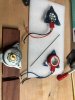
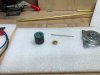
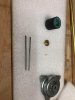
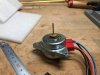
I am using 2mm r/c car axles to replace the spindle. I measure the Thorens one at 1.9mm with my vernier, which, granted is not immune from error, so I think they should fit when I have a chance to get to the hobby store. This one wound up snapping as I was trying (carefully!) to bend it back, so it must've taken a decent enough impact. Wonder if some heat might've helped there, but the plastic bushings might melt there too. I'll need to drill out the magnet a little, as there's a small indent in the magnet shaft to catch some notches in the motor shaft. Probably best not to do the shaft unless you really have to. I'll share here some photos gleaned from Facebook from another fellow replacing TD-160 motor shafts - though he didn't describe his process much either! I too have a spare one to fix from a TD-165 once I figure out this one.
 

Attachments

  • 1.jpg
    1.jpg
    109.3 KB · Views: 102
  • 2.jpg
    2.jpg
    97.8 KB · Views: 98
  • 3.jpg
    3.jpg
    118.7 KB · Views: 92
  • 4.jpg
    4.jpg
    71.3 KB · Views: 92
  • 5.jpg
    5.jpg
    92.1 KB · Views: 92
  • 6.jpg
    6.jpg
    96.5 KB · Views: 93
Last edited:
Back
Top Bottom