Hi, need some advice. Want to spend up to $850 or so on a MC cartridge. Debating between AT 33SA and Hana SL MKii. Would love some feedback!! Leaning toward 33SA because I already have the 33mono and like to swap headshells on my technics SL 1200 MK2. Can keep my phono preamp settings the same, which would make things easy. But I have never heard a Hana and know there are lots of fans out there.


You are using an out of date browser. It may not display this or other websites correctly.
You should upgrade or use an alternative browser.
You should upgrade or use an alternative browser.
Thoughts on Hana SL MKii and AT 33SA carts?
- Thread starter Neeyareh
- Start date
Register to hide this ad

tabarddn51
Super Member
Hi, Both carts having Shibata styli require meticulous SRA set up to get the best out of them. Which means you need variable height adjustment on the arm. Also the A/T would need a heavy H/Shell as has a lowish compliance, yes the PTGii would be better & easier to set up, but still needs height adjustment (unless you are very lucky)
Cheers
Cheers

vinylkid58
Super Member
All you would ever need for a stock SL-1200MK2the PTGii would be better & easier to set up
jeff

ghamilton
Super Member
Hi, need some advice. Want to spend up to $850 or so on a MC cartridge. Debating between AT 33SA and Hana SL MKii. Would love some feedback!! Leaning toward 33SA because I already have the 33mono and like to swap headshells on my technics SL 1200 MK2. Can keep my phono preamp settings the same, which would make things easy. But I have never heard a Hana and know there are lots of fans out there.
Attachments

For the 33Sa (so it's probably true for the 33PTG/II), I needed to add a weight to the 1200 MkII arm to get the resonance frequency into a reasonable range. My setup is 8Hz, with an OEM arm.Hi, need some advice. Want to spend up to $850 or so on a MC cartridge. Debating between AT 33SA and Hana SL MKii. Would love some feedback!! Leaning toward 33SA because I already have the 33mono and like to swap headshells on my technics SL 1200 MK2. Can keep my phono preamp settings the same, which would make things easy. But I have never heard a Hana and know there are lots of fans out there.

Off "Silk Purse." Capitol Records. ECS- 40101. Toshiba-EMI remaster, 1979.
Run-out: ST1 407 25 ... 〄 8 - 5
_________________________________
As a comparison, this is a Linda tune, played on my Sony with a Denon DL-103SA cartridge. The Nautilus pressing of Simple Dreams is one of the best I've found for all you Ronstadt fans.
 I have two subwoofers playing on these videos.
 Off Linda Ronstadt's "Simple Dreams." Nautilus Recordings. NR26. 1/2-speed remaster SuperDiscs. 1981.
Run-out: NR 26 A1 IAM RD 1/2 KM - 6432 - A1
Last edited:


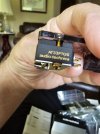
thanks all! I ended up getting the AT 33SA. Will be putting it on this headshell. Will I have any issues with compliance w/my technics 1200 MK2 arm?

Think I would need a weight if I use this standard headshell? I really don’t understand complianceFor the 33Sa (so it's probably true for the 33PTG/II), I needed to add a weight to the 1200 MkII arm to get the resonance frequency into a reasonable range. My setup is 8Hz, with an OEM arm.
This weight screws onto the back of the tonearm.
Long, Long Time.
Off "Silk Purse." Capitol Records. ECS- 40101. Toshiba-EMI remaster, 1979.
Run-out: ST1 407 25 ... 〄 8 - 5
_________________________________
As a comparison, this is a Linda tune, played on my Sony with a Denon DL-103SA cartridge. The Nautilus pressing of Simple Dreams is one of the best I've found for all you Ronstadt fans.
Blue Bayou.
Off Linda Ronstadt's "Simple Dreams." Nautilus Recordings. NR26. 1/2-speed remaster SuperDiscs. 1981.
Run-out: NR 26 A1 IAM RD 1/2 KM - 6432 - A1
I'm using the OEM headshell. The added weight is designed to bring the resonance frequency of the arm and cartridge into a suitable range. I use a Tacet Test record to measure the resonance. I like 8Hz for my system.Think I would need a weight if I use this standard headshell? I really don’t understand compliance

Notice the added weight to the end of the tonearm.

I use a bubble level to adjust the vertical and horizontal (azimuth) angles. Be sure to zero the arm to account for the weight of the level. Use a standard LP and the specified tracking force (2 grams for the 33Sa).
As shown on the headshell in the photo, the level is positioned parallel to the record surface.
Re-zero the arm after removing the bubble level. Reset the tracking force.
Good luck!


You can find smaller and lighter bubble levels on eBay or Amazon.

@Sleiven, many use the level headshell as the measure of choice to arrive at a proper azimuth setting which relies wholly on the manufacturer of the cartridge getting things exactly right as far as the mounting of the stylus is concerned. All too often, this is not the case, so your suggestion of using a different method to measure crosstalk is quite valid......this will require a couple of additional tools to accomplish, such as a test record like you refer to as well as something to measure the signal of each channel independently to then compare and make necessary adjustments in the azimuth until both are as near to identical as possible.Bobble level tell you nothing about what Azimuth is correct… just adjust the twist until the Ortofon or Ultimate Test record gives good electrical crosstalk in both channels.
I find that if you adjust the headshell to be centered with a bubble level — test records will track relatively well.@Sleiven, many use the level headshell as the measure of choice to arrive at a proper azimuth setting which relies wholly on the manufacturer of the cartridge getting things exactly right as far as the mounting of the stylus is concerned. All too often, this is not the case, so your suggestion of using a different method to measure crosstalk is quite valid......this will require a couple of additional tools to accomplish, such as a test record like you refer to as well as something to measure the signal of each channel independently to then compare and make necessary adjustments in the azimuth until both are as near to identical as possible.
Remember, the cantilever and tip are on a movable suspension. So there is room for a small amount of lateral and forward movement within the groove. It is not a completely fixed alignment.
Yes that is exactly what I do. The Ortofon test record is easy to get and good for this. A simple multimeter can be used to measure the RIAA or amp channels Outputs . But I can see the values directly on my Parks Audio Puffin RIAA, before I recorded to my PC a got the singnal value from that. See the Parks Audio YouTube video on this.this will require a couple of additional tools to accomplish, such as a test record like you refer to as well as something to measure the signal of each channel independently to then compare and make necessary adjustments in the azimuth until both are as near to identical as possible. Still have not got any cartridge that did knot need adjustment, very very small increments. See the Parks Audio YouTube video on this
So true @Mr Boochie, and our efforts are in effect a best possible compromise between all the moving parts as we try to get as close as we can. The idea of measuring crosstalk to arrive at the correct azimuth position, as @Sleiven suggests, is indeed an intriguing one though and amounts to getting each channel to reveal equal evidence of crosstalk at the lowest possible level at which azimuth might be thought of as properly set.It is not a completely fixed alignment.
I happened upon this quite unexpectedly when I received my Black Ice Audio F-159 phono stage and started playing around with the calibration of the onboard crosstalk limiting feature. After studying it a bit, I concluded that in effect this circuitry was doing precisely what one might arrive at by rotating the headshell one direction or the other. I decided that instead of using the circuitry to electronically establish "correct azimuth," that I would use the meters to do it manually with headshell rotation and in essence make use of it in the same way one would a Fozgometer. I called BIA and spoke with Jerred who suggested it would be a way, although not the intended one, to use this feature. So far so good......carry on, amigos
Only very small changes can change the crosstalk alot/too much, clamping the record or not change it too,see below
Different record gives different results, but Ortofon is OK, and Analog productions Ultimate test record is one of the best, I used the Toshiba test record (-36/.36) to set Azimuth below, and checked with 3 other records. I have many more ...Ortofon/Ultimate are close to the median, an probably good enough for represent most played records on average too.
The value you get in influenced by rumble and arm resonance and RIAA eq. so the best way is til use a 400hz highpass filter in recording software and look at the value after filtering. If you don't have recording software, REW is free , it can be used with a 30usd usb-soundcard, or just a RCA til 3.5mm from RIAA into PC mic input
Cartridge is AT OC9MLii

https://www.hifisentralen.no/forumet/attachments/1743336952518-png.1110298/
A simple way to allow azimuth adjustment with fixed headshell, 1/8 turn on each side is a suitable increment

Different record gives different results, but Ortofon is OK, and Analog productions Ultimate test record is one of the best, I used the Toshiba test record (-36/.36) to set Azimuth below, and checked with 3 other records. I have many more ...Ortofon/Ultimate are close to the median, an probably good enough for represent most played records on average too.
The value you get in influenced by rumble and arm resonance and RIAA eq. so the best way is til use a 400hz highpass filter in recording software and look at the value after filtering. If you don't have recording software, REW is free , it can be used with a 30usd usb-soundcard, or just a RCA til 3.5mm from RIAA into PC mic input
Cartridge is AT OC9MLii
https://www.hifisentralen.no/forumet/attachments/1743336952518-png.1110298/
A simple way to allow azimuth adjustment with fixed headshell, 1/8 turn on each side is a suitable increment
Last edited:
I find the inner groove tune can sometimes expose azimuth-related mistracking issues. "Esses" and cymbals. Not clean separation between channels. Imagining issues. Not clean vocals.I decided that instead of using the circuitry to electronically establish "correct azimuth," that I would use the meters to do it manually with headshell rotation and in essence make use of it in the same way one would a Fozgometer. I called BIA and spoke with Jerred who suggested it would be a way, although not the intended one, to use this feature. So far so good......carry on, amigos
Main Ingredient - "Euphrates River." RCA Victor Records. APL1-0335. Dynaflex. Unipak. Indianapolis pressing. 1974.
Run-out: APL1 0335 A 2 I