• The move to the new server is done. There are some software and database maintenance updates in process. This has us passing the hat around to help out. We appreciate any donations. Seriously, even a dollar helps. The payment page may be found here - https://www.audiokarma.org/support.html

Thread buffer rcm i the works.

You do have a truly inspirational build. This is one I am going to keep on the back burner for when I have more time. I wonder how much better a job this does than say a conventional RCM?

I had a conventional rcm in the shape of a moth rcm, very like a vpi 16.5.

I also used a keith monks machine at one point.

To my ears they sound the same :D

What i do like with this style is they collect fluid, the other types seem to evaporate it, thus some may be left behind on the lp.

I was planning to quantify my results with a before and after, record into a pc and see if noise floor changed, maybe find a way to count pops.

Perhaps someone with a vpi or similar can join in.

edd
 
I wonder how much better a job this does than say a conventional RCM?

I don't currently own an RCM, but I've been doing a lot of reading about the different types. It is my understanding that one problem with most conventional machines with a suction "pipe" that touches the record surface with cleaning pads, is they can build up a lot of static. Especially if you have to do more than two rotations to completely dry the record. So after cleaning with one of these machines it is advised to use an anti-static device like a Milty Zerostat, or else the record may quickly attract more dust.

Again, I don't own a machine, so my opinion's not worth much, but there's supposed to be very little static build-up with these these thread buffer machines.

Andrew
 
while the machine doesnt seem to build up static, i still suffer from it, thus i doubt its a cure.

edd
 
Hi Edd,

Do you know what the diameter is for the thread you're using? I looked on the McMaster-Carr site and they list three sizes.

I've been trying to find nylon thread here in Toronto and I'm not having any luck. The only thing I've seen is called "Invisible Thread" and it is very, very thin, and translucent like fishing line. I've asked a couple sewing and fabric stores if they've heard of the No. 30 thread that the Loricraft machine uses, but no one knows what that number means.

Thanks,

Andrew
 
the no 30 celbrated talbot thread is fishing related. orvis listed a thread with a similar size reference.

I just used the thickest size from mcmaster.

edd
 
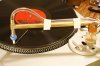
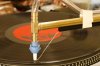
I thought I'd post a couple pics of a machine I put together tonight. I did a quick test and it seems to work pretty good, but I will need to spend a bit more time tweaking things and making it look pretty. I have to move the arm manually, but I don't think that's going to be a problem for the small volume of records I'll probably be cleaning.

I had some good luck putting this together, because the old turntable was donated to me by a local freecycler , and I found the nice brass pipe for the arm sticking out a garbage can when I was walking my dog yesterday morning. It didn't look like that when I found it, but it cleaned up nicely. I found some thread today at a craft shop, but it is still a bit thinner than the one Loricraft recommends.

Cheers,

Andrew
 

Attachments

  • _MG_8189.jpg
    _MG_8189.jpg
    51.2 KB · Views: 201
  • _MG_8188.jpg
    _MG_8188.jpg
    62.3 KB · Views: 188
I have quite a few stepper motors from old hard drives and printers, I wonder if one of them could be rigged using a 555 timer to generate the step rate. It would not necessarily place the arm, that is still manual but would be better than trying to sweep the arm by hand.

BTW they probably use teflon for the same reason they coat frypans with it - slippery.
 
excellent, what are you using as a vacuum source?

For now I'm just using my canister vacuum with the tube stuffed and taped into the crevice tool. I don't know much about vacuum pumps, or where I would even go to buy one in Toronto, but I'm definitely to going to start thinking about it.

As for the tips, it probably doesn't matter much, but the Loricraft site actually says "the nylon nozzle tip of the vacuum arm does not touch the record". Teflon is probably still a better choice, especially if you're pushing the arm manually and can't properly set the "tracking force" like Loricraft suggests. I did a test with the tip that I found at the medical supply store and the teflon desoldering tip that is in the pictures above. I rubbed both firmly across a junk record, and the teflon tip barely left a mark. I don't know what the other tip is made of, but it left white marks on the record that I think you can see in one of the pics. However, it took a lot of force to do that.

Cheers,

Andrew
 
I'm still tweaking my rcm and have been searching for a vacuum pump. I haven't been able to find any local sources here in Toronto, so I may have to turn to ebay or a US dealer. I found a "MEDICAL HOSPITAL Aspirator Suction Machine Vacuum Pump" linked below on ebay today, but I'm not sure if it would work. It says it has a "Controlled Vacuum from 23inHG".

http://cgi.ebay.ca/MEDICAL-HOSPITAL...66:2|39:1|72:1215|240:1318|301:0|293:1|294:50

I also found the pdf below and it says the Keith Monks machines are set to work at 20in Hg, so it sounds like the ebay pump might work.

www.keithmonks-rcm.co.uk/Keith Monks RCM Omni VII.pdf

Any suggestions would be appreciated,

Andrew
 
The only other thing to consider is flow rate, as i found 0.5cfm not high enuff, and 3.5cfm plenty.

I cant tell from the auction what the flow rate is.

edd
 
The pump I to linked above does not include specs for the flow rate, but I found another one for a few dollars more that has a flow rate of 40 litres per minute, which should be about 1.4 CFM:

http://cgi.ebay.ca/Medline-Vac-Assi...66:2|39:1|72:1215|240:1318|301:1|293:1|294:50

I searched online for other medical aspirators and a flow rate of 40lpm with a vacuum range of 0-23" Hg seems typical. So I think these might be good pumps for an rcm. Here's a used one for $75 that looks good, but is missing a couple parts.

http://cgi.ebay.ca/Invacare-Mobilai...0?hash=item5acfa5f36f&_trksid=p3286.m20.l1116

Cheers,

Andrew
 
No problem. Its hard to be presice on what flow you need as lots of things will factor in.

In my case 0.5 wasnt enougth and 3.5 was. There is a 3.5cfm pump from veneer supplies like mine for $119 or so.

Im not sure rotary vane will work, the issue with them is the flow drops severely under vacuum, so while they may hold 25"hg, they do it at very little flow. Also id want an oiless pump.

The rotary vane i experimented with had a 25"hg or so vacuum and 6cfm, it spewed oil everywhere and was less effective than the 3.5cfm piston pump.

edd
 
Thanks again for the advice, and I think you saved me from wasting a couple hundred bucks. I guess you're right about the variables of different machines, because I was reading here that the base model Loricraft actually has a pretty low flow rate of 16.5 litres per minute or about 0.5 CFM. The more expensive models are 28 lpm or about 1 CFM.

Cheers,

Andrew
 
There is a 3.5cfm pump from veneer supplies like mine for $119 or so.

I found a Thomas pump at a surplus store today for $149CAD that looks exactly like the one on veneer supplies. I didn't buy it, but wrote down the model number to try and find more info first. Unfortunately, the number 2643CE41-233A doesn't come up in any searches.

I also noticed the pump on veneersupplies.com comes with a capacitor that needs to be connected. The one I saw doesn't come with this, so I was wondering if your pump uses a capacitor and whether it's absolutely necessary?

Thanks again for any info.

Cheers,

Andrew
 
yes mine has a capaitor, most single phase motors will have one, id assume it was necassary.

You often wont find the number as they are usualy OEM pumps supplied specificaly for a purpose or to go in a specific machine.

edd
 
Well, my search for a vacuum pump continues and I'm honestly starting to get pretty frustrated. I found a used medical aspirator for sale locally that sounded perfect based on the specs. It's an Invacare piston pump rated at 1.4 cfm and 20" Hg. However, when I saw it working it just didn't seem to create enough suction, and I didn't want to take a chance and waste a couple hundred bucks if it didn't work.

I wonder if it matters where you measure the vacuum? If it's 20" Hg at the pump head, do you think it would be much lower at the end of the suction tip once it runs through the tubes, jars, etc?

I'm starting to think about ordering a pump from the states, but I'm worried about excessive shipping, duties or brokerage fees.

Cheers,

Andrew
 
i dont think the vacuum pressure is as important as flow, the keith monks is 18" hg at the nozzle i think. i have no way of measureing mine.

1.4 would probably be fine as a guess, thats the problem with diy! :D

edd
 
Hey Edd,

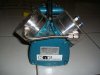
I'm still plugging away at my RCM and finally found a decent pump a few weeks ago (see pics below). It's about 1.5cfm and seems to do a very good job drying the record. It's pretty quiet even out in the open, and I can still listen to music while it's running. I hope to eventually put it inside a cabinet on some rubber mounts, so it should be very quiet then.

Now the big challenge is figuring out how to motorize the arm at the correct speed. I'm not too familiar with servos, but I've been playing around with some small DC motors I salvaged from a junk CD changer. I think they might work with some kind of speed controller.

How did you set the speed on your servo? Do you have to program it, or it is set by the gear ratio? Can you still move the arm freely if you want to pick it up and move it manually?

Cheers,

Andrew
 

Attachments

  • CIMG3060.JPG
    CIMG3060.JPG
    28.1 KB · Views: 107
  • CIMG3061.JPG
    CIMG3061.JPG
    29.3 KB · Views: 88
Back
Top Bottom