I wasn’t too sure about the current demand with lower impedance till you coached me on it .
With a high impedance, the current demand should me lower . If my units delivers 150 wpc @ 8 ohms , it should deliver 75 wpc @ 16 ohms right ?
But this is at max volume , I don’t plan to run at max volume because as I understand, at some point you begin to clip prior to max volume .
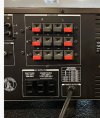
At what point percentage of volume knob or wattage should I stay clear from if I’m going at 16 ohm load , Speaker A Left and Right channel only across the Advents stacked ?
Thanks
Bernard
Yes, at least theoretically.
An amplifier's power rating is not at max volume. Rather, it is the maximum continuous power the amp can deliver into a resistive load (vs a speaker) at the specified frequency (or frequency range) and the specified distortion level, without clipping. An amp can deliver more than its rated power, albeit at a higher level of distortion.
Note that what it can deliver into a speaker may vary significantly, depending upon the speaker's impedance curve and phase angle.
In any case, running an amp at it's maximum output would, by definition, result in a heavily clipped signal. I'll explain why below. Clipping, especially when more severe, can result in more power being delivered to the tweeters and mids than would normally be the case, which in turn can damage them if the power being delivered exceeds their capabilities. Clipping can also drive an amplifier into oscillation, which can damage the amp and speakers. And perhaps most important, clipping sounds bad (unless using a tube amp, as clipping is apparently pleasing in that case ),

The reason an amp running at max output will inherently be clipping is due to the nature of a music signal (as opposed to a sine wave). Music contains momentary (aka transient) peaks. These variations in loudness require brief surges of power (voltage) if they are to be fully amplified...otherwise, the signal is clipped. But if the amp is already running at its maximum output, there is no power in reserve available to amplify these peaks. Note that just a 3dB change in loudness requires a
doubling of power. A 6dB peak requires 4x the power, a 9dB peak requires 8x the power, and so on. BTW, 3dB is generally defined as the smallest change in loudness as to be distinctly noticeable by a person with normal hearing.
Note also that a good recording may have peaks that are 12-15dB louder (or even more) than the averaged/continuous signal level. So, if your amp is running at 2 watts on a continuous basis, it would need 64 watts "in reserve" (unused) to fully amplify a 15dB peak.
The power required to achieve a given loudness is determined by:
- The sensitivity of the speakers. The higher their sensitivity rating, the less power they need to achieve a given loudness. For example, to achieve the same loudness, a speaker with a sensitivity rating of 86dB would need 8x the power of a speaker rated at 94dB.
- Distance from the speakers. In free air, loudness drops by 6dB for each doubling of distance from the speaker. In a normal home environment, the drop is more likely around 4dB, or a bit less.
- Your tolerance for clipping.
Sensitivity is generally rated as the loudness the speaker will produce with a specified level of power or voltage Ideally, it is specified using voltage, as this will negate the sensitivity advantage a 4 ohm speaker would
appear to have vs speakers with higher impedance ratings. The standard voltage for specifying speaker sensitivity is 2.83V. This voltage into an 8 ohm load = 1 watt. The same voltage into a 4 ohm load = 2 watts.
Here are a couple of links pertaining to speaker sensitivity that you might find interesting and/or useful:
The focus of this article is on loudspeaker sensitivity and impedance. Loudspeaker manufacturers sometimes exaggerate the specifications of their products to make them look better than reality.

www.audioholics.com
The focus of this article is on loudspeaker sensitivity and impedance. Loudspeaker manufacturers sometimes exaggerate the specifications of their products to make them look better than reality.
www.audioholics.com
You control power output with volume knob. More correctly, you control voltage. Current, and therefore power (voltage x current) is determined by the speaker and varies with impedance, which in turn varies (quite dramatically in some cases) with frequency of the signal. And of course it also goes up as voltage goes up (see Ohm's Law!),
The specific power level at a given point on the volume dial varies from amplifier to amplifier for several reasons, including:
- The gain structure between various inputs and the output section of the power amp.
- The "taper" of the volume control
- The level of the signal at any given point in time
- Variations in speaker sensitivity (a highly sensitive will become "overloaded" before a less sensitive speaker).
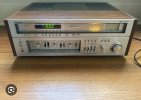
Simply put, there is no good way to advise you as to the loudest "safe" position of the volume knob on your amp. I believe that your Toshiba has power meters. They are fun, but unfortunately don't provide a very accurate indication of power output...especially as regards transient peaks and valleys.
In my opinion, by far the best way to assure that you are not over-powering your speakers or asking too much from your amp is to pay attention to how they sound as you increase the volume. If they start sounding distorted, raspy, or harsh, turn them down. If you hear any unusual sounds, turn them down. If they sound strained, turn them down.
While not of much practical use because of the difficulty in knowing what your continuous (aka RMS) output) is at a given position of the volume knob, you can easily calculate the power you need to keep "in reserve" to accommodate peaks of a given level. For example, if you want to assure the ability to handle 15dB peaks with no clipping, you would divide the amp's rated power by 32 (2 to the 5th power). So, if your amp is rated at 150 watts, you would not want to exceed 4.69 watts of continuous output. If 12dB of reserve (aka headroom) is your goal, it would be 150 divided by 16....or a bit more than 9 watts.
Hint: Remember that each 3dB requires a doubling of power. A 15dB peak = five doublings...or 2
^5. And keep in mind that you should use the amp's rated power at the specified impedance of your speakers when doing these calculations. The math is fun, and can be insightful, but your ears are the best way to know when you are getting close to the limits of your speakers and/or your amp.
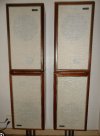
EDIT: A final thought that may be helpful; unless your speakers are of very low sensitivity, and/or your listening distance is beyond that of a normal home situation, and/or the speakers are exceptionally difficult to drive (low impedance, highly reactive), it us unlikely that you will ever push your Toshiba amp beyond its capabilities. It has the power and it has the ability to meet the current demands of most speakers in most listening situations. Your ears will be bleeding before your run out of power with all but the least sensitive speakers. I don't know the power-handling abilities of the Advents....but your ears will tell you if they are becoming over-driven and distorted.