• The move to the new server is done. There are some software and database maintenance updates in process. This has us passing the hat around to help out. We appreciate any donations. Seriously, even a dollar helps. The payment page may be found here - https://www.audiokarma.org/support.html

Toslink and receivers ?

The Yamaha CX-1000 and the Sony TAE-77ESD were sold in the US in decent numbers. I know there were A-91Ds sold in small numbers in the US.

Those models were just ones that came to mind or are floating around in my loungeroom. There were plenty, trust me. The Japanese economy was going gangbusters and R&D budgets were massive. Then it all crashed and by 1991 all this stuff was being dumped on the world markets cheaply (in real terms).

I'm not sure who built your Fisher (Sanyo) unit, but it's likely it was an OEM, based on the internals of other pieces in the series I have seen. If you pull the covers and take some closeups of boards and components, we can date it more accurately and possibly determine who actually made it.

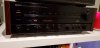
The Sony TAE-77ESD preamp (Japan) and The Yamaha CX-1000 preamp(Japan) are both starting at $700 on eBay now. The Pioneer A91-D,which looks very similar to the fisher RS-Z1,is starting at $1000 on eBay with 5 people watching.They must have be pretty impressive pieces?
 
Last edited:
The Yamaha CX-1000 and the Sony TAE-77ESD were sold in the US in decent numbers. I know there were A-91Ds sold in small numbers in the US.

Those models were just ones that came to mind or are floating around in my loungeroom. There were plenty, trust me. The Japanese economy was going gangbusters and R&D budgets were massive. Then it all crashed and by 1991 all this stuff was being dumped on the world markets cheaply (in real terms).

I'm not sure who built your Fisher (Sanyo) unit, but it's likely it was an OEM, based on the internals of other pieces in the series I have seen. If you pull the covers and take some closeups of boards and components, we can date it more accurately and possibly determine who actually made it.
I haven’t and probably won’t pull the cover for fear of messing something up.
I’m pretty sure it was manufactured by Sanyo( made in Japan)in 1989.
 
Go research the top models from just about every major Japanese manufacturer. Putting D/A converters in amplifiers and calling them Digital Amplifiers was all the rage.

I have a pile of them myself:

Pioneer A-91D (1988)
Akai AM-M939 (1987)
Sony TAF-303ESD (1988)
Sony TAE-77ESD (1988)
Yamaha CX-1000 (1987)
Denon's DAP-2500 and 5500 preamplifiers (1988)

1987 and 1988 qualify as "around 1989" in my estimation. Just sayin...
 
1987 and 1988 qualify as "around 1989" in my estimation. Just sayin...

True, but the OP was being very specific on years of production. At the time, one or two years was significant, by late 1990 the whole show was over in Japan in relation to these types of products.
 
I wouldn’t classify a Fisher RS-Z1 as a “ cheap receiver”

Cheap SPDIF receiver. The single optoelectronic component that you plug the TOSlink cable into, that converts light pulses into electrical pulses.

You need an SPDIF optoelectronic transmitter component at one end, and an SPDIF optoelectronic receiver component at the other end. The quality (speed, noise) of these will affect the jitter.

Given the context of an SPDIF communications channel, I assumed it was obvious that transmitter and receiver referred to the SPDIF components, not the entire piece of equipment that uses the SPDIF communications channel. I obviously assumed too much...
 
It's unfortunate the Toslink spec specified such high jitter.

Fortunately, the engineers in the1980s were well aware of timing issues with optical transmission and designed simple circuits to render the issue (mostly) moot.

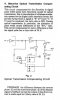
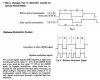
Here is the A-91D's implementation and circuit description:

jitter canceller.JPG

jitter canceller2.JPG

A-91D.JPG

I've never seen a D/A or D/A equipped amplifier without similar circuitry. Some companies went to extreme lengths with twin PLLs.

Consider that coaxial inputs also go through signal conditioning/clean-up too, before sent to the data demodulator.
 
Fortunately, the engineers in the1980s were well aware of timing issues with optical transmission and designed simple circuits to render the issue (mostly) moot.
That's a relative statement. I avoid sources that begin with 4 ns.

The Allo DigiOne used in my RPi garage implementation measures under a picosecond or three orders of magnitude less.
 
Last edited:
Cheap SPDIF receiver. The single optoelectronic component that you plug the TOSlink cable into, that converts light pulses into electrical pulses.

What is meant by the term,”fast edges”? I’m somewhat ignorant to some audiophile jargon.

You need an SPDIF optoelectronic transmitter component at one end, and an SPDIF optoelectronic receiver component at the other end. The quality (speed, noise) of these will affect the jitter.

Given the context of an SPDIF communications channel, I assumed it was obvious that transmitter and receiver referred to the SPDIF components, not the entire piece of equipment that uses the SPDIF communications channel. I obviously assumed too much...
 
What is meant by the term, "fast edges"?
Digital signals are represented as a stream of electrical pulses. When the receipt of pulses is timing-dependent, as it is in some audio protocols, the pulses need to transition from 0 volts to a voltage representing an "on" state -- or from a voltage representing an "on" state to 0 volts or "off" state -- rapidly and smoothly. This allows the identification of "on" or "off" state to be precisely timed. If the transition is sloppy -- i.e., slowly or noisily goes from "on" to "off" or vice versa; in other words, doesn't have a "fast edge" -- then the timing will be imprecise.
 
Fortunately, the engineers in the1980s were well aware of timing issues with optical transmission and designed simple circuits to render the issue (mostly) moot.

Those circuits appear to be intended to correct DC offsets in the optical receiver, and are to do with maintaining the correct duty cycle of the biphase coding, probably to ease data recovery when using an edge detector/MMV/DFF decoder. I don't think they will address the jitter, and, in fact, may introduce further timing jitter themselves.

Timing jitter is caused by a slow signal rise time and noise, either on the signal, or at the input thresholding device#. To minimise jitter, we need a fast edge signal, a fast receiver component, and low noise on signal and receiver.

Once edge jitter is introduced, it can only be removed by clock regeneration and signal reclocking. By measuring the jitter performance of modern DACs, you can see which DACs have clock regeneration and reclocking, and which don't.

# in fact, when developing a universal counter timer in the mid 1980s, we used an ultra-clean triangle wave generator to measure the input noise, using the variation (jitter) in the measured period, caused by the input noise changing the threshold voltage. Knowing the input slew rate and the rms jitter, you can calculate the rms noise of the input stage.
 
TBH reading the article with all the possible limitations of Toslink vs. SPDIF makes me wonder why it was utilized. It apparently required a lot of refinement before it was comparable to SPDIF and finally requires ; in actual application the practical limit was often under 5 meters, constructed from very high purity quartz, a highly polished and properly fitted termination, degradation of performance due to even mild bending of the interconnect assembly!

All these and other issues mentioned in the article make me want to throw out the inexpensive optical cables and replace them if practible with SPDIF which can be as simple as using any quality audio cable.
Toslink is optical S/PDIF. Coaxial is IEC 958, also S/PDIF. Both are consumer carriers, which deliver copy protect data.
 
20181008_184751.jpg
I searched the web hi and lo for an answer of when fiber optical Toslink was first introduced into home receivers. I understand Toshiba invented it to pair their CD players to their receivers, but I never found any toshiba receiver with Toslink. Any clue what year and what amp or receiver first utilized Toslink optical inputs?

My Denon PMA-1520 integrated amp has an Toslink connection and built in DAC. I bought it and a Denon 1520 CD player new in summer of 1988. I used to connect them together with the Toslink. I still have both and they are both still going strong.
 
Once edge jitter is introduced, it can only be removed by clock regeneration and signal reclocking. By measuring the jitter performance of modern DACs, you can see which DACs have clock regeneration and reclocking, and which don't.

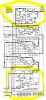
Here's one from 1989. A TOTL $6000 Marantz CD-12/DA-12LE implementation using twin PLLs and memory in the standalone D/A converter.

jitter killer.JPG
 
Here's one from 1989. A TOTL $6000 Marantz CD-12/DA-12LE implementation using twin PLLs and memory in the standalone D/A converter.

Two PLLs: one with a wide loop bandwidth (fast), to track the incoming data, for sampling off the input. The second with a narrow loop bandwidth (slow), to provide a low jitter resampling clock. With a small (16 bit) FIFO buffer. Or it may just be a 16-bit SIPO (not sure if the SAA7220 had a serial or parallel input).
 
Back
Top Bottom