• The move to the new server is done. There are some software and database maintenance updates in process. This has us passing the hat around to help out. We appreciate any donations. Seriously, even a dollar helps. The payment page may be found here - https://www.audiokarma.org/support.html

transmission line stuffing question

ok so I guess that gets back to a question of what to line it with. Could I use something like foam carpet padding for this?
 
What did they use in the original? Foam mattress pad from Walmart works, and comes in different
thicknesses. I've used fiberglass in the past but some people worry about breathing fibers.
 
Not a clue, i don't have the original. Could have been shredded cancer with lead sprinkles and PCB adhesive for all i know.
 
What did they use in the original? Foam mattress pad from Walmart works, and comes in different
thicknesses. I've used fiberglass in the past but some people worry about breathing fibers.
Felt would probably be good enough to knock the high end reflections down.
 
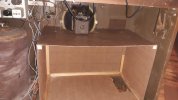
This is where i am so far. Box basically fits, and the template is made for the "ears" that will couple to the speaker. Dont mind the bad alignment, its just taped together. If i get the two bottom bits flat to the top of the box it lines up fine.

I have some 3/16 felt weather strip to use for gasket material around the speaker. Baffles are cut, will mount them after i make the ears.

Trying to avoid spending a lot of money or ending up with a bunch of surplus material that i wont use, so lining or damping materials still tbd. Will worry about that once the final construction is done.
 

Attachments

  • 20241130_162248.jpg
    20241130_162248.jpg
    78.7 KB · Views: 11
  • 20241130_170235.jpg
    20241130_170235.jpg
    89.6 KB · Views: 12
  • 20241130_170244.jpg
    20241130_170244.jpg
    74 KB · Views: 11
IMF uses foam in modern TLs so that's a safe bet. I'd give it a 1-2" wherever the original design had it.
I would not use felt, it is just not commonly used.

I see in the OP that you say you have wool, use it if you don't want to buy anything else.

See the first page and the picture "With Back Removed", seems like one wall is lined in each section,
I'd try that because your driver is similar to what they used and you can be sure that they tried many
different configurations. On the other hand, with more modern woofers I usually line the walls.

19:24 shows the internal damping, not much of it:
 
Last edited:
This is the original Stromberg Carlson driver, so it ought to be more than just similar.

I'm fine with using the wool. I bought it for a project quite some time ago and used what I needed from the roll. Still have a pretty good amount left and its just been sitting since then. If I can make use of stuff I already own and thin down my stockpile of leftovers its a win.

need to get some metal screen to put over the port in the cabinet and some thin cloth for the exit to serve as a bug and potential mouse filter.
 
Like many things in audio, there are a lot of approaches, and which material is best ultimately boils down to how you think it sounds best in your situation.

I've only completed one transmission line design - 8' tapered line with a rear opening at the bottom. I lined the walls with foam, then stuffed the line with a combination of wool and acousti-stuff. It required a lot of experimentation with stuffing density, and location within the line to get it "right".

Rock wool is one material that seems to have a following that I haven't tried yet. Good luck!
 
My impression is that the acoustical labyrinth is, at least in theory, completely different from a transmission line. The acoustical labyrith is trying to augement the low end and get rid of higher frequencies, the idea being that the length, convoluted path, and padding should remove all but the lowest frequencies by the time the soundwave gets to the outer world, but the line still constructively resonates, that low frequency augmentation being the point. With the classical TL, the length and convoluted path are important but it is the heavy fill that is supposed to absorb all the energy of all the frequencies, so there is no resonance (and the line is 1/4 wave so it will cancel them). I hope I have remembered 1/4 and 1/2 wave resonances correctly.
Reality, of course, is different from theory, and reality in the market place is yet another thing, so few, if any, commercial TLS actually cancel out all the low bas frequencies - to many consumers, it would look and sound like a gigantic and astonishingly expensive minimonitor - squeaky clean resonance free bass is not all that popular. So many TLs are encroaching on acoustical labyrinth territory.

My only practical suggestion is that I noticed in the rain soaked Stromberg Carlson I took apart that the upper end of the line had a whole bunch of holes in panel that separated the front of the line from the next fold - I assume this was some sort of pressure relief thing which would have the effect of smoothing out resonances. MIght be worth trying in case the line resonance is too pronounced.

 
The goal of absorbing all of the rear wave was promoted by Bailey in his very poorly written
article for Speaker Builder. In most TL s with the far end open the L/4 frequency is analogous
to Fb in a vented system where the port provides the output and the cone motion is at a
minimum. If the line is heavily damped then this happens to a lesser degree and one is
wasting box volume IMO.
That is fascinating that you found holes in the divider, it has been talked about more recently
on DiyAudio as a way to reduce response irregularities but without a reference to Stromberg.
 
Last edited:
Rock wool is one material that seems to have a following that I haven't tried yet.
The US2031500 patent specifically mentions rock wool lining all the surfaces of the air passages:

"Substantially all of the inner surfaces of this conduit are lined with a sound absorbing material such as rock wool or other material of like characteristics."

That's written in 1934 and, of course, something else could have been used later during production.
 
I have a dim memory of fiberglass, but it might have been rock wool - it was a couple of decades ago that I saw it.
 
I would have guessed cellulose but all kind of similar.

Was this one of their radios or one of their speakers? I believe they used this method on the 50s speakers as well.
 
I can't remember - it had a 12 inch driver but it might have been part of a console rather than an independent speaker.
 
Sounds maybe a little newer than this one. Mine is a 10" field coil speaker in a 1940 console radio.
 
Yeah - I thought that it was likely a late 50s product, based on how it was styled. Though that may have also been because I associate the acoustical labyrinth with the early days of Audio Magazine, when (if memory serves) Roy Allison was experimenting with acoustical pipes. They weren't folded like the Stromberg Carlsons, instead having the driver 1/3 of the way down the pipe. And they weren't tapered either, one of the other design types that interest me. I assume they were straightforward experiments in acoustical theory - an ounce of practice is worth a pound of theory and so on.
I found a field coil speaker once long ago, but I didn't then know that they may have desireable characteristics compared to magnetic drivers, or that there were people who want them, so I think I left it where I found it. Boo Boo.
 
I don't really know about the whole field coil magic thing. They were a massive improvement over the older permanent mag speakers from the 20s. Weaker magnets back then, the field coils allowed a lot more power. Magnet material got better and the fields went away again. I have several but all in antique atuff that ran them originally.


I have to wonder how much is nostalgia for an imaginary past. Its junk until its no longer available, then it becomes rare and desirable and superior to anything available.
 
Has anyone started manufacturing any modern speakers using field coil designs? Since some really old tech can become the latest cool thing.
 
John Wolf owner of Classic Audio speakers. Formerly Classic Audio reproductions.
Uses mostly JBL horn drivers , and certain JBL Woofers and converts them to field coil.
Maybe other brands, Tad? :dunno:
Also know for making Hartsfield enclosures or Reproductions, and many of his own design;
Good stuff for sure, Not Cheap. Very high output and efficiency:rockon:
bobhorn
 
Back
Top Bottom