• The move to the new server is done. There are some software and database maintenance updates in process. This has us passing the hat around to help out. We appreciate any donations. Seriously, even a dollar helps. The payment page may be found here - https://www.audiokarma.org/support.html

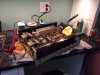
Trash picked HK430, only 1 channel

cwh

33
Hey all, since I'm not making progress on my Sansui 2000 why not start another project....

Your kind support is helping me learn the fun art of audio/electronics repair!

I've got an HK 430 with no right channel. My clueless trouble shooting has revealed Q417,419 with +22v on the mounting screws. Each has one pin that reads .+5v. Same pins on left channel Q418,420 show -21v and 0v on screws.

Am I on the right track? I'll take any trouble shooting 101 anyone wants to offer. Be it specific or just general sage advice. I'm hungry to learn and I've got a whole lot of vintage receivers, turntables, and speakers to repair. And the list keeps growing! :)

Carl


IMG_1621.JPG
 
Register to hide this ad
Yeah, output transistors. I will pull and test. Any thoughts to help me trouble shoot why they're shorted? Obviously a component before them has misbehaved, thus they go out as a pair.

Thanks Carl
 
It's likely the previous owner blew them up by futzing with the speaker wiring when the amp was on, blowing the outputs. Check components upstream of the outputs too.
 
I pulled the the two right channel 2SC1030 transistors that while in circuit were showing +22v on the their collectors.

Following Echowar's transistor testing thread, out of circuit testing indicates the transistors to be good. .50v across base and emitter on both.

Any further diagnosing guidance for me as I go upstream?

Carl
 
Can't offer much beyond encouragement. I have a 430 and it's well worth getting running again. Use it in my bedroom with a pair of Epicure Model 5 speakers. Such great sound out a simple set up.
 
The basics I know:

  1. Have you touched/slightly-moved each component in the main amp and pre amp circuit with a long, non-conductive tool )like a wooden chopstick) during operation to see if you get any sudden change from moving one component?
  2. Are there any resistors or diode with even the slightest discoloration in their midsection?
  3. Are there any darker-than-else where spots on the underside of the PCBs (transistor or resistor that got too hot)?
  4. Is your power supply delivering all the various voltages it is supposed to?
  5. Do you have a circuit tracer (audio generator with probe, small signal amp and speaker? If so, can you follow the signal as it comes into the 430 and trace both channels through the circuit until the right one fails to continue?
 
Good trouble shooting steps, thank you for putting those out there.

The basics I know:

  1. Have you touched/slightly-moved each component in the main amp and pre amp circuit with a long, non-conductive tool )like a wooden chopstick) during operation to see if you get any sudden change from moving one component?
  2. Are there any resistors or diode with even the slightest discoloration in their midsection?
  3. Are there any darker-than-else where spots on the underside of the PCBs (transistor or resistor that got too hot)?
  4. Is your power supply delivering all the various voltages it is supposed to?
  5. Do you have a circuit tracer (audio generator with probe, small signal amp and speaker? If so, can you follow the signal as it comes into the 430 and trace both channels through the circuit until the right one fails to continue?

From my studying of AK I've picked up the visual inspection routine of checking fuses, looking for dark spots and cracked solder on pcb. Midsection diode discoloration is new to me, note made.

VOLTAGE TESTING: Beyond a little bias current adjusting this was my first foray into supply voltage testing. This is where I got stuck and confused! Lack of schematic reading skill, lack of electronic component understanding, and mixing up output transistors. Assigned to the correct transistors, the voltages were in line with the service manual. However pulling them gave me a chance to get more acquainted with the 2sc1030 and ultimately find my way out. H/T Echowars http://audiokarma.org/forums/index.php?threads/bipolar-junction-transistor-testing-basics.43186/

CIRCUIT TRACER: http://billmaudio.com/wp/?page_id=1254 Made one of these and yet to use it. I haven't read much on practical application.
 
I generally pull fuses, and check for continuity, or at least pull one end out. That's how I was trained anyhow. If you put the probes on a fuse while it's still in place, there's the potential for a completed circuit that doesn't include the filament. Visual's not good enough, because a fuse can come apart inside one of the end caps, where you can't see it.
 
CIRCUIT TRACER: http://billmaudio.com/wp/?page_id=1254 Made one of these and yet to use it. I haven't read much on practical application.

That's a really cool link! I hadn't thought about making my own.

I like vintage test gear, so I've been using using the EICO and Heathkit versions of the same idea:

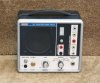
eico-150-solid-state-signal-tracer_1_cd724939c5853504fcbd0fd0753674c8.jpg EICO 150 Solid State Audio Circuit Tracer

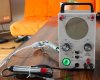
Heathkit-Model-IT-12-IT12-Signal-Tracer.jpg Heathkit IT-12 signal tracer
 
From my studying of AK I've picked up the visual inspection routine of checking fuses, looking for dark spots and cracked solder on pcb. Midsection diode discoloration is new to me, note made.

I misspoke on the diodes. I can't remember having seen a discolored diode, but I have found fried ones, working-but-low-voltage Zeners, and sometimes-working Germaniums. So, for me, diode testing or outright shotgun-style replacement is cheap and a short path to reliability. But, again, that's just me and my newbie, OCD mentality.
 
I've got stereo.

So taking a lap around the hk430's main amp board measuring voltages led me to the conclusion, albeit unassured, that the main amp board was not responsible for the missing audio channel. To my eyes the schematic didn't give me a clear route to follow after the main amp. Visually tracing the main amp's left and right output wires took me to the push buttons. I had done some spraying of the tone control pots but only dry manipulated the buttons when I first got into the trouble shooting.

I remembered some AK threads mentioning the 430's push buttons as a source of audio issues so it felt like I might be headed in the right direction.

Playing with the mono button got me two channels! It was sporadic and required some voodoo but the signal was being amplified into the channel. Lots of Deoxit followed fader lube and still funky. The tape monitor button was mentioned as troublesome so I did more of the same with the pleasing result of full buttery stereo sound.

I still want to have a clearer understanding of the connections but a step towards understanding none the less.
 
I've got stereo.

So taking a lap around the hk430's main amp board measuring voltages led me to the conclusion, albeit unassured, that the main amp board was not responsible for the missing audio channel. To my eyes the schematic didn't give me a clear route to follow after the main amp. Visually tracing the main amp's left and right output wires took me to the push buttons. I had done some spraying of the tone control pots but only dry manipulated the buttons when I first got into the trouble shooting.

I remembered some AK threads mentioning the 430's push buttons as a source of audio issues so it felt like I might be headed in the right direction.

Playing with the mono button got me two channels! It was sporadic and required some voodoo but the signal was being amplified into the channel. Lots of Deoxit followed fader lube and still funky. The tape monitor button was mentioned as troublesome so I did more of the same with the pleasing result of full buttery stereo sound.

I still want to have a clearer understanding of the connections but a step towards understanding none the less.
Doh! I was going to say check those push buttons. I had to by-pass the tape monitor switch completely in my 330.
 
Can't offer much beyond encouragement. I have a 430 and it's well worth getting running again. Use it in my bedroom with a pair of Epicure Model 5 speakers. Such great sound out a simple set up.
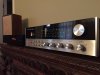
Yes it is. Gotta love the simple setup. Hooked it up last night to a pair of KLHs that I cleaned up but had yet to listen to. Good match. They'd definitely be at home in a bungalow in Portland. SE Portland, near Laurelhurst Park would be nice.
IMG_1651.JPG
 
I've got a thrown away 330b that's blowing speaker fuses. Might post that next.

I've literally got both my 330B's opened and I'm sending in an order to Mouser right now for a thorough recap (which, for me, includes all new transistors, diodes, and heavy-duty resistors).

HK330B restomod.png

Looking forward to your HK 330B thread....
 
I've literally got both my 330B's opened and I'm sending in an order to Mouser right now for a thorough recap (which, for me, includes all new transistors, diodes, and heavy-duty resistors).

View attachment 781764

Looking forward to your HK 330B thread....
Nice.

Well since playing seems to be winning out over actually working I think I will open up the 330 and see if AKers can help me get the receiver working.

I look forward to you jumping in with some good ideas and maybe that parts list:)

Keep your eyes open for a trash picked JVC QL-7 thread. It's sitting next to the Harman 330.
 
Back
Top Bottom