• The move to the new server is done. There are some software and database maintenance updates in process. This has us passing the hat around to help out. We appreciate any donations. Seriously, even a dollar helps. The payment page may be found here - https://www.audiokarma.org/support.html

Traynor TS-200 - Capacitor Question

dtsew

New Member
Hello,

I have a Traynor TS-200, Yorkvillve Sound LTD., 1978. There are some electrical issues I am sorting out for the owner. There are 2 large filter capacitors that look original to the build. They are MEPCO/ELECTRA, 3110JC123U075, 12000MFD, 75WVDC. The original electrical schematics that came with the unit shows a different spec for the caps - 6000uF @ 75V. Is it possible this a factory install and they just put in what was readily available? I am basing my assumption that it is a factory install due to the vintage of the capacitors and appearance of the install.

Whether it is or isn't a factory install, if you were to replace these caps what would you go with - what is installed and has apparently worked for years or something closer to the diagram specs? Thank-you.
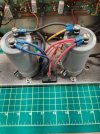
2 Caps.jpg Cap Info.jpg Diagram.jpg
 
Register to hide this ad
Those caps have a 1978, 50th-week manufacturer's date (362-7850). If the amp was made in 1978, my guess is this is a Yorkville modification to the original schematic. What are the voltages that you are reading off those caps? Are they +50 and -50VDC?

What is wrong with the amp?

Thanks
 
Last edited:
Those caps have a 1978, 50th-week manufacturer's date (362-7850). If the amp was made in 1978, my guess is this is a Yorkville modification to the original schematic. What are the voltages that you are reading off those caps? Are they +50 and -50VDC?

What is wrong with the amp?

Thanks

Yes, -50 and +50 volts supply for 2 seperate boards with power transistors. Did not power "ON" after visual inspection of power cord.

There was issues with the power cord, ground not connected internally, damaged wire insulation and previous owner said the pots may need cleaning due to static noise when turning. The person who bought it said it was powered "ON" and amp was shown to work before the purchase.

I thought I would start with replacing the power cord, connect the ground, replace the electrolytic capacitors, use some Deoxit on the pots, general cleaning/inspection, and then see how it operates from there.
 
Yet another capacitor question.
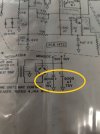
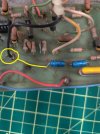
The picture of the schematic in post #1... If you look up and to the right from the yellow circle there is 2 polarized 4.7 microfarad capacitors connected in series with the negative lead of one cap connected to ground. Here's how they are actually connected on the circuit board...

Series Caps 2.jpg

The indented side of the axial capacitor is positive. The positive of the capacitor connects to ground which is higlighted in yellow, then negative to positive of the next capacitor, and finally negative to the next junction on the circuit board. I suspect that these 2 original capacitors are correctly installed on the board vs the schematic. Otherwise, they would have failed years ago - correct?

Lastly what is the purpose of having these 2 caps in series with positive connected to ground?

Thanks

EDIT: looking at the schematic again I see that the -50V rail connects to a 22 ohm resistor and the other side of that resistor connects to one side of the 4.7uF series caps. Therefore, if the actual installation is correct vs the schematic the positive of the capacitor connecting to ground is because ground is more positive relative to the opposite end of the series connection which has negative connected to the other side of the 22 ohm resistor. This would mean that the schematic is definitely incorrectly showing the polarity of the two 4.7uF capacitors.
 
Last edited:
Not out of the woods yet.

After the above repairs were completed the amp was used for several days without issue. Today the following issue was demonstarted to me; amp is powered "ON", volume is turned up to "5", guitar is connected to "Normal" input, Traynor head is connected to the Traynor TS-98 cabinet (designed to go together as a set), guitar is played and within a minute there's feedback/distortion. If the guitar is still played while there's feedback/distortion eventually the power circuit "OPENS". The power interruption is caused by the new thermal overload opening which is mounted to the power transistor heatsink. Let it cool and the power returns.

If the volume is lowered to "3" and the same set-up is used there was no feedback/distortion. This test was performed for several minutes. Maybe the problem would have resurfaced if the guitar was played for an extended amount of time. Not certain. But as soon as the volume was turned up past "3" the feedback/distortion starts.

One maintenance item I did not perform was remove the old thermal paste and add new for the power transistors. But I suspect this recent issue is likely due to something more than old thermal paste breaking down. I think I will start with checking the power transistors. Any suggestions to troubleshoot would be appreciated. Thanks.
 
I have not fixed big Traynor solid-state amps. It does sound like output stage issues. Have you adjusted the output's DC offset?
 
I have not fixed big Traynor solid-state amps. It does sound like output stage issues. Have you adjusted the output's DC offset?

Did the following test:

With a cable connected to the "Internal On" output (internal speaker ON output) I connected my Fluke 117 to the other end of the cable to measure DC voltage when powered "ON". As well, I had an AC power meter connected inline with the power cord. With the Traynor volume on set to "0", I powered the amp "ON". The voltage = 75mV DC and the AC current slowly increased from about 0.5 amps to 0.8 amps before stabilizing.
 
Is 75 mV the amp's lowest DC offset? What is the idle current of the output stage transistors?

I did not check either. I decided to desolder all the power transistors, remove all the old thermal paste, test, and re-install. I did notice that the old thermal paste was thicker than what I applied.

Built a dummy load and set-up a test:
- 100Hz signal input with an Arduino based DDS VFO
- dummy load connected at the output
- oscilloscope connected to dummy load through a 10:1 attenuated circuit
- clamp-on meter measuring amps on one leg of dummy load
- power meter between wall outlet and Traynor amp

I have a Flir thermal camera that I used to monitor temperatures. No temperature issues noticed throughout testing while increasing the volume.

Did more testing with a guitar connected at input. Still, temperature was well below thermal overload cut-out regardless of attempts to stress the amp. Maybe the apparent excessive thermal paste was the problem? Maybe there was some bad solder legs? Can't get it to overheat.

Unfortunately, another problem has revealed itself. The signal/volume was intermittent. I sprayed DeOxit in the master volume potentiometer, worked it back and forth many times, and checked the solder connections. Worked for awhile and then it would cut-out again. If I tapped on the volume dial sometimes the signal would come back. Plan on replacing the potentiometer.
 
I did not check either. I decided to desolder all the power transistors, remove all the old thermal paste, test, and re-install. I did notice that the old thermal paste was thicker than what I applied.

Built a dummy load and set-up a test:
- 100Hz signal input with an Arduino based DDS VFO
- dummy load connected at the output
- oscilloscope connected to dummy load through a 10:1 attenuated circuit
- clamp-on meter measuring amps on one leg of dummy load
- power meter between wall outlet and Traynor amp

I have a Flir thermal camera that I used to monitor temperatures. No temperature issues noticed throughout testing while increasing the volume.

Did more testing with a guitar connected at input. Still, temperature was well below thermal overload cut-out regardless of attempts to stress the amp. Maybe the apparent excessive thermal paste was the problem? Maybe there was some bad solder legs? Can't get it to overheat.

Unfortunately, another problem has revealed itself. The signal/volume was intermittent. I sprayed DeOxit in the master volume potentiometer, worked it back and forth many times, and checked the solder connections. Worked for awhile and then it would cut-out again. If I tapped on the volume dial sometimes the signal would come back. Plan on replacing the potentiometer.
So all is okay now, except for the volume control?

Good luck with the new pot.

Thanks for the update!
 
So all is okay now, except for the volume control?

Good luck with the new pot.

Thanks for the update!

Based on the testing it appears the Volume potentiometer might be the only problem.

I haveb't removed the potentiometer yet. With it in circuit and power "off" I connected my analog Simpson 260 meter to watch the needle as I turned the dial and tapped on the dial. Needle moves smoothly all the way through from 0 - 50K.

The only time it shows "flaky" performance is under power.

The DeOxit seemed to help temporarily. Sprayed "a little" in there twice and turned it 30 or more times.

I have a new Philmore 50KA potentiometer on order. Should be here by Thursday or Friday. In the meantime I will run a few more tests.
 
Based on the testing it appears the Volume potentiometer might be the only problem.

I haveb't removed the potentiometer yet. With it in circuit and power "off" I connected my analog Simpson 260 meter to watch the needle as I turned the dial and tapped on the dial. Needle moves smoothly all the way through from 0 - 50K.

The only time it shows "flaky" performance is under power.

The DeOxit seemed to help temporarily. Sprayed "a little" in there twice and turned it 30 or more times.

I have a new Philmore 50KA potentiometer on order. Should be here by Thursday or Friday. In the meantime I will run a few more tests.
Cool!

Yeah, if the carbon tracking is partially gone, Deoxit won't fix that. Hope that the new one works! [It is a log, audio pot, right?].
 
Cool!

Yeah, if the carbon tracking is partially gone, Deoxit won't fix that. Hope that the new one works! [It is a log, audio pot, right?].

Yes, it is a "log taper audio" pot.

Question - if the tracking is partially gone and I spray DeOxit in there I was lead to believe that the DeOxit can temporarily act as a "bridge" (for lack of a better term) between the sweep and the remains of the tracking?

Have you had this experience with flaky pots where the DeOxit seems to help only for the issue to return?

Thanks
 
Yes, I have. I don't know if it's directly due to Deoxit's action or the temporary cleaning of a funky, weak wiper — which then loses contact after a few wipes.

Probably a combination of both. Replacing the pot is the only long-term cure.


Good luck!
 
Removed the old pot. Not easy. Plastic volume knob fitted onto plastic (nylon?) ribbed shaft of the CTS pot (model: CTS 137-MEX784 4472). Pretty much welded together. Did not want to ruin the volume knob which has a very thin "brim" where the numbers are marked. After numerous unsuccessful attempts of the least destructive methods I opted to go destructive. Drilled out the plastic shaft from the backside. This seperated the pot from the the metal panel. Now I have an intact original knob with a piece of ribbed nylon sticking out of it (I have ideas about how to deal with that) and a ruined pot that was being replaced anyhow.

Question - the Philmore pot that I am replacing the CTS with, are they worlds apart in quality? Not expensive; Philmore 50k Ohm pot


Or should I be searching for a better quality NOS CTS on ebay.ca? For example; ebay.ca 1995 CTS 50k ohm pot

I seen Alpha models are often recommended for their quality like this model at amplifiedparts.com; Alpha 50k Ohm pot

I do not know how the Alpha and Philmore differ internally but the general specs seem very close. Am I over thinking this? Wait and see how the Philmore performs before dismissing it?

Thanks
 
Last edited:
Update - decided to order and install the NOS CTS. It arrived fast. Although the old potentiometer seemed flaky I don't think that was the source of this recent problem. After further investigation the source of the signal issue was the grounds at the 2 input jacks. I remade all the grounds at the jacks up to the circuit board with the new Volume potentiometer. BTW - Simpson 260 analog meter was tool for the job to discover the intermitent grounding issue. Digital meter could catch it but not as obvious versus watching a needle response.

Set-up my test equipment and got a strong sine wave on the screen. Adjusted the Volume, tapped on it, tapped on the panel that the circuit board is mounted to... Sine wave never flickered. This might be the end of the problems. As it looks right now, it appears 100% operational. Wait and see if it comes back anytime soon.
 
Update - decided to order and install the NOS CTS. It arrived fast. Although the old potentiometer seemed flaky I don't think that was the source of this recent problem. After further investigation the source of the signal issue was the grounds at the 2 input jacks. I remade all the grounds at the jacks up to the circuit board with the new Volume potentiometer. BTW - Simpson 260 analog meter was tool for the job to discover the intermitent grounding issue. Digital meter could catch it but not as obvious versus watching a needle response.

Set-up my test equipment and got a strong sine wave on the screen. Adjusted the Volume, tapped on it, tapped on the panel that the circuit board is mounted to... Sine wave never flickered. This might be the end of the problems. As it looks right now, it appears 100% operational. Wait and see if it comes back anytime soon.
Very good! Sorry, I missed post #17. The ALERTS get overloaded by one or two main threads. :(

If possible, I always go for name-brand potentiometers and other controls in guitars and amps. Guys are always twirling them, spilling brewskies, or whatever. Cheap generic stuff dies a quick death under those conditions.

Glad it seems to have worked out. How's the sound?
 
Very good! Sorry, I missed post #17. The ALERTS get overloaded by one or two main threads. :(

If possible, I always go for name-brand potentiometers and other controls in guitars and amps. Guys are always twirling them, spilling brewskies, or whatever. Cheap generic stuff dies a quick death under those conditions.

Glad it seems to have worked out. How's the sound?

No problem. Appreciate the feedback.

I am not a musician myself. The owner will test and let me know.
 
Back
Top Bottom