

You are using an out of date browser. It may not display this or other websites correctly.
You should upgrade or use an alternative browser.
You should upgrade or use an alternative browser.

petehall347
the brandy coffee man
JE01 pin 3 is the input unless i am going crazy . couple by ce05 to pin 2 .. your first pic shows this signal or so i thought .

PoDuck
Active Member
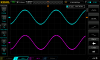
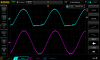
Okay, new results. I pulled that tantalum out, and it was reading 83 uf, and it should be 3.3 uf. I checked it multiple times, and it sometimes read about 3.6 uf, but other times it would read something much higher, between 65 uf and 85 uf. I don't have any 3.3 uf tantalums, so I replaced it with an electrolytic. When I put the board back in, instead of the clipping increasing as I increase the bass but the level remaining the same, like it was before, the signal increases, which I expected from a 40 hz tone. I still get some clipping as the knob is turned further clockwise.
This is a positive development.
Without bass turned up (Top is left channel, bottom is right channel):
With bass turned up fully. Previously, this would have shut out all sound:
This is a positive development.
Without bass turned up (Top is left channel, bottom is right channel):
With bass turned up fully. Previously, this would have shut out all sound:
petehall347
the brandy coffee man
i would look at the other tants first . might be a trend ..

I always replace tantalums with either films or electrolytic, preferably films.
Get them out of there. From all of my research, they have no place in a signal path.
Another question. Is this issue present with the tone mode switch set to out?
Upload a pic of the board for us.
Get them out of there. From all of my research, they have no place in a signal path.
Another question. Is this issue present with the tone mode switch set to out?
Upload a pic of the board for us.
PoDuck
Active Member
Yes, the issue is present with the tone mode switch set to out.I always replace tantalums with either films or electrolytic, preferably films.
Get them out of there. From all of my research, they have no place in a signal path.
Another question. Is this issue present with the tone mode switch set to out?
Upload a pic of the board for us.
Sounds to me like you may have a solder bridge somewhere. With the tone mode set to out, the bass pot is bypassed and goes straight to the final preamp gain stage, or so it looks to me. When tracing through double pole rotoray switch, I seem to get lost often. 
I would get those tantalums out, check for solder bridges ( you may need an original copy service manual as my copies are so faded you cant see the traces) and make sure wafer 4 on that tone mode switch is super clean.
I would get those tantalums out, check for solder bridges ( you may need an original copy service manual as my copies are so faded you cant see the traces) and make sure wafer 4 on that tone mode switch is super clean.
Last edited:
petehall347
the brandy coffee man
i looked at the tone defeat earlier but was beyond me . schematics of these multi switches are hard to follow .but
if bass pot making a difference with tone defeated leads towards the bass pot and surrounding components . change all tants and rule them out .
if bass pot making a difference with tone defeated leads towards the bass pot and surrounding components . change all tants and rule them out .
PoDuck
Active Member
Okay guys. Final update, hopefully. It was as I was originally suspecting. I just have the same difficulty following these schematics as you all do, and I actually have an original printed copy. I replaced all the tantalums with electrolytics and everything is working as it should. I found one other that was testing inconsistently.
Anyway, thanks a ton for holding my hand through this.
Anyway, thanks a ton for holding my hand through this.

petehall347
the brandy coffee man
am happy you sorted it .
PoDuck
Active Member
Yeah, I have tons of electrolytics and ceramics, but I don't have much of an assortment of anything else.Glad to see a positive outcome here.
Now it's time to enjoy it!
As much as I dont like to promote multiple heating of those traces, these tants can be replaced with quality films. I tend to use wimas in these locations.
Some tantalums are known to go bad, but most of them tend to last about like ceramics do, so I usually don't go replacing them unless I need to. I have never experienced the failure mode these ones took though. One seemed to have random capacitance that would fluctuate each time I tested it. The other bad one intermittently tested bad. In fact, when I first tested it, it tested good, and it wasn't until I pulled them all and tested them again at the end that it failed. The rest were all in spec. If this is a common failure for Marantz equipment, they must have been getting tantalums from a questionable source.
Anyway, I was pretty convinced that the problem was capacitors from the beginning, because of the symptoms. I just didn't want to go replacing every single one, including non-tantalums. I was just having trouble with the schematic.
