• The move to the new server is done. There are some software and database maintenance updates in process. This has us passing the hat around to help out. We appreciate any donations. Seriously, even a dollar helps. The payment page may be found here - https://www.audiokarma.org/support.html

Tube checker recommendation... Again

Salbreth1

Active Member
So I'm looking for a checker that will do a variety of tubes as well as output matching. I'm fairly new to the tube world but from what iv read Hickok is one of the go to brands. I have a $600 budget and am looking at a calibrated 752A and an 800. Both are transconductance models.
The first project I will be using it for is a Dynaco st70 with the original tubes. Thanks for the help.

Sal
 
Register to hide this ad
there is no reason keeping tube measurment devices for personal use.
Get new tubes from a reputible vendor and beer for the remaining ( that is much beer)
If you encounter a tube that you suspect is bad, get a new one and throw the old.
 
I have to respectfully disagree with peterh. Some people like to roll tubes and use vintage tubes, which are not always new. So they may have a collection of all kinds of tubes that need to be tested and matched before use. If you have the funds and you want a tube tester, who am I to tell you not to have one.

Calibrated is good. As for comparing the two models, I'll let others do that who have owned them. There is a good Hickok reference site that will give you info on the features and merits of each model.
 
If you are buying a lot used tubes, it is really hard to get by without a tester. But if you have a fairly modern tester like a Mighty mite or EICO 667, that is usually sufficient for signal tubes. For power tubes no tester is going to give test results as good as the current reading on the cathode resistor since that number is what the power tube idling current is in the actual amp. So, to match up power tubes i take the tube tester reading and then in one of the single ended amps measure the actual current at the cathode. With those 2 numbers you have a very good basis for matching power tubes. I have also had various Hickok testers and i find that for testing signal tubes the EICO always mirrored the results of the expensive testers. And since the setup procedure for the 667 is a little easier i sold all my other testers and just kept that one.
 
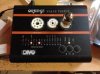
upload_2017-6-17_17-3-26.jpeg

I just got one of these Orange VT1000 testers. It's just a basic "Good, Fair, Lousy POS" meter, and doesn't have anywhere near the ability of some of the testers mentioned above. But I'm not intending or wanting to get too deep into the tech stuff of tubes, and this does all I need. Of course, you could make the argument that a used full range tester would be a better bargain, even if you only use a small fraction of it's capabilities.
 
The best thing any tube tester provides is an accurate shorts/leakage test. Transconductance tests for small signal types can be indicative of dead or alive,but say nothing re sound quality,microphonics or noise level. Testing power tubes accurately requires power,which most machines just don't have.

Frankly,if you are interested in tube rolling,a tube tester is an absolute must,if for nothing more than providing a short test. Who knows what condition old,used tubes are in,and even if you buy new or nos from reputable suppliers,anything can and will happen in shipping. Plugging in a shorted tube will at best cost you a fuse,at worst perhaps a power or output transformer going up in smoke.Testing is just common sense,and the machine does not need to be fancy or expensive.
 
Last edited:
Thanks for the info guys. I did some reading on the pros and cons of a few different brands and models. I think a hickok 539b or c is pretty versatile and will do most of what I want. They are pricey but probably worth the extra hundred bucks.

Thoughts?
They usually are bought by tube resellers and guys that do a lot of testing. They are one of the best but really unless you have a lot of money are more for technicians or labs. they will go for almost a 1000 if in calibrated excellent condition and over 500 for a regular one that you have to send to somebody for testing and calibration which will be almost a l000 when you add up the damages.
I buy tubes all the time for my own use and to test others tubes, i even own a TV2 tester, which is the "cadillac of tube testers". And if you like the look of meters it has 5 or 6 of them but, yet, i always trusted my EICO for its accuracy and ease of use. I would save the extra 500 bucks plus, and buy more tubes or some really good output transformers.
 
I had a SICO (superior instruments co.) Checker, and it was pretty unreliable, so I bought my first "real" tester a Hickok 800 that I bought cheap, its pretty easy to work on and calibrate, but honestly... I still don't feel like I can match tubes very well with it, if I was a richer man I would spring for something a bit more complex with fixed bias points, those knobs are very touchy.

Maybe there's a learning curve, its not as easy to test tubes as i thought, at least not with the accuracy some tube sellers seem to be able to.

It seems to me that people who are great at testing tubes basically have to understand the characteristics of a specific tube and also have to understand their specific tester very well. Then from that knowledge they can make a honest appraisal of a tubes quality according to the designed specs.

I've learned that the tube checker isn't going to do the work for you. It could just be me, but it seems like all the tubes I need to test are "finicky" on the base model Hickoks... 12ax7s, 6922s, a lot of our audio tubes are known to be tricky on those testers...

If you are a tube collector or reseller, then you should probably get a tester that other tube buyers and collectors trust and understand, and then test a million tubes to build a point of reference.

The best I can get out of my Hickok 800 is a general idea if someone was lying when they say a tube I bought "tests strong" I can somewhat confirm that it is strong... Or not...... And later i can attempt to pair strong ones together.

Putting tubes in an amp yields more specific information, and at least the 800 can help me determine if that's safe to do with tubes I'm unsure of.

I'll probably never sell off this 800 though, and I ain't complaining :) it is really pretty, its easy to play with, its leaps and bounds better than my last tester. One day I'll have something more sophisticated, until then I'm happy to keep learning.

I'd say, with your $600, spend it all on the best tester you can buy, if I had that type of dough, I would not get an 800, get one with fixed English, or shunt or whatever they call it :)

 
Last edited:
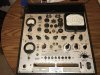
So I ended up finding a 539b for a great price. It hasn't been recently calibrated but I had a good conversation from the tech who owned it for 20 years. It's pretty dirty and the controls definitely oxidized. But I fired it up and tested the tubes in my ST-70 after I downloaded the manual and watched some videos. One of my 6CA7s had descending gm from 7500 to 6000. Not sure what that means yet. But I've been reading tons of info. Like john blue said, ill have to test a ton of tubes to get a point of reference and get to know the characteristics of different tubes.

IMG_0133.JPG
 
That's a very nice piece of gear!

Did he replace the (couple of) caps that are probably in it?
 
Are restored Simpson tube testers any good?

I don't think Simpson actually made any of their own. The couple I've seen were re-branded from someone else. The Simpson 1000 looks for all the world like a dressed up Eico 666.
 
So I ended up finding a 539b for a great price. It hasn't been recently calibrated but I had a good conversation from the tech who owned it for 20 years. It's pretty dirty and the controls definitely oxidized. But I fired it up and tested the tubes in my ST-70 after I downloaded the manual and watched some videos. One of my 6CA7s had descending gm from 7500 to 6000. Not sure what that means yet. But I've been reading tons of info. Like john blue said, ill have to test a ton of tubes to get a point of reference and get to know the characteristics of different tubes.

View attachment 961785

That's a mighty fine tester!
 
Wowsa! That's awesome! I had a lot of fun cleaning up my 800, and I would have a blast getting that thing shined up. :) Congrats Man! At least you know you won't be needing an upgrade anytime soon. :)

Awesome! I'm sending my tubes to you for testing from now on. Lol.

I'm not sure how much different the calibration procedures are for the 539s but I think most Hickok's are similar, you can do it, or at least start testing it a bit with a meter to make sure its in the ballpark, I did have to recap and switch out the 83 tube in mine, someone had installed an 83v and it took me a while to figure that out. Watching an 83 tube come to life is a pretty cool event. :)
 
Last edited:
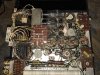
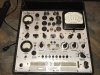
I had some time to download the calibration manual and went through what I could without a calibrated 6L6. The revised calibration is for the 539b/539c. Everything is pretty damn close but the bias voltage. The bias meter reads about a volt lower than my fluke 87V on the 10v scale and 5v low on the 50v scale. but I have a max voltage of 40v as I should. I checked the appropriate resistors and tried adjusting the variable wire wound but that brings the voltage up as well as the meter reading. This might be due to loading. There are 2 original electrolytics. One I replaced with a Low ESR Nichicons. The other is an 8uf, 350v that I'll order. The tubes look original and hazy inside. I deoxed the controls with non residual contact cleaner but I think that's as far as I will go assuming the tubes may be out a bit. There is some carbon build up in the 83 but the 5y3 looks good, both are RCA. I check most of the carbon resistors and they were surprisingly accurate.

She cleaned up nice!

IMG_0146.JPG IMG_0150.JPG
 
Last edited:
Back
Top Bottom