• The move to the new server is done. There are some software and database maintenance updates in process. This has us passing the hat around to help out. We appreciate any donations. Seriously, even a dollar helps. The payment page may be found here - https://www.audiokarma.org/support.html

"Tube life" Anxiety Caused By Using My Amplifier

I, sort of used to be like the OP, in a sense. If I bought a car with new features I wasn't used to I was hesitant to use them, almost a sense of saving them for some weird occasion. Eventually I said "f it" that's what they're there for. So your tube amp is there to provide music enjoyment for YOU! Use it, fix it (if needed) and enjoy it for what it is!
 
i used to feel like the OP, but i was eventually able to get over it and enjoy what i had. FBOW, my amp simply sounds best with TOTL vintage tubes, and i just want to hear my amp at its best (within reason of course, and with the "best" power tubes depending on the particular circuit, of course). Currently, that means a Mullard 5AR4, Tung-Sol 6SU7, and Sylvania 6CA7's.

if you want to get nuts and do an interesting comp, try a Sylvania 6CA7 quad in there. who knows, the XF3's might become your new "burner" tubes!
 
You can extend tube life by running them cooler. One of the Collins radios had a horrible short life spans of the tubes until they put tube coolers on them.

Basically: the warmer the glass gets the more impurities get dispateched and more gass will enter the tube reducing the vacuum and hence tube life.

Have a look at what is written up extensively on www.pearl-hifi.com on this subject. For the small noval tubes you can find the original military ones on ePray at both cheap and ridiculous asking prices. Military studies have shown reduced live span when the smaller tubes repeatedly are inserted or removed (stress on the glass by the pins moving, octal does not suffer the same fate).

Tubes are also rated for x number of turn on / day. This can be greatly extended by using either propery sized NTC resistors in series with the power transformer or by using a stepping transformer ( I use NTC's but also have some transfomers that sre normally used for controlling fan speed and go from 90 to 240V in 5 steps. There will be something in your part of the world and normally they are a) cheaper than a variac and b) often safer to use as they cannot go "over voltage" as some variacs do. Plus I do not like the contacts on a variac....).

(I am using some pearl tube coolers on a pair of NOS EL84 ($$$) that are running well beyond their recommended ratings...So far so good...)
 
Looks like your board has Sprague Orange Drops and Mallory brown drops. If the rest of the unit has these coupling caps, you'll be good to go for a long time. I would not put in any boutique coupling caps, if you want long reliable life from your tubes. I presume those capacitor cans are relatively fresh? Less than 20 years old? Bias supply caps under 20 years old?

Check bias once every six months. Get a used Dynaco wired lid on the top. So you can't inspect the amp every second it is turned-on. Hide the amp a bit, in an area with plenty of air space above and below it. Do NOT turn it on-&-off several times a day. Blackburn Mullard EL34 are good tubes. Should last a long time. Save money and get another set. BTW... Matsushita GZ34 is built from same machinery die as the famous Blackburn Mullard GZ34. And we all know how long those last. :)

https://www.dynakitparts.com/shop/dynakit-st-70-cover/
 
When Duda Rebuilt most of my amps, some 20 yrs ago he would use Vitamin Q's as the coupling caps. He called them Doomsday caps.
While some say they are not particularly detailed, in my horns they seem to take the edge off. compared to the orange drops.
 
I run a Variac for my Fairchild 260's, and bring the voltage up to 115 V slowly. even though the 5V4g rectifier's come up slowly, i was told a lot of theTube life-use /abuse comes from initial turn on . When long sessions are expected I also use a small fan to keep them cool
Looks like your board has Sprague Orange Drops and Mallory brown drops. If the rest of the unit has these coupling caps, you'll be good to go for a long time. I would not put in any boutique coupling caps, if you want long reliable life from your tubes. I presume those capacitor cans are relatively fresh? Less than 20 years old? Bias supply caps under 20 years old?

Check bias once every six months. Get a used Dynaco wired lid on the top. So you can't inspect the amp every second it is turned-on. Hide the amp a bit, in an area with plenty of air space above and below it. Do NOT turn it on-&-off several times a day. Blackburn Mullard EL34 are good tubes. Should last a long time. Save money and get another set. BTW... Matsushita GZ34 is built from same machinery die as the famous Blackburn Mullard GZ34. And we all know how long those last. :)

https://www.dynakitparts.com/shop/dynakit-st-70-cover/
Thanks guys!

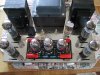
I installed a new capacitor 30,20,20,20uf only several days ago. (Which I did have bypassed internally beforehand)

Original bias caps where 50uf,75v. I replaced with 100uf,200v.

I bypassed the Selenium diode with Silicon 1N4007.

Installed mutch nicer Gold RCA jacks by modifying the original RCA mount to use the ones I had.

I also removed and snipped almost every solder joint. And replaced all the older solder on the PCB with silver solder I had left from my Magnepan repair kit.

Replaced the bias resistors that either had an iffy tolerance, or drifted.

And also replaced both bias Pots with the far nicer/smoother, and more accurate ones from Dynakit.

Also running the amp on 115VAc.
TvRYipY.jpg

pGKtnVs.jpg

VGYWD9h.jpg

hMFQSdz.jpg
 
Last edited:
Thanks guys!

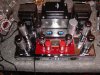
I installed a new capacitor 30,20,20,20uf only several days ago. (Which I did have bypassed internally beforehand)

Original bias caps where 50uf,75v. I replaced with 100uf,200v.

I bypassed the Selenium diode with Silicon 1N4007.

Installed mutch nicer Gold RCA jacks by modifying the original RCA mount to use the ones I had.

I also removed and snipped almost every solder joint. And replaced all the older solder on the PCB with silver solder I had left from my Magnepan repair kit.

Replaced the bias resistors that either had an iffy tolerance, or drifted.

And also replaced both bias Pots with the far nicer/smoother, and more accurate ones from Dynakit.

Also running the amp on 115VAc.
TvRYipY.jpg

pGKtnVs.jpg

VGYWD9h.jpg

hMFQSdz.jpg

Think you are good to go for a long time. What I would do, is keep an eye out for good testing Blackburn Mullard EL34. RCA or Sylvania 7199. Maybe, one Mullard or Matsushita GZ34. You have time. :)
 
I guess I can't resist jumping in here and getting mud thrown at me so here goes....

Tubes are misunderstood by most and especially by those that are somewhat new to the game. There are some that actually believe that the for example Mullards will yeald a superior sound and I guess as PT Barnum said a sucker is born every minute or something along that line. Been down the Dynaco trail probably 50 or 60 times and modified the hell out of everyone one of them because to be blunt they sound like crap in my opinion in stock form. When a circuit is poorly designed there is a chance that the sonic s might change a bit with different tubes and with a properly designed circuit tube rolling has little to no effect at all. I was in the business for over 25 years before I retired and have seen my share of snake oil and superior parts claims.

My advice as follows.... don't be worried about the difference between say 115VAC at the outlet and 120VAC feeding your amp because in a lot of cases voltages in the chassis can easily vary 5-10%. If your worried about your boutique tubes then pull them out and replace them with another brand. Your 7199's my opinion a nasty once popular tube thats hard to find and while suited to the job when the Dynaco first came out can easily be replaced by simply purchasing an adapter or doing some trace work and replacing them with a 6GH8 or better yet junk the original driver board live a little and venture into the unknown with a new driver board with different more advance circuitry.

With respect to the 5AR4 warm up time.. sure the 5AR4's have a controlled warm up that allows the B+ to ramp up slowly. They can be replaced with a 5U4 and the world won't end and your Dynaco won't go up in a puff of smoke and you won't be a victim of cathode stripping. Cathode stripping so you know does not happen at the voltages the Dynaco works on. Cathode stripping occurs when plate voltage are around 1000VDC or more on the plate despite what some of the know it alls say on some of the audio forums. God help me you can even use a SS rectifier in place of your 5AR4 and the world won't quit spinning and you won't be meeting St. Peter at the gate. One can simply add a small value resistor in the power supply to drop the voltage if one is worried about it. One can even add several 1N4007 diodes in series in the secondary HV lines to rectify the voltage prior to the 5AR4 a trick I started over 20years ago and mentioned on several forums and it caught on. This little trick will save your 5AR4 from arcing when you exceed the capacitor ratings of the 5AR4.

I see your Dynaco looks like you still have the original multi-cap capacitor which has seen its good years and needs to be replaced. I could mention a cap replacement board that is available that would cause your Dynaco to take on a whole new life but that would be cheating on my part and you think it sounds good now.

Maybe in the future you will learn that the Dynaco for its time had superior sounding output transformers which in todays world can be replace by some made by Edcor.

For the record... been down the boutique tube road before and now I simply enjoy the sound of regular tubes and put my time and effort in the circuits and will yeald far more and better results....again my opinion. I will leave in posting several pictures of some of my prior Dynaco toys of the past.
P2010003.JPG P3160023.JPG

The amp on the left is one I built entirely from scratch. Has individual bias for each output tube, a SS rectifier in conjunction with a damper diode tube to allow a slow B+ rise, different driver board, a Hewlett Packard power transformer, and a power supply cap board hidden beneath the chassis. I started out with a bare scrap chassis and put it together from there. The amp on the right I had purchased off ebay and it had a driver board with (4) 6DJ8's on it and the amplifier didn't work. It had some extra holes in the chassis that has caps sticking up thru them which I removed. In their place I made two boards in which I mounted the bias adjusting pots (the blue pots) in the holes. This Dynaco I purchased a driver board from Mapletree from Lloyd Peppard and began the task of putting it all back together. The original multicap I left on the board at the time the picture was taken and later I removed it and put a pop in stainless steel plug in its place.

As your interest and skills grow hopefully you will start to enjoy the world of tube amplifiers and no longer spend hours wondering if your boutique tubes will allow you another 300 yours of listening enjoyment.
 
Last edited:
I'll add one more picture.
P2060007.JPG
This picture shows a 5U4 in place of the SS rectifier and a tube I added for a different bias circuit. The sound was amazing and then I converted it for use with 6BG6GA output tubes which due to a hard drive failure I don't have a picture of.
 
Tube life is all about how hard the tube is being pushed. Run them to the max voltage and current wise and life will be short. Its kinda like taking your 65 GTO 389 Tri-power 4 speed and shifting every gear at 5600 RPM's . Life will be shorter than running it partial throttle and shifting at a lower RPM.
 
Back
Top Bottom