• The move to the new server is done. There are some software and database maintenance updates in process. This has us passing the hat around to help out. We appreciate any donations. Seriously, even a dollar helps. The payment page may be found here - https://www.audiokarma.org/support.html

Turntable Relativity and Ratings

I have an XA and it hovers around .15% to .2% W&F on my annually calibrated Leader LFM-39A. It was my father's TT so I keep it around. But, your description of the sound is more like a wine tasting, very subjective. What is correct is an accurate reproduction of the audio when the audio was recorded. Sorry, but I am an engineer, member of the IEEE for over 30 years, so I don't accept the fluff.

Do you mean cd like accuracy?
 
This thread is kind of an interesting concept. I don't see how it would ever work, though. It really is all relative.
 
This thread is kind of an interesting concept. I don't see how it would ever work, though. It really is all relative.

Exactly. What is worthwhile however are the descriptions that accompany the discussion. The sound that I might prefer, you might find dreadful. I've come to grips with this. This is why I try avoid any "this is "better" than that" statements. If we're lucky, some of our members might have the vocabulary to describe the differences.
 
Everybody's turntables suck but mine.

There end of list:D

:lmao::lmao::lmao:

But seriously, I currently have two tables, a Pioneer PL15D and a VPI HR19 Jr.

Both I have modded extensively. And I bought the VPI because of its "upgradeability". The Pioneer was fine until I tweaked it until I could tweak no more (isolated the motor, changed springs for spikes, added weight and damping to the plinth, etc, etc). At that point I tried, but could not get any more out of the table. It was good, but that was as good as it was going to get.

Then came the VPI. Highly tweakable and I have currently only scratched the surface (same basic upgrades, added a new 10.5" arm, damped the motor). I want to upgrade the junior platter among other things...coming soon, budget not withstanding.

I love the sound of my system...always have, I just am always looking to upgrade.

My current focus is room and what I can tweak. And my basic question is...How can I get the most out of what I already have?
 
Since we can't all hear each other's tables we're reduced to trying somehow to verbalize the sonic character we experience. But I'm afraid one guy's airy soundfield may be sloppy to another. I'd be more interested in knowing what kind of music is preferred by people who enjoy a particular table. If folks that tend towards smooth jazz also gravitate to Thorens and Rega (hypothetically) then that may give me a basis for matching my tastes to something that may be likely to appeal to me before I drop some cash.
Of course, ideally you never hear the equipment - just the record. But, you know...
 
I do understand the impossibility of quantifying what makes one turntable better than another aside from the measurable stats. But how manny times have someone asked a question like which between a denon 35f and jvc ql7 is better? To have a database where one can find out if the turntable he saw in cl belongs to the "keep on looking" list or "drop the hammer now!" kind would be very helpful.

I am not talking about splitting hairs kind of discussions but the kind where, say:
turntable x > turntable y because the tonearm is better, it's quieter and is easier to find parts for.
turntable y= turntable z because their performance level is almost similar so therefore,
turntable x is > turntable z as it has been established (and debated) that it it is superior in performance to y, which is equal to z.
but then turntable a > x and turntable b is < y so in hierarchy a>x>(y=z)>b so when someone wants to know how two tables he is curious about stacks up against each other he will not have to search the whole forum because his answers are all there in one thread, or sub forum.

i know it's confusing and an exercise in futility but it was just an interesting thought.
 
Last edited:
It IS an interesting thought. HOWEVER... I like my current cheap Pioneer PL-516 because it sounds alright with the rest of my equipment and the music I generally play, and it's semi-automatic (a high priority). Plus, it's super cheap and easy to repair, and it fits the decor. I actually own much better turntables if you look at the specs or listen to almost anyone here, but I don't like them as much for various reasons - too finicky and need too much attention, or all manual, or whatever. Now, how many people would say a PL-516 is better than an SL1200? Can't think of any. But it is to me. That's why it's futile.
 
I do understand the impossibility of quantifying what makes one turntable better than another aside from the measurable stats. But how manny times have someone asked a question like which between a denon 35f and jvc ql7 is better? To have a database where one can find out if the turntable he saw in cl belongs to the "keep on looking" list or "drop the hammer now!" kind would be very helpful.

I am not talking about splitting hairs kind of discussions but the kind where, say:
turntable x > turntable y because the tonearm is better, it's quieter and is easier to find parts for.
turntable y= turntable z because their performance level is almost similar so therefore,
turntable x is > turntable z as it has been established (and debated) that it it is superior in performance to y, which is equal to z.

i know it's kinda confusing and an exercise in futility but it was just an interesting thought.

800 times!!

You haven't been around long but these ? are presented everyday. People start a thread and ask which one is better or what price is fair and so forth. the best knowledge is gained in trial and error. A data base is available with research and not from on thread, one site and limited opinions. My tables are hardly ever talked about on this site so does that mean their junk?
 
I do understand the impossibility of quantifying what makes one turntable better than another aside from the measurable stats. But how manny times have someone asked a question like which between a denon 35f and jvc ql7 is better? To have a database where one can find out if the turntable he saw in cl belongs to the "keep on looking" list or "drop the hammer now!" kind would be very helpful.

I am not talking about splitting hairs kind of discussions but the kind where, say:
turntable x > turntable y because the tonearm is better, it's quieter and is easier to find parts for.
turntable y= turntable z because their performance level is almost similar so therefore,
turntable x is > turntable z as it has been established (and debated) that it it is superior in performance to y, which is equal to z.
but then turntable a > x and turntable b is < y so in hierarchy a>x>(y=z)>b so when someone wants to know how two tables he is curious about stacks up against each other he will not have to search the whole forum because his answers are all there in one thread, or sub forum.

i know it's confusing and an exercise in futility but it was just an interesting thought.

Well, let us know when you get one started. Perhaps we can fill in some of the blanks for you. If you want the answers, roll up your sleeves and get to work! I am willing to watch :D

Regards
Mister Pig
 
bahaha!!! now i feel like don quixote out to slay windmills with mister pig to egg me on!

to try this concept out. let's say,(all hypothetical, of course)

when comparing a thorens td 160 against a dual 1229 objectively, what are the strengths and weaknesses of both? if they're viewed as even, the choice will boil down to personal preference then, as both of them as judged as "equal". so with them being equal, then it may be said that a td 125 is better than a 1229 because it is similar to the td 160 and the 125 is "considered" better than them.
if a pioneer pl70 is "better" compared to a td 125, someone trying to decide between the dual and it would know that the pioneer is the better one, despite the lack of direct comparison. and so on and so forth.
i know the logic is faulty at best. i am not trying to incite flame wars or to get banned. :) just wondering if the concept is even remotely doable at all.
 
You can see the problem when you see marc morin's post and compare it with this one.

I've had standard AR turntable with a Linn Akito arm, which has latterly been replaced by an LP12 with the same arm. Cartridge, a Gorldring 2500. On both tables I replaced and tuned the springs, belts cleaned and lubricated etc. The AR I sold on, as it was a bit flat sounding, while the LP12 is clean, neutral and full, though there is a touch of the mid-bass plod about it. Have recently changed the cartridge, and that seems to have solved most of the problem.

I'm aware the with the marcmorin modified AR you're essentially getting a marc morin turntable using some AR components and therefore is a class apart, but I certainly wouldn't rate the the AR based on my experience with it, the LP12 is much better. So, my rating would be the LP12 above the AR.

By the way, I'm not sure about soundstage. My understanding is that it's fixed in the studio, and the speakers usually have a lot to do with how well it is reproduced. That, and, I suspect, the listener's own perceptions.
 
I have an XA and it hovers around .15% to .2% W&F on my annually calibrated Leader LFM-39A. It was my father's TT so I keep it around. But, your description of the sound is more like a wine tasting, very subjective. What is correct is an accurate reproduction of the audio when the audio was recorded. Sorry, but I am an engineer, member of the IEEE for over 30 years, so I don't accept the fluff.

Some things are wrong with the table. Here's a link to specs taken from a a table I did very minor work to, and retains the stock suspension springs.
what work was done. Rigid centering spring perches. Mass load and balance pulley, polish spindle and bearing wells, new thrust plates. Repair vertical pivot assembly in arm. new run cap.

http://www.audiokarma.org/forums/showthread.php?p=5437571&posted=1#post5437571

W/F numbers are a mechanical issue. I'm a retired Mechanical Engineer. it's not fluff.
 
Last edited:
By the way, I'm not sure about soundstage. My understanding is that it's fixed in the studio, and the speakers usually have a lot to do with how well it is reproduced. That, and, I suspect, the listener's own perceptions.

Marcmorin's observations about the Linn's soundstage qualities have been noted by others. Art Dudley (Stereophile), using his own Linn/Naim turntable combo to compare with the VPI Scout, wrote, "The VPI combo also sounded different from the Linn in its sense of scale and space. The Scout and JMW-9 did a better job of separating voices and instruments from one another, and overall created a bigger "stage" between the speakers. The Linn/Naim combo sounds smaller, with more of a chunky, mono-like focus that some may or may not prefer."

In my own experience, long a user of an all-Linn system, when I wanted to hear the imaging qualities of a pair of Vandersteens I had purchased, I found that aspect of performance to be greatly enhanced not only by switching from an LP12 to a Well Tempered, but by replacing the Linn amplifier (described in another review as "closed-in" and "airless") with Audio by Van Alstine. Speakers matter, but the whole system has to work together to achieve specific sonic goals.

 
With violin or piano music some experts say anything over .05% W&F is objectionable. But, I think .08% is fine. 48dB SNR is not top of the class but better than many new consumer TTs, I think.

As a comparison. A consumer Technics direct drive (SL1300-1800) from the 1970s will have .03% Wow and Flutter and around 60 dB S/N. A Technics SL 1200 MK2 has better specs than these, but it was a far more expensive TT.

Thanks for the info.
 
Marcmorin's observations about the Linn's soundstage qualities have been noted by others. Art Dudley (Stereophile), using his own Linn/Naim turntable combo to compare with the VPI Scout, wrote, "The VPI combo also sounded different from the Linn in its sense of scale and space. The Scout and JMW-9 did a better job of separating voices and instruments from one another, and overall created a bigger "stage" between the speakers. The Linn/Naim combo sounds smaller, with more of a chunky, mono-like focus that some may or may not prefer."

In my own experience, long a user of an all-Linn system, when I wanted to hear the imaging qualities of a pair of Vandersteens I had purchased, I found that aspect of performance to be greatly enhanced not only by switching from an LP12 to a Well Tempered, but by replacing the Linn amplifier (described in another review as "closed-in" and "airless") with Audio by Van Alstine. Speakers matter, but the whole system has to work together to achieve specific sonic goals.
I'm sure if you looked there'd be plenty of other opinions suggesting the opposite. That's the trouble with subjective opinion. It's also a problem with turntables in particular, since few can afford to do direct comparisons using parallel arms and cartridges. Also a plus, by the way, in that variety, whether subjective or not, is the spice of life, and that's why there is so much choice with turntables, arms and cartridges :)
 
Also a plus, by the way, in that variety, whether subjective or not, is the spice of life, and that's why there is so much choice with turntables, arms and cartridges :)

truly. and like i've always told my kids when they insist everything is all the same, there will only be one brand and one manufacturer of everything if that's the truth.
 
Some things are wrong with the table. Here's a link to specs taken from a a table I did very minor work to, and retains the stock suspension springs.
what work was done. Rigid centering spring perches. Mass load and balance pulley, polish spindle and bearing wells, new thrust plates. Repair vertical pivot assembly in arm. new run cap.

http://www.audiokarma.org/forums/showthread.php?p=5437571&posted=1#post5437571

W/F numbers are a mechanical issue. I'm a retired Mechanical Engineer. it's not fluff.

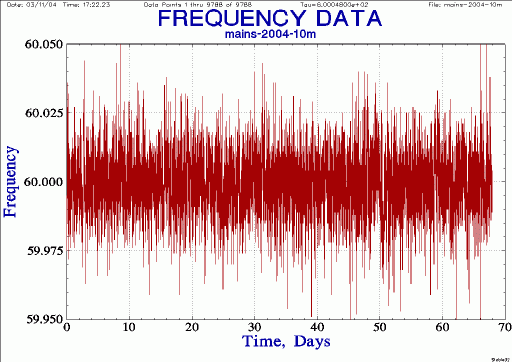
W/F numbers are an electrical issue and part of my initial my point was that they are not fluff, but objective measurable "quality" parameters. I am an active Electrical Engineer and have been aN IEEE member for over 30 years. As an electrical engineer I know that mains is not a steady frequency reference as it will consistently vary by .05 Hz and will sometimes peak to a Hz +/- 60 Hz. That variance will affect the effective speed of the platter.

2freq1.gif
 
I'm trying to decide.. .How could we compare a Mustang, to a Le Car, to a VW Bug, to a Ferrari Enzo, to a Dodge Challanger, to a Nissan Quest, to a Hummer....

..and then, we start talking about which years of those compare better to what year...

I hope this clears up how simple the chore would be for the OP so they can get started on it for us.. :D
 
Back
Top Bottom