
• The move to the new server is done. There are some software and database maintenance updates in process. This has us passing the hat around to help out. We appreciate any donations. Seriously, even a dollar helps. The payment page may be found here - https://www.audiokarma.org/support.html

Turntable Relativity and Ratings

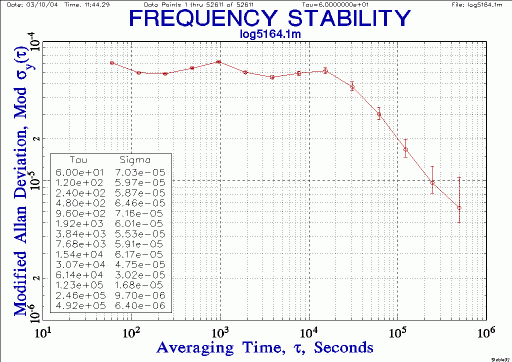
W/F numbers are an electrical issue and part of my initial my point was that they are not fluff, but objective measurable "quality" parameters. I am an active Electrical Engineer and have been aN IEEE member for over 30 years. As an electrical engineer I know that mains is not a steady frequency reference as it will consistently vary by .05 Hz and will sometimes peak to a Hz +/- 60 Hz. That variance will affect the effective speed of the platter.
Not disputing your qualifications. But the variance in the grid you post is over a longer period of time than it took you to measure W/F figures. Those figures you posted are of a mechanical nature. If the grid was +/- 1hz over 10 seconds, 20 seconds you would be correct.
 
Not disputing your qualifications. But the variance in the grid you post is over a longer period of time than it took you to measure W/F figures. Those figures you posted are of a mechanical nature. If the grid was +/- 1hz over 10 seconds, 20 seconds you would be correct.

Old electric clocks worked well because the frequency over time, averages almost exactly at 60 Hz but the frequency varies in the very short term, the time that W&F measurements are taken.

And the figures are electrical in nature. They are, however, a result of a mechanical phenomenon, i.e. changing electrical loads on the generation equipment.

1sigma1.gif
 
I don't dispute that frequency variations of the grid will have an effect on those TTs (like my Empire) that clock to the utility, but the variances you have demonstrated with your graphs don't really address the issue of Wow and flutter. I am more concerned with the speed stability of the platter during a single revolution than I am its stability over 5.8 days; the point furthest to the right. While is is true, as shown in your graph, the greatest expected drift is in the short term (60 seconds in the case of the left most point) it is still only .0000703 hertz, or an average variation of .00011% over 60 sec. The greater concern would be sudden jumps or significant sub-second variations, but due to the nature of the connected generation in any giver grid control area (i.e. the total number of connected generators) disturbances resulting in noticeable changes are extremely rare. I check the speed of the platter prior to use since my TT is dependent on utility frequency. I rarely have to make any change and if I do they are small tweaks. I find myself more in agreement with markmorin and believe that WOW and Flutter in TTs is more a mechanical function than an electrical one.
 
Back
Top Bottom