• The move to the new server is done. There are some software and database maintenance updates in process. This has us passing the hat around to help out. We appreciate any donations. Seriously, even a dollar helps. The payment page may be found here - https://www.audiokarma.org/support.html

Turntable Request, what’s the easiest to work on vintage table?

‘What’s the easiest to work on vintage table?…….. That was the question.
-WTT with Rube Goldberg tonearm hung with fishing line?
-Sota with all sort of things to go wrong?
Not saying they might be better sounding turntables in top form but that wasn’t the question, as has already been stated.

The AR? The many audio critics who used the table in their early years used it in stock form. Replace the delrin pivots with sapphire, really concentrate on the main bearing and tonearm wells and then judge it. The tonearm is an ingenious design.

Now, comparisons to other tables on sound quality is difficult mainly due to finding the right cartridge for the arm. I successfully put my DL-103 on it by adding a lot of mass to both ends of the arm. It sounded really good but the weight probably compromised the turntable suspension. That cartridge on another table and arm sounds a bit better. However, I just put a Stanton 681 on the XA and it sounds fantastic! All the air and sound staging the XA is known for but with low end weight, depth and punch. This is the best sound I’ve had from the XA, by far, and it is very, very good.

But again, the XA really started it all and anyone wanting to explore vintage turntables should get one and dive in.

You’re obviously a little confused. Nobody mentioned Sota as a viable option with it costing well over the OP’s budget and both Sota and Well Tempered were merely mentioned in a comparison about what tables are high-end compared to the AR - between Sgt Shultz and myself. BTW - no idea what issues you have had with Sota but mine have been awesome and trouble free. Rarely does anything go wrong with them that’s not related to mishandling by someone who didn’t prepare them properly for shipping - and failed to lift the platter transport screws or remove the platter - which will destroy the sapphire thrust bearing in short order. And, saying anything silly about a Well Tempered, which is probably one of the best sounding tables made, shows you have a bit to learn.. :)

Nothing wrong with liking ARs but there are other options as well.
 
Fair enough. No, I have no experience with either of the turntables you mentioned other than hearing a Well Tempered in an audio store back in the 1990s. It was very impressive. However, I have always enjoyed reading audio Rags in an attempt to expand my knowledge and occasionally lust after new or used gear to own. More than one reviewer commented on the difficulty in dealing with fishing lines, damping fluid and the occasional golf ball.

My XA sat for almost a year because another very affordable TT project won the day, so I have no illusion that an XA is a great or truly high end piece. What it is is a simple and relatively cheap turntable that performs surprisingly well with a bit of updating.
 
Old school VPI HW-19 (or Jr.) ought to be within the OPs budget?

I don't know what the parts and support situation is at this point, though, on those old tables. Bought my Jr. 25 years ago and later upgraded it to Mk III platter and bearing status, but other than that I've had zero interaction with the factory. No issues, no problems.
 
I guess that depends on what your definition of “easy” is.

For me it turns out that the Dual tables are “easiest”.

I went through several other brands of vintage tables (belt and direct drives) and while they were good and I had no problems keeping them “up to snuff”, I eventually landed on a Dual 1249 (belt drive) and a Dual 1229Q (idler) as my daily drivers.

Fully automatic tables than can be used as partial manual if you so chose to cue the lever where you want to drop it. You don’t get an option to not “auto lift and return” at the end of the record, but thats ok with me.

They will also run as fully auto stackers with a center spindle change. Theres even an option to use them as a 45 stacker, but that accessory is super rare these days and goes for quite a few bucks, if you can even find one for sale.

Plinths are kind of crappy from oem (thin plastic things usually), but the tables are all metal and on a suspension, so plinth design is only limited by your imagination. I built my own and I wanted them to look a bit more like a furniture piece than a plain square box:

IMG_3074.jpeg

they’re not finished, but you get the idea. They give you the freedom to make them what looks good to you, not someone else.

I know lots of people look at the guts of a Dual and see lots of confusing clockwork:

IMG_3026.jpeg

but thats because they just aren’t used to it and it all makes sense after a couple minutes working on/watching it. If you’re the kind of person who can look at a gear-train and know which way the last gear will turn compared to the input gear rotation, you won’t have much problem with one.

It’s like comparing the insides of a mechanical Swiss watch to a quartz watch. Its just different, but not hard to understand. Nothing is hidden in a little black magic box, its all analog and out in the open for you to see it do its thing.

Electronic bits can’t fail and/or become obsolete because there are none. No places to let the magic smoke out of other than burning up the motor and you pretty much have to make a deliberate effort at that. No caps to leak, no resistors to drift, no “unobtainium” IC’s to fail. It works or it doesn’t and getting it to work again 99% of the time just a bit of servicing.

Lots of NOS parts out there and there are even some custom parts being sold to make them better than (or at least as good as) new.

Lots of information on them out there on the net, including full user written pdf’s on teardown, servicing and adjustments. Everything from lubrication and adjustments right down to rebuilding the motor itself.

There’s even places that will do a full servicing on them for you if you want (Dualcan was a factory trained Dual technician and still works on them).

If you have trouble handling small parts and following exact step by step procedures, then they’re probably not for you. Theres no shortcuts working on a Dual. You service it all from step 1 to step 863 or not at all. Try to jump into the middle of it to fix a problem and you just mess other stuff up. It has to all be adjusted/serviced or the results are not going to be satisfactory.

But if you have more of mechanical mind than electronic, a Dual is a good fit.

You do need to be careful servicing them though as you can easily damage things like the tone arm when flipping them upside down to work on the mechanisms. I built a special purpose work stand so I can flip them over as needed and not worry about damaging something:

IMG_5260.jpeg

Once properly serviced and adjusted, they can go for years (or decades) before needing to be touched again. I usually pull mine out of the plinths and go through them every 12 months or so, just because I can. I actually enjoy a day of going through them and servicing them. Just another part of the “hobby” to me, but I’ve always been more of a “greasy paw” than a “spark chaser”.

You either get to know them intricately or you learn to hate them. There doesn’t seem to be much “middle ground” on that with Duals.

You are pretty much locked in to using them as they are though. But thats pretty much a “German thing” as it is with anything designed and built in Germany.

They don’t loan themselves very well to modifications (like changing to a new tone arm, etc) so you have to like them they way they are for the most part. Some don’t like the auto functions and believe it makes them “noisier”, although my old, failing ears can’t hear any difference. There are some “Dual-isms” like the cartridge mounting, but I’ve never had a problem working with any of those “isms”.

Again, nothing wrong with the other vintage tables I had (still have some in the storage room), but the Duals are a good fit for me.

YMMV….
 
Last edited:
I guess that depends on what your definition of “easy” is.

For me it turns out that the Dual tables are “easiest”.

I went through several other brands of vintage tables (belt and direct drives) and while they were good and I had no problems keeping them “up to snuff”, I eventually landed on a Dual 1249 (belt drive) and a Dual 1229Q (idler) as my daily drivers.

Fully automatic tables than can be used as partial manual if you so chose to cue the lever where you want to drop it. You don’t get an option to not “auto lift and return” at the end of the record, but thats ok with me.

They will also run as fully auto stackers with a center spindle change. Theres even an option to use them as a 45 stacker, but that accessory is super rare these days and goes for quite a few bucks, if you can even find one for sale.

Plinths are kind of crappy from oem (thin plastic things usually), but the tables are all metal and on a suspension, so plinth design is only limited by your imagination. I built my own and I wanted them to look a bit more like a furniture piece than a plain square box:

View attachment 3098369

they’re not finished, but you get the idea. They give you the freedom to make them what looks good to you, not someone else.

I know lots of people look at the guts of a Dual and see lots of confusing clockwork:

View attachment 3098337

but thats because they just aren’t used to it and it all makes sense after a couple minutes working on/watching it. If you’re the kind of person who can look at a gear-train and know which way the last gear will turn compared to the input gear rotation, you won’t have much problem with one.

It’s like comparing the insides of a mechanical Swiss watch to a quartz watch. Its just different, but not hard to understand. Nothing is hidden in a little black magic box, its all analog and out in the open for you to see it do its thing.

Electronic bits can’t fail and/or become obsolete because there are none. No places to let the magic smoke out of other than burning up the motor and you pretty much have to make a deliberate effort at that. No caps to leak, no resistors to drift, no “unobtainium” IC’s to fail. It works or it doesn’t and getting it to work again 99% of the time just a bit of servicing.

Lots of NOS parts out there and there are even some custom parts being sold to make them better than (or at least as good as) new.

Lots of information on them out there on the net, including full user written pdf’s on teardown, servicing and adjustments. Everything from lubrication and adjustments right down to rebuilding the motor itself.

There’s even places that will do a full servicing on them for you if you want (Dualcan was a factory trained Dual technician and still works on them).

If you have trouble handling small parts and following exact step by step procedures, then they’re probably not for you. Theres no shortcuts working on a Dual. You service it all from step 1 to step 863 or not at all. Try to jump into the middle of it to fix a problem and you just mess other stuff up. It has to all be adjusted/serviced or the results are not going to be satisfactory.

But if you have more of mechanical mind than electronic, a Dual is a good fit.

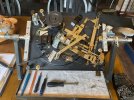
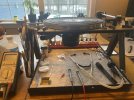
You do need to be careful servicing them though as you can easily damage things like the tone arm when flipping them upside down to work on the mechanisms. I built a special purpose work stand so I can flip them over as needed and not worry about damaging something:

View attachment 3098323

Once properly serviced and adjusted, they can go for years (or decades) before needing to be touched again. I usually pull mine out of the plinths and go through them every 12 months or so, just because I can. I actually enjoy a day of going through them and servicing them. Just another part of the “hobby” to me, but I’ve always been more of a “greasy paw” than a “spark chaser”.

You either get to know them intricately or you learn to hate them. There doesn’t seem to be much “middle ground” on that with Duals.

You are pretty much locked in to using them as they are though. But thats pretty much a “German thing” as it is with anything designed and built in Germany.

They don’t loan themselves very well to modifications (like changing to a new tone arm, etc) so you have to like them they way they are for the most part. Some don’t like the auto functions and believe it makes them “noisier”, although my old, failing ears can’t hear any difference. There are some “Dual-isms” like the cartridge mounting, but I’ve never had a problem working with any of those “isms”.

Again, nothing wrong with the other vintage tables I had (still have some in the storage room), but the Duals are a good fit for me.

YMMV….
Great post, great pics, great plinths! Thanks for posting. I have a Dual 1019. My father bought one new in about 1968 or so. Fabulous auto TT. I want to clean and lube mine, but I need to collect the correct lubes and knowledge. :)
 
Great post, great pics, great plinths! Thanks for posting. I have a Dual 1019. My father bought one new in about 1968 or so. Fabulous auto TT. I want to clean and lube mine, but I need to collect the correct lubes and knowledge. :)
If you have a vinyl engine membership, there's pdf's posted there on rebuilding them by a semi-retired dual technician. Has modern equivalents for the original oils.greases also. They are very thorough.

If you don't have a membership (and I think new memberships are still closed) you can still read the forum threads, but I'm not sure if you can open the pdf's without a membership.

There's also Dual service manuals available for pretty much all Dual TT's. They have them on vinyl engine as well, but you definitely need a membership to download those. They're also all over the internet though. Google will turn them up. They might even be in the Audiokarma database on this forum.

Here's the service manual on Electrotanya's web site: https://elektrotanya.com/showresult?what=dual+1019&kategoria=Under&kat2=Under
 
I guess that depends on what your definition of “easy” is.

For me it turns out that the Dual tables are “easiest”.

I went through several other brands of vintage tables (belt and direct drives) and while they were good and I had no problems keeping them “up to snuff”, I eventually landed on a Dual 1249 (belt drive) and a Dual 1229Q (idler) as my daily drivers.

Fully automatic tables than can be used as partial manual if you so chose to cue the lever where you want to drop it. You don’t get an option to not “auto lift and return” at the end of the record, but thats ok with me.

They will also run as fully auto stackers with a center spindle change. Theres even an option to use them as a 45 stacker, but that accessory is super rare these days and goes for quite a few bucks, if you can even find one for sale.

Plinths are kind of crappy from oem (thin plastic things usually), but the tables are all metal and on a suspension, so plinth design is only limited by your imagination. I built my own and I wanted them to look a bit more like a furniture piece than a plain square box:

View attachment 3098369

they’re not finished, but you get the idea. They give you the freedom to make them what looks good to you, not someone else.

I know lots of people look at the guts of a Dual and see lots of confusing clockwork:

View attachment 3098337

but thats because they just aren’t used to it and it all makes sense after a couple minutes working on/watching it. If you’re the kind of person who can look at a gear-train and know which way the last gear will turn compared to the input gear rotation, you won’t have much problem with one.

It’s like comparing the insides of a mechanical Swiss watch to a quartz watch. Its just different, but not hard to understand. Nothing is hidden in a little black magic box, its all analog and out in the open for you to see it do its thing.

Electronic bits can’t fail and/or become obsolete because there are none. No places to let the magic smoke out of other than burning up the motor and you pretty much have to make a deliberate effort at that. No caps to leak, no resistors to drift, no “unobtainium” IC’s to fail. It works or it doesn’t and getting it to work again 99% of the time just a bit of servicing.

Lots of NOS parts out there and there are even some custom parts being sold to make them better than (or at least as good as) new.

Lots of information on them out there on the net, including full user written pdf’s on teardown, servicing and adjustments. Everything from lubrication and adjustments right down to rebuilding the motor itself.

There’s even places that will do a full servicing on them for you if you want (Dualcan was a factory trained Dual technician and still works on them).

If you have trouble handling small parts and following exact step by step procedures, then they’re probably not for you. Theres no shortcuts working on a Dual. You service it all from step 1 to step 863 or not at all. Try to jump into the middle of it to fix a problem and you just mess other stuff up. It has to all be adjusted/serviced or the results are not going to be satisfactory.

But if you have more of mechanical mind than electronic, a Dual is a good fit.

You do need to be careful servicing them though as you can easily damage things like the tone arm when flipping them upside down to work on the mechanisms. I built a special purpose work stand so I can flip them over as needed and not worry about damaging something:

View attachment 3098323

Once properly serviced and adjusted, they can go for years (or decades) before needing to be touched again. I usually pull mine out of the plinths and go through them every 12 months or so, just because I can. I actually enjoy a day of going through them and servicing them. Just another part of the “hobby” to me, but I’ve always been more of a “greasy paw” than a “spark chaser”.

You either get to know them intricately or you learn to hate them. There doesn’t seem to be much “middle ground” on that with Duals.

You are pretty much locked in to using them as they are though. But thats pretty much a “German thing” as it is with anything designed and built in Germany.

They don’t loan themselves very well to modifications (like changing to a new tone arm, etc) so you have to like them they way they are for the most part. Some don’t like the auto functions and believe it makes them “noisier”, although my old, failing ears can’t hear any difference. There are some “Dual-isms” like the cartridge mounting, but I’ve never had a problem working with any of those “isms”.

Again, nothing wrong with the other vintage tables I had (still have some in the storage room), but the Duals are a good fit for me.

YMMV….

Nice rotisserie!
 
If you have a vinyl engine membership, there's pdf's posted there on rebuilding them by a semi-retired dual technician. Has modern equivalents for the original oils.greases also. They are very thorough.

If you don't have a membership (and I think new memberships are still closed) you can still read the forum threads, but I'm not sure if you can open the pdf's without a membership.

There's also Dual service manuals available for pretty much all Dual TT's. They have them on vinyl engine as well, but you definitely need a membership to download those. They're also all over the internet though. Google will turn them up. They might even be in the Audiokarma database on this forum.

Here's the service manual on Electrotanya's web site: https://elektrotanya.com/showresult?what=dual+1019&kategoria=Under&kat2=Under
Thank you very much!
 
Theres even an option to use them as a 45 stacker, but that accessory is super rare these days and goes for quite a few bucks, if you can even find one for sale.
They turn up. I just got another for my son as part of a package on eBay. Do a "saved search" on eBay and you'll get an email when one turns up. They haven't been super expensive in my experience. I guess it depends on your definition of expensive. :) I paid $160 for two LP stacker spindles, a 45 stacker (AS-9), and a 45 rpm adapter. Of course, the LP stackers need new rubber, but are otherwise like new. The AS-9 just works!
 
They turn up. I just got another for my son as part of a package on eBay. Do a "saved search" on eBay and you'll get an email when one turns up. They haven't been super expensive in my experience. I guess it depends on your definition of expensive. :) I paid $160 for two LP stacker spindles, a 45 stacker (AS-9), and a 45 rpm adapter. Of course, the LP stackers need new rubber, but are otherwise like new. The AS-9 just works!
Thats cool. I don't have any 45s (and have no desire to) so am happy to bypass the 45 stacker attachment. Which is not to say I wouldn't pick one up "just because" if I found one at a bargain basement price at a local store or similar.

I've got several 33 stackers that are functional, I just don't use them other than to test them once and put them away. I prefer using single play when listening to vinyl.

I use FM, CD or streaming if I want continuous music in the house while doing chores or whatnot....
 
Nice rotisserie!
Just a bunch of scraps I threw together. The frame and uprights are old bed rails, the bottom is a piece of plywood and an old towel, the clamps are machined out of some leftover aluminum scraps from various previous projects. The oil holding "rack" is just a piece of an old aluminum screen door.

Virtually no money into it, it all would have been thrown out as leftover scraps. I basically just have a little of my own time in it as an expense.

You could do the same thing with wood bits, I'm just a "metal guy" so I'm already set up to make stuff in metal.
 
've got several 33 stackers that are functional, I just don't use them other than to test them once and put them away. I prefer using single play when listening to vinyl.
I have some opera boxed sets that are pressed for stacking, so it's nice to stack them and get three or four sides without having to get up; then get up and flip the whole stack. :)
 
If your budget were higher I would say VPI belt driven turntables. You might be able to find a used Scout for that price. Empires are pretty easy. The tone arm cartridge platform can be a pain from time to time. But the man is correct in recommending the AR turntable most of the time.
 
I have some opera boxed sets that are pressed for stacking, so it's nice to stack them and get three or four sides without having to get up; then get up and flip the whole stack. :)
Whatever works for ya I always say!

;)
 
Back
Top Bottom