• Please note that Audiokarma will be offline briefly for updates early on Monday morning, September 28th.

Turntable Stabilizer Weight: How Heavy?

What purpose do they serve? I have yet to hear a viable answer.

Record weights and Shakti Stones what are they good for? Absolutely nothing.
There've been many "viable" answers. Whether or not there's a detectable difference with your gear and ears is another matter. And what do Shakti Stones have to do with it? Are you just listing things you don't accept?
 
Many people use the terms "clamp" and "weight" interchangeably, as if they're the same thing — which they are NOT. A clamp grips the spindle, to actively press the LP down, and needs weight very little weigh. A weight is just a weight, and it just sits there; its "flattening" effect is directly proportional to what it weighs: unless it's heavy it has no effect, and if it's heavy it's not good for the bearing long term.

An active clamping system weighing 6 ounces (properly designed) will completely flatter the outer edge of a mildly warped LP, while a passive weight of 2 pounds will have no effect at all.

And I'm not talking about the expensive peripheral clamps, just one in the center as 4-2-7's definitive thread demonstrates.
So it seems to me there is no way a clamp can push down on a record unless it has a static point to push up against to maintain a certain downforce, which would then be equal to the amount of compression weight of the spring. So rather than pushing down like a weight, it actually pulls up on the spindle, then pushes down. So why not just get a weight that is equal in weight to the poundage of compression that a good quality clamp has,,,,,,,,, are they all equal i wonder, probably nowhere near.
 
I think some people use clamps or weights for more than just to push a record flat. Many records are already flat and not warped, but their is the idea of coupling it to the platter so as to lesson resonate energy from the needle. kind of like using mass like a ballast. I think I read some also think it lessons the chance of slippag of the vinyl by the drag that the stylus creates on the record. Myself I have no idea other thn I like the looks. If it looks good to me it sounds better as well! :)
As far as bearing damage I doubt it would present any challages to my tables due to them being of fairly good build quality.
 
I use this Clearaudio puck. Only 6.5oz so not a weight or clamp as such, just a stabilizer, stops any vibration.
6cleaciclamp-large__05929.1620285332.jpg
 
The only table I've had around here that I heard a "marked" improvement with the use of a weight was a Technics SL1200MKII. The bass was rather wooly so I tried one of my weights, the bass noticeably tightened up. This was very easily repeatable by removing the weight during play, then putting it back on.

Here's the weight.
View attachment 1795493
Direct drives like the sl1200mk2 HATE weight on the platter you would for sure have increased wow and flutter and the feedback loop would struggle with the extra weight. Also the sl1200mk2 bearing is not up to more weight.
Chris
 
So it seems to me there is no way a clamp can push down on a record unless it has a static point to push up against to maintain a certain downforce, which would then be equal to the amount of compression weight of the spring. So rather than pushing down like a weight, it actually pulls up on the spindle, then pushes down. So why not just get a weight that is equal in weight to the poundage of compression that a good quality clamp has,,,,,,,,, are they all equal i wonder, probably nowhere near.
A weight pushes on the bearing and increases rumble and wear and clamp does not this is why we use a clam not a weight.
Chris
 
The purpose of either is to couple and mass-load the record to the platter, restoring dynamic impact and reducing record playback resonances. Vacuum hold down on a properly designed platter accomplishes this best, but is comparatively complex and costly.
A reflex clamp is an easier inexpensive option, I'm not a fan of adding mass load to the thrust bearing with a weight.
 
I have both a clamp and a weight. The weight is one of those 'Bren' things that I got from Vinyl Nirvana. It seems to offer a slight sound improvement when I use it with my TD-160 , but I don't expect it to flatten out a warped record, of which I (thankfully) own only a few. My Michel clamp takes care of those duties, rendering a unplayable LP useable again. I really like that feature.

Now my problem - how do I get my Michel clamp to work on my Garrard 301? I suspect that it won't work due to the "floating" spindle found on all 301's but I'd like to find out if anyone has discovered any kind of work-around for this.
 
Table manufactures should have all put threads on the end of the spindles so we could simple thread a puck type clamp on to the end of the spindle.

I am not buying all the bearing is going to handle it, remember all those changers in the past with stacks of records, and that extra weight was way out on the outer rim of the platter, which would seem to be much more stressful being a radial load and a thrust load on the bearing.
 
I believe I said earlier on in the thread that I've used weights and clamps, and that the clamp I used was clearly beneficial, whereas the weight was much less obviously beneficial - it seemed to deaden the sound. I am not unwilling to believe that Cafe Latte is right that adding weight can interfere with the feedback loop on DD tables, but I'm not convinced. The effect on rotational inertia of the clamp can't be very great - all the mass is in the center, so I would guess there is little affect on rotational inertial. And I've used heavy mats - in the case of the Osawa mat, a very heavy mat - with positive results (I assume because of its effect on rotational inerta), so I suspect it is not the mass on the platter that is the issue. I suspect that it is the mass on the record, which lowers the resonant frequency of the the record, unhelpfully.
A clamp does at least something in terms of coupling the record to the mat and flattening the record - actually just the center of the record. And that may be helpful, and it does it without having much effect on the resonant frequency of the record.
I'll be honest - this makes sense in my mind, but I could be full of it. Not my observations, but my explanation.
 
I believe I said earlier on in the thread that I've used weights and clamps, and that the clamp I used was clearly beneficial, whereas the weight was much less obviously beneficial - it seemed to deaden the sound. I am not unwilling to believe that Cafe Latte is right that adding weight can interfere with the feedback loop on DD tables, but I'm not convinced. The effect on rotational inertia of the clamp can't be very great - all the mass is in the center, so I would guess there is little affect on rotational inertial. And I've used heavy mats - in the case of the Osawa mat, a very heavy mat - with positive results (I assume because of its effect on rotational inerta), so I suspect it is not the mass on the platter that is the issue. I suspect that it is the mass on the record, which lowers the resonant frequency of the the record, unhelpfully.
A clamp does at least something in terms of coupling the record to the mat and flattening the record - actually just the center of the record. And that may be helpful, and it does it without having much effect on the resonant frequency of the record.
I'll be honest - this makes sense in my mind, but I could be full of it. Not my observations, but my explanation.
Then check, as it has been proved, it is the reason the the SP10mk2 has the weight of platter it has. More weight on a sl1200mk2 or an SP10mk2 and they start to really suffer, but cope, but wow does go significantly up. Try the same weight on a sl1200G (I have one and tried this) and the newer coreless motor REALLY hates the extra weight and wow and flutter goes up from 0.02% to 0.25% which is massive.
Chris
 
Table manufactures should have all put threads on the end of the spindles so we could simple thread a puck type clamp on to the end of the spindle.

I am not buying all the bearing is going to handle it, remember all those changers in the past with stacks of records, and that extra weight was way out on the outer rim of the platter, which would seem to be much more stressful being a radial load and a thrust load on the bearing.
Bearings are made usually for the mass of platter they carry. Look at a spindle for instance on a Commonwealth idler it is huge, the bearing is white metal and at base there are two ball bearings, this can clearly take quite a load, that said more load will mean more friction and more noise. Then compare say a Technics spindle with its soft plastic thrust pad, add more mass here wow and flutter and feedback loop aside and that thrust pad will indent and wear through really quickly.
Chris
 
Table manufactures should have all put threads on the end of the spindles so we could simple thread a puck type clamp on to the end of the spindle.

I am not buying all the bearing is going to handle it, remember all those changers in the past with stacks of records, and that extra weight was way out on the outer rim of the platter, which would seem to be much more stressful being a radial load and a thrust load on the bearing.
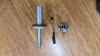
Here is a Tecgnics bearing compared to a Commonwealth bearing. The spindle on the Commonwealth is pulled to to show diameter. Not all bearings are equal.20210629_083845.jpg
 
I believe I said earlier on in the thread that I've used weights and clamps, and that the clamp I used was clearly beneficial, whereas the weight was much less obviously beneficial - it seemed to deaden the sound. I am not unwilling to believe that Cafe Latte is right that adding weight can interfere with the feedback loop on DD tables, but I'm not convinced. The effect on rotational inertia of the clamp can't be very great - all the mass is in the center, so I would guess there is little affect on rotational inertial. And I've used heavy mats - in the case of the Osawa mat, a very heavy mat - with positive results (I assume because of its effect on rotational inerta), so I suspect it is not the mass on the platter that is the issue. I suspect that it is the mass on the record, which lowers the resonant frequency of the the record, unhelpfully.
A clamp does at least something in terms of coupling the record to the mat and flattening the record - actually just the center of the record. And that may be helpful, and it does it without having much effect on the resonant frequency of the record.
I'll be honest - this makes sense in my mind, but I could be full of it. Not my observations, but my explanation.

Most warp issues I have had were on the outer tracks, which a weight or clamp isn't all that effective.
 
A clamp that weighs a few ounces will not harm the bearing, and will exert more flattening down-force than a 10-kilo passive weight.

However, it will only flatten the label-area. The only way to flatten the edges, where the warps are, is to adapt your clamp as 4-2-7 outlined a couple of years ago on AK. I've linked to it before, but no longer remember.

Well-worth searching for it. When you find it, please send it back to me.
 
Table manufactures should have all put threads on the end of the spindles so we could simple thread a puck type clamp on to the end of the spindle.

I am not buying all the bearing is going to handle it, remember all those changers in the past with stacks of records, and that extra weight was way out on the outer rim of the platter, which would seem to be much more stressful being a radial load and a thrust load on the bearing.
They had rumbly annular ball thrust bearings rather than silent single rounded point and plate like most single play TT did.
 
I had an AR for many years which had the Merrill subchassis and bearing. After 25+ years of use that ball bearing in the well showed no visible wear, nor did the spindle. Accounting for the heavier platter and clamping ring, I have no doubt it could take the added weight of any commercial weight on the record.
Now, the delrin disc in the well of my current AR? No way. Nothing more than a Sota I-Clamp.
 
Back
Top Bottom