• The move to the new server is done. There are some software and database maintenance updates in process. This has us passing the hat around to help out. We appreciate any donations. Seriously, even a dollar helps. The payment page may be found here - https://www.audiokarma.org/support.html

Two receivers don't tune well under 98 MHz?

fredcohiba

Super Member
I have come across two Yamaha CR-620 receivers over the last few months. The first one was about three months ago from CL. Got it home, cleaned the pots, switches and blew out the chassis. everything worked fine with the exception of the tuner. Every station below about 98 MHz was hard to tune. The signal strength meter barely moved, and the stereo signal was very noisy. Above 98 MHz, things worked normal. Good signal strength, easy to tune and quiet FM stereo.
Sunday, I found another unit on CL, and auditioned it at the sellers house. I brought my own dipole antenna (just in-case) and hooked it up. So, any guesses on what I found? If you guessed that I found the exact same tuning issue, you'd be right. Any ideas on what is happening? Is this maybe a common problem of Yamaha receivers of that model/vintage?
 
Register to hide this ad
Could also be an adjustment issue. There are separate steps for FM adjustments for frequencies above 98 Mhz and below 98 Mhz.
 
coils are adjusted at the bottom end of the scale.
caps are adjusted at the top end of the scale.

coils don't get contaminated over time and change values. caps do.

So the caps are eliminated due to the problem being at the low end of the scale, and the coils are eliminated cause they don't change.

Leaving only the tuning cap as a suspect, which is out in the open air and gets coated with whatever is in the air. Usually nicotine.
 
Variable inductors (coils) are used in a lot of tuner front ends, they certainly DO change over time or from impact etc., and the inductors in the majority of receivers or tuners I work on are out of alignment at least a little bit at this point.

Having said that, I would also probably start by making sure the tuning cap wasn't damaged or contaminated with solvent.

John
 
The easiest is always cleaning. That was never in question.

From there it may need some adjustment to improve reception. A skill not many have. And a service manual is also a good idea. That may be a consideration in the OP's decision to buy.

The How to Clean an Analog Tuner sticky is at the top of the Tuners forum.
 
Knowing absolutely nothing of the tuner design, I'll toss out an idea about something that happened to me. My shortwave receiver (Sony 2010) uses an FET in the front end. It got static zapped. The only real symptom was that reception of high frequency signals was untouched, but the gain for low frequency signals was way down. Replacing the FET brought all the low frequency stations back. It was bad for several years before I realized there was a problem.

If the unit has a split at 98 MHz, that's certainly a clue that something is amiss down below.

IMO, the only way to know what's really going on is to do a proper alignment and check the sensitivity over the whole range. Or, maybe your antenna is just mistuned!
 
Variable inductors (coils) are used in a lot of tuner front ends, they certainly DO change over time or from impact etc., and the inductors in the majority of receivers or tuners I work on are out of alignment at least a little bit at this point.

They don't change. You had to adjust them due to a dirty capacitor somewhere.

On countless tuners I've aligned, cleaning the tuning cap and adjusting the trimmer caps was all that was needed. Once the tuning cap is clean and virgin, the alignment falls into place with no inductor adjustment needed.

This is also the reason that the detector slope tuned circuits need to be aligned sometimes. It's not that the inductor changed value. It's because the capacitor connected to the detector coil has changed value. But those aren't variable capacitors. So you adjust the inductor.
 
They do change. I've had to take overhauled tuners back to re-tweak inductors that changed during transit (had to paint those to prevent it happening again). I routinely find them out of adjustment during alignments. Optimizing the front end on most of the pieces I work on starts by adjusting a series of them, with the generator and tuner set to low frequency (typically 90mHz or thereabouts). The cap adjustments follow that, with the generator and tuner set to higher frequency (105mHz etc.).

Even cheaper designs with wire coils used in place of variable inductors can be tuned, will be glad to post an excerpt from a service manual that says so if it'll help. That type definitely is MUCH less prone to change over time than the variable ones, but certainly not immune to it.

I can assure you I am not making any of it up though. As an example, in the Tandberg 3011A the following steps require an inductor adjustment:

Front end optimizing (low end of band): four variable inductors L101-L104
FM-IF: two variable inductors L107/L108
Discriminator: two variable inductors L201/L202

On the 3001A there are twelve individual inductors that are absolutely adjusted during an alignment. The older 2080 receiver has 8 for FM, 4 for AM, and so on.

I can pull out some manuals for other non-Tandberg tuners or receivers if you want more examples, those above are just from units I am real familiar with. I know I have manuals that describe using a tool to carefully open or close the coils on an air-core inductor to adjust some of the same parameters mentioned.

We can always ask Mike @ punkerX or Bob from the tuner group to weigh in on this... but I assure you that tuning inductors is an integral part of many FM (and AM) alignment procedures.

John

They don't change. You had to adjust them due to a dirty capacitor somewhere.

On countless tuners I've aligned, cleaning the tuning cap and adjusting the trimmer caps was all that was needed. Once the tuning cap is clean and virgin, the alignment falls into place with no inductor adjustment needed.

This is also the reason that the detector slope tuned circuits need to be aligned sometimes. It's not that the inductor changed value. It's because the capacitor connected to the detector coil has changed value. But those aren't variable capacitors. So you adjust the inductor.
 
<several edits later to keep from sounding like a dick.>

I'm well aware of how to adjust adjustable inductors.
I'm well aware of how to adjust non adjustable inductors.
I can do an alignment without a service manual or any tech data.

I welcome anyone you care to ask, to weight in on this thread.

But you're missing the point.

The Point: Inductors don't change value. Just because there is an adjustment doesn't mean it needs to be adjusted. It was set correctly at the factory and worked fine when the tuning cap was clean and virgin.

In 95% of the tuners I've aligned, the inductors don't need adjusting. If you follow the service manual and find that turning that inductor from a position where it was, makes an improvement, there is a reason. If you find yourself returning to where it was originally, then it didn't need adjustment!

I'm not saying to eliminate the step from the alignment procedure, I'm saying ask yourself why it (if) needed to be adjusted. Inductors do NOT change value. Even adjustable ones, unless abused.

Possible reasons that the inductor was found NOT peaked:

- is the ferrite core loose in the inductor?
then some tool tweaker was there before you. Rewax it. Or paint it I guess.

- the tuner voltage is off spec
a definite possibility

- the tuning cap is dirty
in anything that even HAS a tuning capacitor the probability of this is ~100%.


When you do an alignment (AFTER cleaning the tuning cap), do you find a peak NOT at a position where the inductor was positioned before you started?

If so, then see the three possible causes above.

This is what led me to clean tuning caps in the first place! I suggest you add it to your alignment procedure.

<shhhh, it's not in the service manual, Tandberg or anyone else!>

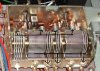
pic below to keep it interesting....
 

Attachments

  • tuning cap coils caps.JPG
    tuning cap coils caps.JPG
    111.8 KB · Views: 14
I guess we are coming from a different place on this. I go into an alignment with NO assumptions about what has or hasn't been done, and I therefore check and adjust anything that has to do with tuning performance per the manual when I have it and based on experience when I don't. Why skip one of the normal steps based on an assumption, instead of actually checking it? I have often seen improvement in low frequency front end sensitivity from the inductor adjustment, and not ones that were obviously loose from tweaking. The fact that your experience differs doesn't invalidate my experience, right?

And, while also trying to avoid being a dick, cleaning the tuning cap is part of my repertoire when it applies, and I DID recommend it above as you may have noticed. But, I don't ever have to screw with that on Fm alignments for Tandberg gear because they use varactor tuning with a 100 ohm pot, no nasty open frame variable caps (only used for AM on a few models). And, setting the regulated tuning voltage is the first step for all of those models too so trust me, I am covering the fundamentals.

It doesn't seem like we're going to agree on this. But, I think you're absolutely wrong when you say that a variable inductor won't change value, they absolutely do, for the reasons I've mentioned. You seem to be looking at it from somewhat of a theoretical position, but in the world I live & work in they need to be checked and set regularly if I want to be assured the tuner is going to perform correctly. I can't imagine skipping that step while having abstract thoughts about WHY I should check and set them correctly, know what I mean?

Anyway, ymmv but I will keep doing alignments by the book. The results measure correctly and the gear performs & sounds great, and that suits me and the owners of the gear when it's a paid job, and that's all I really care about.

John


P.S. I added a thread over on the Tuners forum on this topic where it may attract some other expert input: http://www.audiokarma.org/forums/showthread.php?t=461106
 
Last edited:
cleaning is the first part of proper servicing ... especially with with tuner circuits ...if you have ever worked with old televisions you know what i mean ..as you would have more than likely also worked on tuners .. i wish there was a market for tuners in the uk as i love working on them ..
as for the op.s question i suggest cleaning first ...sorry had a beer again .. plus not familiar with your tuner ..
 
Back
Top Bottom