• The move to the new server is done. There are some software and database maintenance updates in process. This has us passing the hat around to help out. We appreciate any donations. Seriously, even a dollar helps. The payment page may be found here - https://www.audiokarma.org/support.html

Ultrasonic Cleaners - They do Work...

Any questions as to whether ultrasonic is worth the bucks, try Record Genie.

He'll do 3 for starters, and has a couple plans to cover a variety of cleaning scenarios.

Google is your friend. I'm surprised he hasn't popped in here (unless I missed it).
 
Vinyl is deforming because only the grooves are heated and they expand the label is not heated and does not expand. like anything else there is a limit to what the vinyl will take, who's going to be the unfortunate one to find out that they have caused irreversible damage to their lps by "cavitation erosion" caused by using too powerful an ultrasonic transducer. Like without research who would have figured that using more 8inches vacuum suction on an LP holddown would cause the vinyl to gas off!

Cleaning records with Ulta Sonics is not new.

Oh and I have three SOTA's with vacuum hold down so my records must be toast anyway.:sigh:
 
Last edited:
Ok tonight I just passed the 400 mark cleaning with my new unit. It's very realistic to clean 50 or so records in an evening after work. I have only had this 8V sonic unit 5 days now so in maybe a month and a half all my records will be clean and static free.:thmbsp:
 
kd-cln-lp200_r31_p1-700x700.jpg


Not cheap but probably the last word on personal record cleaning...

http://klaudio.com/kd-cln-lp200-lp-vinyl-record-ultrasonic-cleaner-dryer
 
image.jpg


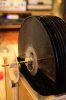
Here some pictures of my newly purchased usw. First putting all (8) records on the spindle, then laying the spindle onto the bath (30 minutes washing time, speed one rotation in 4 minutes), the spindle rotates as the spinning wheel (acrylic wheel) rests upon a motor driven knot (motor built into the machine), and lastly the drying position.
Washing temperature no more twenty degrees, or none at all.

The machine is a standard usw reworked and put together by a fellow norwegian vinyl enthusiast, a very creative and handy one.
Result? Superb. Old dirty records with lot of firecracking noise play just fine!

Ole G

(Edit) sorry, but the pics came in the opposite order)
 
Last edited:
not exactly

Good to know, thanks. I do have a white-label promo copy of Royal Scam (which I forgot about until this second), but maybe they stopped the white labels before Aja.

I went to double check, and have a White Label promo of Aja. Its
sounds lovely.:music:

I have the Spin Clean System, and one thing i would recommend is high-end lens cloths, especially by Zeiss. These are used for telescopes and their lenses. They have to be as faultless as possible, as Astronomers don't like to ever have to clean their lenses...thats how picky they are. So, no scratchee, no lint and no big hassle. Often, i sort of sweep it over an LP on the TT, and i use large versions of these anti-stat cloths after Spin Cleaning, to wonderful effect. Only get the very toppermost quality of these. No ShamWows. :nono:

That will have to do for me now. I have close to 15 k in Astronomical gear, close to 2k in Oil Painting, and a growing amount on Audio. It takes a very patient and fine wife to put up with this. I will also be buying a higher end TT, long before i buy a RCM that costs more than it. The nickel and dime stuff, of course, is still rolling in— speaker brackets, more Monster cable, adapters, and ultimately an Audio/Video stand that can accommodate everything. i saw a Sonus wall bracket that could be prime with my granite slab....forgive the digression.

I would love to even have the VPI cleaner model the guy i bought my TT from had, but i am chuffed to bits, just to have what i do.:banana:
 
Yep they made that one look pretty.
List on the KLAudio is $4K. The advantage is that it dries, so you put the LP in and get it out ready to play in 5-7 minutes. The drawback is it is a single-play (plus the additional $$). It is, like the V8, getting excellent reviews/feedback from the users.
 
I bought a used Nitty Gritty a little while back and have been pleased with it in terms of getting surface grime (dust, finger prints, etc.) off the albums I've been buying, but there's still a bunch of crud deep in the grooves that it won't lift. So, I just ordered a 6 liter ultrasonic cleaner off of eBay. I'll give it a whirl (pun intended) manually for a few LPs and if it shows promise, I'll order the low-RPM motor and rig up a DIY system to do multiple LPs at once. I'll use the Nitty Gritty to clean the water off the LPs as they come out of the ultrasonic cleaner.
 
Pro's and con's, audible, that is

List on the KLAudio is $4K. The advantage is that it dries, so you put the LP in and get it out ready to play in 5-7 minutes. The drawback is it is a single-play (plus the additional $$). It is, like the V8, getting excellent reviews/feedback from the users.

The CableCo kindly cleaned a few of my LPs on the Audio Desk Systeme (ADS). The result was beyond my expectations and I am sold on *the need* for ultrasonic cleaning: it does work, indeed. :thmbsp: There have been quite a few discussions of the operational differences of the 3 commercial machines: Audio Desk, Klaudio and V-8, on the one hand, and of "N" DIY options, on the other. My listening to the Audio-Desk-cleaned examples (most of them 2nd copies of LPs I own, so I could do A/B tests ad naseum) revealed improvements in 6 "dimensions", listed below. I am dying to know if anyone has listening notes from comparing any of these "3+N" options. :scratch2:

1) Years ago, a friend who was a recording engineer demo'ed for me the "fine white mesh" (my analogy) that sonically lies over virtually all the program material on LPs, and is not present on high-quality tapes of the same program. I had come to think of this as "extra detail" on LPs, but my friend taught me that it was spurious "noise". The noise is quite "white": not particularly confined to any audio band. The level of this noise seems to me to correlate with the general modulation level on LP. The ADS *substantially* reduced this whitish noise.
2) ADS'ed LPs (like Calvin, I do occasionally verb words) exhibit clearer room acoustics. I *think* this is because my ear/brain can more easily distinguish the direct sound front the reverb, so I can hear the room as itself, but that's my guess. Room acoustics are experientially clearer.
3) ADS'ed LPs exhibit better "thereness": listening through my Stax 009s as if they were "a window into the venue", instruments and vocalists sound more spookily "there".
4) ADS'ed LPs allow better discernment of individual instruments in choirs: e.g., a "violin section" becomes clearly a "group of violins".
5) ADS'ed LPs better reveal the "action" of instruments, i.e., how they are actually producing the sound. E.g., you better hear the different flows of air associated with trombones and flutes, or again, the interaction of a vocalist's cords, cavities, tongue, etc. In the latter case, diction is more easily understood as an important byproduct.
6) ADS'ed LPs make metallic percussion sound more metallic. This is really a subset of 5), I suppose, but it's so important to me I am artificially separating it out.

Given the highish to high price of commercial options, a DIY solution has its attractions. However, I *just* want to get the most audible improvement in the dimensions listed above, and would love to hear of other people's comparisons between them regarding the resulting sonic benefits to LPs along the lines of the dimensions mentioned above.

 
I thought about scouring the internet for something longer, but then I measured an LP at the label and it's 11" edge-to-edge, so I figured I had 3/4" to spare. For $187, it's not going to break the bank like some of the commercial ultrasonic record cleaner machines would.
 
I wonder how my method would stack up against UC if checked before/after with microscope photography.

My simple method:

1. Pre-soak with a cleanser that will not damage vinyl.
2. Pressure wash at 350-400psi/2-3GPM.
3. Dry with an air knife.
 
The link you shared has:
'Tank Size 11 3/4" L x 6" W x 6" H'
I guess you don't need a full 12" since the LP is only going in to not quite the label. Has anyone seen cleaners with a little more leeway?

There are baths with 9 and 12lt that I've seen. Perhaps, apart from being able to work with less demanding tolerances, they offer an additional benefit from having higher power U/S transducers and perhaps 4 of them instead of the 3 able to fit on a 6lt bath.

Regarding the length of the bath, yes, you can fit the LP in a slightly shorter length bath but you need to ensure that the grooves section is dipping in the bath. The typical cleaner will have a maximum water level allowed / optimum and that needs to coincide with the immersion depth of the LP in the bath - or the last track may be left uncleaned.
 
Back
Top Bottom