• The move to the new server is done. There are some software and database maintenance updates in process. This has us passing the hat around to help out. We appreciate any donations. Seriously, even a dollar helps. The payment page may be found here - https://www.audiokarma.org/support.html

UMIK/REW/Equalizer APO and room modes...

bhairavi

AK Subscriber
Subscriber
Someone had told me room modes are hard to get rid of and I believed them for too long...

I had a terrible room mode with an AU-717 driving ADS L1590s in my living room. Awful boomy bass at 40 and 80 hz. Since my source is my main audio server, it wasn't going to be a problem to run Equalizer APO, a parametric EQ for computers.

Only thing missing was a calibrated mic - in the past I'd tried this with a Dayton audio mic following a tutorial over at ASR, but it was an awful tutorial and only served in confusing me further. Thought I'd try again and put up an ad for a UMIK in Bartertown and quickly got a response from an AKer. This time I used minidsp's own website and a tutorial off of YT and it was a breeze.

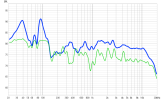
After getting measurements and running correction, the room modes are gone! I also toned down a bit of the the brightness of the 1590s.


Blue is uncorrected with massive spikes, green is corrected:
1757809204038.png


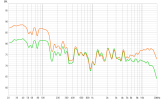
And here is an example of the corrected curve compared to the same curve with the Sansui's loudness applied:
1757809289324.png


I've come to realize I'm not a fan of new gear or the ASR/objectivist philosophy, but I also don't believe in fancy DACs or cables.. these on the other hand are very useful pieces of modern hardware and software.
 
Register to hide this ad
No pics of the plots but I had a similar experience with similar results with REQ, a UMIK-1, and my DSP-408.

A big hump next to a big dip in the bass that is much better after corrections.
 
I too had a terrible problem with a bass resonance at 77Hz and somewhat poor imaging. At least the imaging was
better than my previous apartment, which had a room wider than long. I thought of tube traps
but our long time high end dealers dissuaded me. They also dissuaded me from $10,000 of new speakers because of the room.
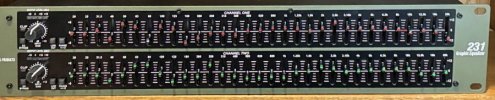
I spent $140 on one of those UMIK-1 mikes, $140 on a Chineseium 31 channel equalizer, which came only
with XLR and TRS connectors, thus, another $80 for cables. I also used some old big rolls of foam I had for carrying things in my SUV.

It took quite a while to get both good frequency response in each stereo side as well as respectable imaging.
Taking room reflection responses with Audacity helped a lot. But I eventually succeeded. The curves on the equalizer
are quite agressive, though the range of each slider is only +- 6 dB.
eqUntitled2.jpgroomx.jpgresponse20260209.jpg

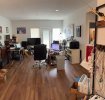
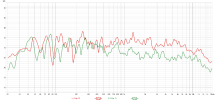
I'm attaching (I hope) a graph of the response at the listening position (the big black chair in the middle of the room)
and a picture of the rather cluttered room, 1/4 of the way from the back wall. On the right side of the chair is my main computer and
on the left is my ham radio setup. It also took lots of work with ferrite clamp on chokes to get it where I could
listen using while transmitting digital 100W ham radio. On all but the lowest band its now totally inaudible. (Being entirely digital
the ham setup only makes a tiny fan sound.) The main speakers are KEF105s, the backs 16 inches from the
lit end of the room. The main TV is off center between them. The small white chair damps the floor
reflection from the left speaker. I'm still looking for something a bit more decorative. The response difference between 20 and 400 Hz
helps the imaging. Its remarkable how big a listening area works OK ... its between the computer and ham radio
and about 8 feet total front to back.
 
Funny that you posted this now, I was in my wife's car just now, it has a crappy JBL system and muddy as heck, and I was wondering if I could UMIK/REW this as well and save it as a parametric present in my phone for listening via Bluetooth...


By the way I think a parametric EQ would serve you much better than the graphic you got. They come in hardware as minidsp.
 
Last edited:
Why would a parametric be better? It would need at least 20 or more parameters ...
something like five frequencies per channel, with 5 Qs. It would be a nightmare.
The settings on the 31 channel are nowwhere near what computer programs suggest ...
those don't address what I hear in my ears as imaging.

Please explain. Do note that the 31 channel goes between my main surround sound receiver
"stereo" preamps outs and my main R-L amp, while the surround and center speaker use the
receiver power amps.
Because of this I get lots more real power.

I've never "understood" why a parametric would be better. People do say that ... but there
is no explanation.
 
Parametric eq's can be a lot more flexible but also more complicated. Better or not would be up to you.

There is a parametric eq built in to the DSP-408 and I found it easy to use.
 
In terms of eqing speaker response and taming room modes, PEQ can be substantially more accurate, with q curves tailored to match those precise frequencies affected by the room modes. Most DSP crossovers will have 9-10 per channel, so 30 bands for 3-way speakers, which is usually plenty. REW will generate parametric eq info, I’ve found it to be quite reliable.
 
Someone had told me room modes are hard to get rid of and I believed them for too long...

I had a terrible room mode with an AU-717 driving ADS L1590s in my living room.
Part of it is being sure the proper terms are being used. EQ can help resonant peaks, which it sorta sounds like you may have had, but can't practicallu fix mode type where it's nulls/cancellation.
 
Last edited:
I've never "understood" why a parametric would be better. People do say that ... but there
is no explanation.

I think it depends on the specific context. One might consider a parametric eq as having the ability for surgical precision with center, Q, and level, whereas a graphic EQ, even with 31 bands is a broader focus at any given point.
 
I think it depends on the specific context. One might consider a parametric eq as having the ability for surgical precision with center, Q, and level, whereas a graphic EQ, even with 31 bands is a broader focus at any given point.
Yeah and I think what's relevant here is that @dtvmcdonald is saying he didn't follow the conclusion of REW exactly, that just got him roughly where he wanted and he did the rest by ear. Not that I didn't do that with the parametric EQ, but I think by its nature the parametric provides a greater toolset - you can adjust in both broader strokes like shelf filters, and with more precision. Graphic EQ is limited to a fixed granularity, you can't just modify the whole thing by adding a shelf unless you laboriously turn up or down every frequency over/under the shelf.
 
I've continued to experiment, with very minor improvement. The curves look just a teensy bit better than what I showed above.
And it sounds wonderful.

But there is one thing that is exceedingly strange. The curves above are what is measured. Listening to
pink noise the two channels sound the same, and are the same loudness. I'm sitting the same distance from
each speaker. The impulse response of the two speakers on REW is similar. The impulse response measured in Audacity with a
1 mS gaussian pulse of 5 kHz is not similar. The left speaker has a reflection at 1.8 mS that is 6 dB down,
while for the right speaker it is 11 dB down. I can get the left reflection down to 12 dB down with a pillow on the floor.

With everything set up like that, almost all ordinary music sounds like its too far to the right. If I make the
left channel 2.5 dB higher than the right everything sounds centered. I'm currently listening to a famous recording
of the Albaniz "Iberia" by de Larrocha on Decca that shows this well. Sounds made up in Audacity of either plucks or synthetic
tics with 50 mS exponential decays, at the frequency of every key on a piano also show it. The pillow does
reduce the "moving" of the image with frequency a bit.

Why would I need to unbalance the channels? Other than that I am 81 years old and somewhat of a lead ear
(though I can hear somewhat out to 11 kHz, not equally in each ear.)
 
I have a channel imbalance as well, but to the left. I've decided it's just in my head, and just glad I can balance it out.
 
I continued to play with mostly room damping and a little bit of equalization changes. I've now got it where using
fake piano (staccato) notes generated in Audacity (25 to 4200 Hz) when they are supposed to be either in the right speaker or
the center, they really sound like it. Below 2000 Hz that's true for the left speaker too. Above 2000 Hz they slowly
move about 12% or so over to the right.

I consider this to be "really good".
 
One final attempt to get rid of the 200-400 Hz anomaly seen in the graph above failed totally.
It really is necessary to get proper imaging in that (fundamental) frequency range.
 
One final attempt to get rid of the 200-400 Hz anomaly seen in the graph above failed totally.
It really is necessary to get proper imaging in that (fundamental) frequency range.
What are you doing to treat your room? I'm not seeing anything in your photo apart from a lot of refection points and questionable speaker positioning. Judging from the photo you've posted, you're going to want to tame reflections on the front wall behind your speakers with at least 4" damping traps, as well as pull them off the wall and throw a thick rug on the floor. Then I'd advise adjusting the toe-in of your speakers towards your MLP for better imaging and you may find it beneficial to reduce reflections on the side wall, as well as tidy up the clutter.
 
The speaker positioning is constrained by everything else. E.G. the flat TV has no other place to go
and use the main speakers. The orchids need at least some sunlight, etc.
Some people "collect" vintage audio gear. I collect vintage video gear and its most of the clutter. You do see one of two gigantic rolls
of foam rubber. These are a measurable ... and audible ... help. Pulling the speakers out from the front wall does not help.
A floor damper for the mid and tweeter of the left speaker was installed after a photo. One for the right speaker
does not help. And the speakers in fact ARE toed in ... the mid/tweeter unit of those KEFS is adjustable under the black cloth cover.
It does help. Finally, the room is is not a rectangular box ... a kicthen is attached on the right back side. Putting an old mattress
in a place to damp it has a huge effect, but is not exactly esthetically (nor culinarily) feasible.

But as I said ... I now have it satisfactory.
 
"Satisfactory" was a relative term. "Better" is probably more accurate. Or "unsettling".

So I tried again using only two criteria:
1) Both left and right measured SPL curves had to be "smooth" and looking reasonably like the "usual"
desired room response curves, sloping down starting around 300 to 800 Hz.

2) A single ear test. This was for imaging, and consisted of listening to series of staccato notes
of online simulations of various instruments and synthetic waveforms. Among the most sensitive were
piano, guitar, clarinet, and half way between full and half wave rectified sine. This was a sequence of
notes at each piano key frequency. I can't hear harmonics above 6 kHz. This test proved to be
very very sensitive. The main criterion is that a note had to appear as far left or right as
possible for left or right speaker only, and exactly centered for equal levels going into the equalizer.

Using different fake instruments is necessary since they have different levels of harmonics.

The final result was the most satisfying yet for classical music and jazz. For the first time I am
happy with balance between right and left violin sections; previous tries always
slighted the left.

Here is the set of measured responses from REW:

audioMarch15_2026.png

and as you see its quite odd looking. But it sounds right. The speaker posiotions are within 6 inches of the previous tries.
The whole affair has been quite interesting to me. I would never have thought that the best sound would have such
inequivalent curves. The GD curves show one substantial modest peak in the bass; the midrange
and treble are quite nice.
 
I've now listened to over 40 classical music tracks or parts thereof. I'm actually quite happy now.
For the time being the system meets the criterion
I try to apply to every thing I buy: there is no problem that is actually infuriating.

I also rechecked my hearing as best I could, and find that nothing has changed:
it starts falling off about 3.4 kHz, with the right ear starting at a slightly lower
(yes, lower) frequency. I've never been to more than an hour or two or three of too-loud
concerts, and even then ( sutuck my fingers in my ears. I'm just old. I could hear
15734 Hz quite well into my early 70s. At 19 I could hear up to 23 kHz.
I'd think that if the problem was hearing then left ear would be worse.

I've ordered a cardiod microphone to try to find reflection directions.
 
I try to apply to every thing I buy: there is no problem that is actually infuriating.
Hahaha. I'm the same way.


I've also noticed odd imbalances in my various setups, usually related to adjacent surfaces. I just turn the balance knob and call it a day. I set up a system at my folks' home and used the separated channel tone controls on the Yamaha CA1000 to take care of some boundary reinforcement.
 
I tried something new for analysis. The room treatment remained as in my last post with graph.
I got the cardiod mike, and made up a correction curve for it from the published response curve and
an absolute sensitivity measure.


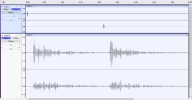
I then made up an impulse track with a 6 dB down point of 525 Hz. This has impulses from left (first)
and right (second) speakers. The equalizer is in use. I then took time responses with the cardiod mike,
top being the front facing halfway between the speakers, at the usual listening position, This is the top
response line. The bottom line is with the front of the mike facing exactly backwards from the
same position.

clivksforAudiokarma.png


Its interesting that despite the rather different gains in the equalizer below 500 Hz, the overall impression
is that the two sides are roughly equal. This is a very interesting finding and was worth buying a mike just for it.
Its an Audio-Technica ATR2500x-USB. One requirement was that it has a published response curve and published
rudimentary (few frequencies) polar curves. Its a lot higher noise floor than the omni one I got. The frequency response of the mike is
corrected by the curve I installed.

I also did the same with clicks made with a center frequence at about 800Hz, in the range of the midrange speaker.
Note that this one does not reproduce the same reflection timings as the one above, as the midrange and
woofer are at very different heights.

clivksMidrangeforAudiokarma.png

I didn't do the tweeter since I can barely hear it.

These sort of tests provide more info than possible with an omni mike.

Doug McDonald
 
Back
Top Bottom