

You are using an out of date browser. It may not display this or other websites correctly.
You should upgrade or use an alternative browser.
You should upgrade or use an alternative browser.
Unique & Distinctive Speakers
- Thread starter Yamahalic
- Start date


Yamahalic
Super Member
Eames Quadraflex
VREY COOL speakers at this site, one that caught my eye was the Quadraflex by Eames:

VREY COOL speakers at this site, one that caught my eye was the Quadraflex by Eames:

Randy Kunin’s St. Louis suburb-based Sounds by Design is doing some intersting speakers, here is one I particularly like:

Yeah, but I'll betcha it sounds like Hell, I can't think of a worse way to use a Lowther. Maybe the guy uses woofers to augment these?
Yamahalic
Super Member
Yeah, but I'll betcha it sounds like Hell, I can't think of a worse way to use a Lowther. Maybe the guy uses woofers to augment these?
Well, Randy Kunin has some compelling ideas that challenge some precepts that may be common in the audiophile world, so he seems on the edge of design & function. Keep in mind that he is an audiophile that will not compromise the aesthetic. So, his perspective seems more of the "innovate to ensure no compromise in a th art and music". He says, "I love art as much as I love music...I can blend art and audio."
Below are some comments from Randy that make for interesting reading...
On The Blackmore
Blackmore took everything I thought I knew about audio and tossed it in the trash and gave it the big middle finger. And the design has everything to do with the propagation of sound. Typically, high-efficiency drivers are either front- or rear-mounted horns. I think the problem I’ve had for so many years is that every single horn I’ve ever stood in front of sounded awesome when playing about five songs, and outside of those five songs—once you start listening to things you’d typically listen to—they’re rancid. And that’s just me, of course. Everyone listens and hears differently. But I became jaded against horns, and it wasn’t until hearing a set open-baffle at a local reviewer’s house that I was kind of turned back on. The driver wasn’t the problem; it was the application.
With the Blackmore I took the design even further and thought, well, what about eliminating all coloration? What I found out was that, even in an open-baffle design, once you start removing all the nastiness, all the little-bitty details come to light: in the baffle, we’re still introducing a form of coloration. So I decided, let’s remove that, too, and see what we can do. And I sat down and listened to them, and it was a revelation. Everything I thought I knew was wrong.
Essentially, the Blackmore is a completely colorless presentation. It’s effectively transparent.
On His Passion (misc. thoughts)
Most of my designs are very organic and rounded by nature, for the most part. So you’ll see a lot of large, rounded baffles. I usually try to mechanically align voice coils. Internally, most of my pieces are completely random. I typically create my pieces in layers, and I create as much random chaos internally as I can to kind of break up any type of internal standing waves.
I use a technique called translam. Essentially, what you do is create a master, and you continuously copy that master to create a general shape. And it’s usually done out of a wood material. I calculate my airspace that’s required, start doing some testing and simulations, and from that point on I just draw random shapes, cut them out systematically, and then along with that I’ll do a healthy amount of internal dampening and cross-bracing.
But the thing is, my designs tend to hide all of that. People don’t notice any of that neat stuff, so I have to bring it to the front page and say, “Hey, there’s some really neat stuff going on under the hood here.” But that’s good! I really want to make hi-fi an interactive medium.
If it’s a wide-band or high-efficiency driver, I tend to gravitate toward a Lowther. If it’s a lower-efficiency design, I usually use stuff from Markaudio. Depending on the speaker, I also use everything from Scan-Speak to Audio Technology to Dynaudio to Accuton—some of the very premiere drivers. It’s really a matter of what’s best for the design, though.
I’m also using Cardas Audio for all of the interconnects and connections in my builds. They’ve been incredibly supportive, as well.

Well, Randy Kunin has some compelling ideas....
Sounds like he makes a virtue of necessity; he wants to make cool looking stuff and then argues that it's sonically better that way. Like his notion that mounting Lowthers in the open gets rid of coloration; what he's getting rid of is the bass and lower midrange. I don't hold with it.
You see products like his that get more attention among the art and design crowds than among the hi-fi ones , Specimen and Scandyna come to mind.
Regards
Last edited:
Yamahalic
Super Member
The new Rethm Saadhaana speakers:

Those are cool, I looked them up and there is some cool design on the inside as well, with a claimed 102dB sensitivity with 18Hz-20Khz extension (source: their website). These have a sealed Isobaric chamber / bass labyrinth with 3 bass 6.5" drivers.

I know nothing about Randy Kunin, but I don't get the value of his comments on his speaker -- has there ever been a designer who didn't think his or her speakers were wonderful in some way or another? (The answer is no, by the way -- one of the big problems with audio is whatever you build yourself sounds great at first. Its only later you actually start hearing the thing, rather than your own advertisements.)
What I'd like to see is some explanation of why that fancy woodwork is any better than a two by four to support the tiny baffle the Lowther is on. Seems to me he has added a whole lot of parsley -- eye candy -- to a Lowther driver and wants us to think he is providing an actual speaker system.
What I'd like to see is some explanation of why that fancy woodwork is any better than a two by four to support the tiny baffle the Lowther is on. Seems to me he has added a whole lot of parsley -- eye candy -- to a Lowther driver and wants us to think he is providing an actual speaker system.
I know nothing about Randy Kunin, but I don't get the value of his comments on his speaker -- has there ever been a designer who didn't think his or her speakers were wonderful in some way or another? (The answer is no, by the way -- one of the big problems with audio is whatever you build yourself sounds great at first. Its only later you actually start hearing the thing, rather than your own advertisements.)
What I'd like to see is some explanation of why that fancy woodwork is any better than a two by four to support the tiny baffle the Lowther is on. Seems to me he has added a whole lot of parsley -- eye candy -- to a Lowther driver and wants us to think he is providing an actual speaker system.
I'm glad everyone sees through the bull....his clients however..

Poultrygeist
Lunatic Member
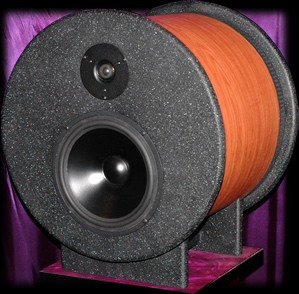
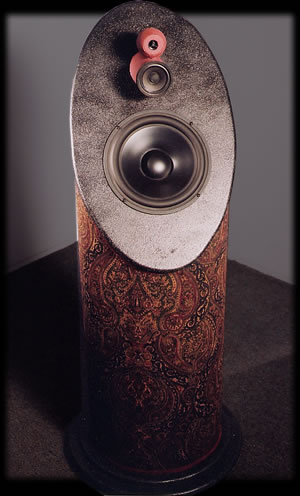
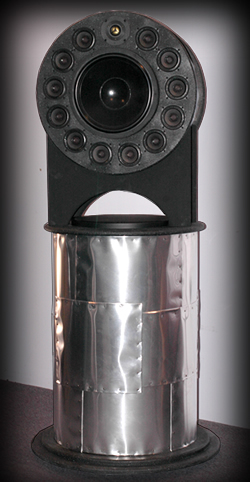
My No Baffles over "I" Baffles




dread31
Addicted Member
Here is a pair of Jack Daniels barrel speakers I found on eBay. I bought them and rebuilt them. They sound damn good.


The above pic is what they look like now. I have them at our cottage.
Cheers.
Now that gives me idears......I have one Jack Daniels barrel and can get all of the Jamaica Blue Mountain Coffee barrels I want.........Sub and satellite system?:scratch2:
Dave


Poultrygeist
Lunatic Member
My Note Hangers


BlackScholes
Active Member
I'd like to see a JBL compression driver and tweeter hung like that over a ported box.

bluesky
Lunatic Member
Here is a pair of Jack Daniels barrel speakers I found on eBay. I bought them and rebuilt them. They sound damn good.
The above pic is what they look like now. I have them at our cottage.
Cheers.
Now that is pretty cool! :thmbsp:

