• The move to the new server is done. There are some software and database maintenance updates in process. This has us passing the hat around to help out. We appreciate any donations. Seriously, even a dollar helps. The payment page may be found here - https://www.audiokarma.org/support.html

"Unmodding" an ARC SP3 Preamplifier

I think that the gain in excess was there for offering the possibilty to use low level (MC ?) cartridges
They, ARC, has that thinking in later products with phono stages rated to produce 67dB gain to main output. The SP-3 spec is 57dB to main outputs, 34dB to line level, the tape outputs.

The company is just marching to their own drum.
 
I guess. I'm not the biggest tone controls fan just because many suck and do bad things even when flat. This design is really nice because they can be fully eliminated with just a switch if desired
Understand the desire to defeat, but you kinda know the sound I like and using the Variable Loudness on the SP-3 which rotates ccw from 12:00-off to 1:00 for full effect, really sounds good 10:30-11:30, just barely engaged.

Similar to the Linear Equalizer on the Luxman gears which rotates the flat response -2, -1, 0, +1, +2 dB around 1kHz sometimes only on phono, other units on all audio. Subtle but useful to make listening more fun.

The barely engaged SP-3 loudness looks like a -1/-2 tilt on the Linear Equalizer, less shrill, more body.
 
Last edited:

High gain preamps have no benefit except perhaps in very specific circumstances where a source is well below 1V. In fact, anything more than 6dB or 7dB is pretty much unusable and often only serves to accentuate tracking errors in the volume pot. Also, there's no direct correlation between gain and dynamic range if the volume control is at the input. With the control at the input, dynamic range is determined solely by the residual noise level with inputs shorted and the maximum signal output available at the onset of clipping.

Jack
 
Hig gain preamps have no benefit except perhaps in very specific circumstances where a source is well below 1V. In fact, anything more than 6dB or 7dB is pretty much unusable and often only serves to accentuate tracking errors in the volume pots. Also, there's no direct correlation between gain and dynamic range if the volume control is at the input. With the control at the input, dynamic range is determined solely by the residual noise level with inputs shorted and the maximum signal output available at the onset of clipping.

Jack
Well, whatever the reason, the ARC pre-amp's house sound of that era didn't float my boat. I know that many (maybe most) like the sound.

I will remove myself from this thread before the Mods do (thread crapping, etc) ;)

Sorry. :(
 
Last edited:
Much of what I know about commercial audio products I learned back in college, '74 or so. ARC invented the disease and the cure. The disease was "grain" in your sound. Nobody was ever sure if they had it and certainly nobody wanted to admit to not being able to hear it. The cure, of course, was ARC products. Even then they were expensive so very few people had experience with them. I knew the SP3A1 only by reputation, but you'd have had to look hard to find anybody with a bad word against it. Unlike many things, I think that reputation has held up to today. Technically, I could throw all manner of rotten tomatoes at ARC, but mostly at their solid state and potted module products.
 
Technically, I could throw all manner of rotten tomatoes at ARC, but mostly at their solid state and potted module products
Their move to SS damn near destroyed the company. They got back to tubes quick enough to save it back then.

Wondering how the 5 new products in affordable high end prices, $5000-12,000 or so are doing. Is it saving the company this time around?
 
To challenge my ARC SP3A-1, I have an SRPP Anzaï preamplifier :

xV58Qb-P1190223.jpg


It offers superior performances...

aZ58Qb-P1190237.jpg


aZ58Qb-P1190239.jpg


bZ58Qb-P1190242.jpg


... With a simpler circuit :

XbvBQb-SRPP-ANZAI-PREAMP-BG-27-08-2023.jpg


It's a different animal, due to its passive RIAA equalization and input/output capabilities, but however, I would not throw any tomatoes to the SP3A-1... :no:

I think that there are much more costy (or not) "modern tubes and wannabee-tubes" ( i.e. a solidstate device in which a tube is thrown in to give it a tubey tone :naughty:) , that could be flooded in rotten tomato juice :idea: !

But it's me, OK ? :biggrin:;)

T
 
Understand the desire to defeat, but you kinda know the sound I like and using the Variable Loudness on the SP-3 which rotates ccw from 12:00-off to 1:00 for full effect, really sounds good 10:30-11:30, just barely engaged.
Most of why I don't generally like tone controls comes from experiencing too many bad ones. A lot of old gear has purely passive tone controls with lots of R and C, turnover points that are too close to the mid band, and don't actually go fully flat at any position. Much rather have no controls than two knobs that do nothing but make things sound worse. I don't mind tone controls that don't suck, but some of them just do and without re-designing the whole preamp there isn't much to be done about it. I don't have any particular opinions on the ARC ones, I just appreciate that they go completely out of circuit at the flip of a switch if desired.
 
Understand the desire to defeat, but you kinda know the sound I like and using the Variable Loudness on the SP-3 which rotates ccw from 12:00-off to 1:00 for full effect, really sounds good 10:30-11:30, just barely engaged.

Similar to the Linear Equalizer on the Luxman gears which rotates the flat response -2, -1, 0, +1, +2 dB around 1kHz sometimes only on phono, other units on all audio. Subtle but useful to make listening more fun.

The barely engaged SP-3 loudness looks like a -1/-2 tilt on the Linear Equalizer, less shrill, more body.

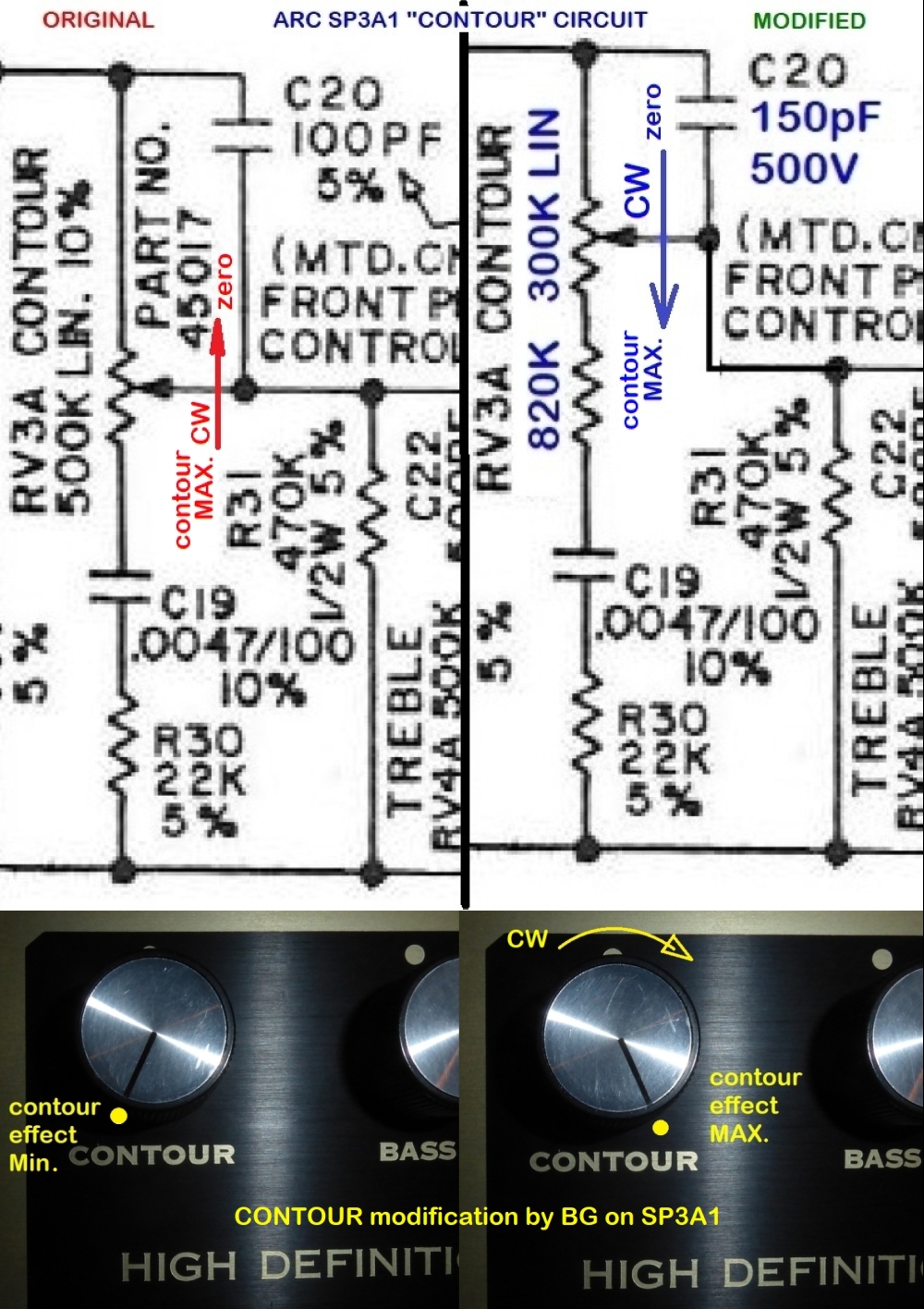
The loudness pot on my SP3A-1 had a strange behavior : it worked counterclockwise by design and was moreover useless on half the travel of the pot... :idea:

So while I was at it, I modified the ergonomics of that Variable Loudness control :

VlRLWb-CONTOUR-modification-by-BG-on-SP3A1-2.jpg


* The control goes from "no effect" (min or zero position) to "maximum enough" (fully CW position).
* When in "no effect" position, engaging or disengaging the TONE function provides no level nor tone change in the sound (assuming the Bass and Treble controls are in neutral center position).
* When in "maximum enough" position, the modded circuit maintains the best compromise between maximum loudness effect and minimum drop in volume.

This modification offers me a better balance in level between Min and MAX CONTOUR settings, and also a well-balanced, regular spread in the effect adjustment in-between. :)

T
 
Chinese manufacturing is very good at counterfeiting, and the fakes are getting better. I haven't been there in a long time, but my wife still visits every year. She always brings back stories of the counterfeit merchandise in the stores, and tells me how difficult it is now to know that it's fake just by looking or handling. If you ask a worker if it's "real," they'll laugh at you. Everyone knows. Personally, I wouldn't trust anything not sold through a legitimate Western supplier, and certainly not something sold direct from China. Hope the control you bought doesn't eventually disappoint.

Jack
A friend is one of the primary exporters of Bostitch products from China. He has to go back to China twice a year, not to check on Bostitch, but to monitor all the Mom & Pop knockoff shops around the main plant. He has a staff in China just to do this.

He says MUCH of the plans and AI software is leaked from their own employees. It’s a way for them to make money on the side.

The only thing that seems to be true is that knockoffs are made with thinner and cheaper metal alloys. They are only made to last a year or two of heavy use. Otherwise, it’s VERY hard to tell the real from the fake.
 
Last edited:
Chinese manufacturing is very good at counterfeiting, and the fakes are getting better. I haven't been there in a long time, but my wife still visits every year. She always brings back stories of the counterfeit merchandise in the stores, and tells me how difficult it is now to know that it's fake just by looking or handling. If you ask a worker if it's "real," they'll laugh at you. Everyone knows. Personally, I wouldn't trust anything not sold through a legitimate Western supplier, and certainly not something sold direct from China. Hope the control you bought doesn't eventually disappoint.

Jack
Maybe there should be two distinct categories of "fakes", i.e.

1. Crappy execution / poor quality
2. Damn! I can't tell the difference but it seems pretty good.

:banana:
 
Counterfeits are only the same when examined superficially. There's always some aspect of construction or materials that isn't up to snuff (not referring only to ALPS pots here). The culture surrounding this is derived from more than export sales. Inside the country, consumer items purchased at stores generally aren't returnable. If something stops working or falls apart two or three days after you buy it, tough luck. Very different than in the West. Ironically, products made by Western operated factories in China usually cost more in that country than they do on the shelves here. Most factories don't distribute directly into the domestic market, so products are shipped to the West, then shipped back again to select high-end retailers. I don't understand the business model that promotes this, but it sure encourages the less expensive counterfeits.

Jack
 
CAVEAT

Without a load, the preamp produces >3VDC on the outputs for a bit while the tubes warm up and the capacitor on the CF charges up. Placing a blocking capacitor on the output didn't really help -- that capacitor charges too!

This is a potential problem for my client if he uses a DC-coupled SS amp, as the DC could appear amplified on the outputs and cook woofers.

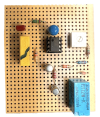
So to be on the safe side, I built a 2 minute (adjustable) time-delay for the output signal from the pre. That way the preamp will have stabilized and the output voltage drop to zero or thereabouts. The box is powered by the switched output of the preamp, so the timer starts when the pre is turned on.
 

Attachments

  • Delay box.png
    Delay box.png
    501.6 KB · Views: 6
  • Timer PCB.png
    Timer PCB.png
    924.1 KB · Views: 6
Counterfeits are only the same when examined superficially. There's always some aspect of construction or materials that isn't up to snuff (not referring only to ALPS pots here). The culture surrounding this is derived from more than export sales. Inside the country, consumer items purchased at stores generally aren't returnable. If something stops working or falls apart two or three days after you buy it, tough luck. Very different than in the West. Ironically, products made by Western operated factories in China usually cost more in that country than they do on the shelves here. Most factories don't distribute directly into the domestic market, so products are shipped to the West, then shipped back again to select high-end retailers. I don't understand the business model that promotes this, but it sure encourages the less expensive counterfeits.

Jack

I think the reality, is that most Western operated factories are NOT ALLOWED to sell directly to the Chinese consumer market.

The reality is, the companies doing the counterfeiting, are usually controlled by and/or paying off Chinese government officials or close friends of government officials. That's why they get the privilege of doing domestic business. OTOH, many Western companies operating in China, are either not connected that way, or don't make those same payoffs. So, their gear has to go out of China- and the only people allowed to re-import it, are those who DO make those payoffs.

You can be sure, that the people in the Chinese government, are going to "get theirs", somehow. That's just how China operates.

Regards,
Gordon.
 
CAVEAT

Without a load, the preamp produces >3VDC on the outputs for a bit while the tubes warm up and the capacitor on the CF charges up. Placing a blocking capacitor on the output didn't really help -- that capacitor charges too!

This is a potential problem for my client if he uses a DC-coupled SS amp, as the DC could appear amplified on the outputs and cook woofers.

So to be on the safe side, I built a 2 minute (adjustable) time-delay for the output signal from the pre. That way the preamp will have stabilized and the output voltage drop to zero or thereabouts. The box is powered by the switched output of the preamp, so the timer starts when the pre is turned on.
Interesting

Back in the day I would always turn on the preamp first wait a bit then turn on the amp.

Prevented those jarring thumps.

Conversely I would shut down the amp first to again stop those thumps

Nice fix

Frannie
 
Back
Top Bottom