A fellow AK'er sent me a great project . . . he had purchased a premium ARC SP3 preamplifier that had been "modified" [somewhat] according to Curcio Audio's recommendations, which included changing the phono RIAA curve to "correct the severe inaccuracy in the original design;" removing the phono stage cathode follower which is allegedly "responsible for serious veiling"; the line amplifier was accused of being non-linear and noisy (the reconfigurer omitted Curcio's "power supply regulator" that he claims will "deliver a truly neutral and sonically inert power supply.") There were also other functional issues, yet to be plumbed.
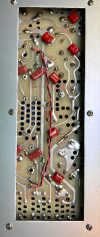
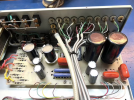
The photo of the pre (as received) speaks for itself.
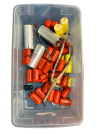
Note the abundance of Sprague Orange Drop™ caps (the guy must have gotten a great deal on 0.47 @ 400V parts. AFAIK these were added by the the modifier and not a Curcio recommendation). They were used to bypass the 50 year old electrolytic caps in the power supply – which were not replaced. Most of the coupling caps were altered: piggybacked Sparague 0.47 caps replaced single 1 MFD axial units; line stage caps were boosted from 1 MFD to 11 MFD; caps in the phono section were increased by an order of magnitude, etc. . . . I guess according to the theory that "more is better."
Note the "battery jumper cables" to the phono inputs and to the line outputs (also the modifiers decision). Red wires reveal where components have been removed and shorted out.
In my opinion:
1. "More" does not necessarily equate to "better." Designers have a reason for the values they choose and component cost is unlikely a limitation in ARC's products. (I remember increasing all of the coupling caps in a Scott 222 integrated amp [to "improve? bass response] which caused it to be unstable and "motor-boat." Lesson learned). Caps can cross-couple if placed in proximity, and "the outer foil of a cylindrical capacitor frequently acts like an unintentional antenna, picking up unwanted RF signals and introducing noise into sensitive circuits." There's a pretty good antenna array here.
2. What makes someone an "audio guru" and how can anyone discern their good advice from bad? For example, Curcio offered mods for the venerable Dynaco PAS's phono stage, claiming there was a large deviation from the RIAA curve: "Unfortunately, the moving magnet phono response of the Dynaco PAS preamplifier as designed departs significantly from the standard by as much as 5db at the lowest frequencies."
George Ronnencamp of Audio Regenesis performed a comprehensive analysis and measurement of the PAS phono stage and noted, "the RIAA equalization could be stated simply as: +0.58dB / -0.41dB 20Hz - 20KHz. This would be considered outstanding performance for any vintage preamplifier." Hardly the 5 dB error Curcio claimed.
A lot of the claims made by "experts" aren't backed up with solid (quantitative) test data. As if ARC's or Dynaco's engineers didn't have a clue?
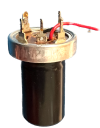
AFAIK Curcio hasn't revealed his test setup for the PAS; nor were "before and after" plots and curves of the mods provided with the the SP3 mod instructions. I disagree with the removal of a CF for a 12AX7 phono stage, so I decided to take all of the recommended mods with a grain of salt and try to restore the unit as much as I could to its original condition so that the other issues could be dealt with (with the exception of changing the large cans in the power supply and adding smaller 0.1 MFD bypass caps).
And so the work begins . .

The photo of the pre (as received) speaks for itself.
Note the abundance of Sprague Orange Drop™ caps (the guy must have gotten a great deal on 0.47 @ 400V parts. AFAIK these were added by the the modifier and not a Curcio recommendation). They were used to bypass the 50 year old electrolytic caps in the power supply – which were not replaced. Most of the coupling caps were altered: piggybacked Sparague 0.47 caps replaced single 1 MFD axial units; line stage caps were boosted from 1 MFD to 11 MFD; caps in the phono section were increased by an order of magnitude, etc. . . . I guess according to the theory that "more is better."
Note the "battery jumper cables" to the phono inputs and to the line outputs (also the modifiers decision). Red wires reveal where components have been removed and shorted out.
In my opinion:
1. "More" does not necessarily equate to "better." Designers have a reason for the values they choose and component cost is unlikely a limitation in ARC's products. (I remember increasing all of the coupling caps in a Scott 222 integrated amp [to "improve? bass response] which caused it to be unstable and "motor-boat." Lesson learned). Caps can cross-couple if placed in proximity, and "the outer foil of a cylindrical capacitor frequently acts like an unintentional antenna, picking up unwanted RF signals and introducing noise into sensitive circuits." There's a pretty good antenna array here.
2. What makes someone an "audio guru" and how can anyone discern their good advice from bad? For example, Curcio offered mods for the venerable Dynaco PAS's phono stage, claiming there was a large deviation from the RIAA curve: "Unfortunately, the moving magnet phono response of the Dynaco PAS preamplifier as designed departs significantly from the standard by as much as 5db at the lowest frequencies."
George Ronnencamp of Audio Regenesis performed a comprehensive analysis and measurement of the PAS phono stage and noted, "the RIAA equalization could be stated simply as: +0.58dB / -0.41dB 20Hz - 20KHz. This would be considered outstanding performance for any vintage preamplifier." Hardly the 5 dB error Curcio claimed.
A lot of the claims made by "experts" aren't backed up with solid (quantitative) test data. As if ARC's or Dynaco's engineers didn't have a clue?
AFAIK Curcio hasn't revealed his test setup for the PAS; nor were "before and after" plots and curves of the mods provided with the the SP3 mod instructions. I disagree with the removal of a CF for a 12AX7 phono stage, so I decided to take all of the recommended mods with a grain of salt and try to restore the unit as much as I could to its original condition so that the other issues could be dealt with (with the exception of changing the large cans in the power supply and adding smaller 0.1 MFD bypass caps).
And so the work begins . .
Last edited: