• The move to the new server is done. There are some software and database maintenance updates in process. This has us passing the hat around to help out. We appreciate any donations. Seriously, even a dollar helps. The payment page may be found here - https://www.audiokarma.org/support.html

"Unmodding" an ARC SP3 Preamplifier

A fellow AK'er sent me a great project . . . he had purchased a premium ARC SP3 preamplifier that had been "modified" [somewhat] according to Curcio Audio's recommendations, which included changing the phono RIAA curve to "correct the severe inaccuracy in the original design;" removing the phono stage cathode follower which is allegedly "responsible for serious veiling"; the line amplifier was accused of being non-linear and noisy (the reconfigurer omitted Curcio's "power supply regulator" that he claims will "deliver a truly neutral and sonically inert power supply.") There were also other functional issues, yet to be plumbed.

The photo of the pre (as received) speaks for itself.

Note the abundance of Sprague Orange Drop™ caps (the guy must have gotten a great deal on 0.47 @ 400V parts. AFAIK these were added by the the modifier and not a Curcio recommendation). They were used to bypass the 50 year old electrolytic caps in the power supply – which were not replaced. Most of the coupling caps were altered: piggybacked Sparague 0.47 caps replaced single 1 MFD axial units; line stage caps were boosted from 1 MFD to 11 MFD; caps in the phono section were increased by an order of magnitude, etc. . . . I guess according to the theory that "more is better."

Note the "battery jumper cables" to the phono inputs and to the line outputs (also the modifiers decision). Red wires reveal where components have been removed and shorted out.

In my opinion:

1. "More" does not necessarily equate to "better." Designers have a reason for the values they choose and component cost is unlikely a limitation in ARC's products. (I remember increasing all of the coupling caps in a Scott 222 integrated amp [to "improve? bass response] which caused it to be unstable and "motor-boat." Lesson learned). Caps can cross-couple if placed in proximity, and "the outer foil of a cylindrical capacitor frequently acts like an unintentional antenna, picking up unwanted RF signals and introducing noise into sensitive circuits." There's a pretty good antenna array here.

2. What makes someone an "audio guru" and how can anyone discern their good advice from bad? For example, Curcio offered mods for the venerable Dynaco PAS's phono stage, claiming there was a large deviation from the RIAA curve: "Unfortunately, the moving magnet phono response of the Dynaco PAS preamplifier as designed departs significantly from the standard by as much as 5db at the lowest frequencies."

George Ronnencamp of Audio Regenesis performed a comprehensive analysis and measurement of the PAS phono stage and noted, "the RIAA equalization could be stated simply as: +0.58dB / -0.41dB 20Hz - 20KHz. This would be considered outstanding performance for any vintage preamplifier." Hardly the 5 dB error Curcio claimed.

A lot of the claims made by "experts" aren't backed up with solid (quantitative) test data. As if ARC's or Dynaco's engineers didn't have a clue?

AFAIK Curcio hasn't revealed his test setup for the PAS; nor were "before and after" plots and curves of the mods provided with the the SP3 mod instructions. I disagree with the removal of a CF for a 12AX7 phono stage, so I decided to take all of the recommended mods with a grain of salt and try to restore the unit as much as I could to its original condition so that the other issues could be dealt with (with the exception of changing the large cans in the power supply and adding smaller 0.1 MFD bypass caps).

And so the work begins . .

View attachment 3787967

Curcio's work was debunked long ago...
 
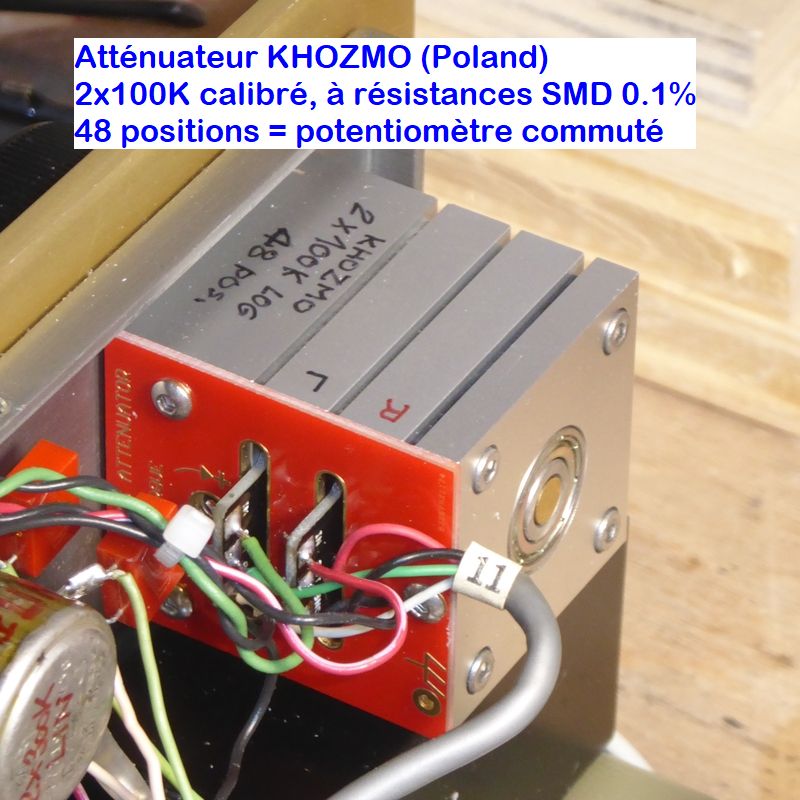
I use the Khozmo 48-step 100K series attenuator in my own SP-3A-1. A wonderful component, but pricy.
With ARC looking for at least $125 for the Blue Velvet and a couple caps, that puts these pricey options in a better position. Sure a bit more but better and the preamp is still a legend worth the time and money.
 
I've read that, its a well done piece that confirms the Dynaco guys weren't idiots, which is backed up by data from decades ago when the PAS was in current production.

What I meant was I'm curious how Curcio came to the conclusions they did, which just don't seem to jive with the results from others.

1782392564100.png

I can't honestly say I've seen other sources claiming "severe inaccuracy" in the SP3 phono response. They claim this with the PAS too though so I wonder if perhaps there is a problem with the test method on their end, and the "correction" is actually compensating for that issue, not any actual fault by ARC or Dynaco.
 
I can't honestly say I've seen other sources claiming "severe inaccuracy" in the SP3 phono response. They claim this with the PAS too though so I wonder if perhaps there is a problem with the test method on their end, and the "correction" is actually compensating for that issue, not any actual fault by ARC or Dynaco.
It would be interesting to compare the original VS the modified design in LT Spice. Unfortunately I'm in the middle of two other projects at the moment. It's unfortunate Curcio doesn't mention how those conclusions were derived.

Jack
 
I've read that, its a well done piece that confirms the Dynaco guys weren't idiots, which is backed up by data from decades ago when the PAS was in current production.

What I meant was I'm curious how Curcio came to the conclusions they did, which just don't seem to jive with the results from others.

View attachment 3789153

I can't honestly say I've seen other sources claiming "severe inaccuracy" in the SP3 phono response. They claim this with the PAS too though so I wonder if perhaps there is a problem with the test method on their end, and the "correction" is actually compensating for that issue, not any actual fault by ARC or Dynaco.
Do you recall "The Last PAS" series of articles in Audio Amateur? The RIAA compensation network was majorly modified too.
 
I've read that, its a well done piece that confirms the Dynaco guys weren't idiots, which is backed up by data from decades ago when the PAS was in current production.

What I meant was I'm curious how Curcio came to the conclusions they did, which just don't seem to jive with the results from others.

View attachment 3789153

I can't honestly say I've seen other sources claiming "severe inaccuracy" in the SP3 phono response. They claim this with the PAS too though so I wonder if perhaps there is a problem with the test method on their end, and the "correction" is actually compensating for that issue, not any actual fault by ARC or Dynaco.

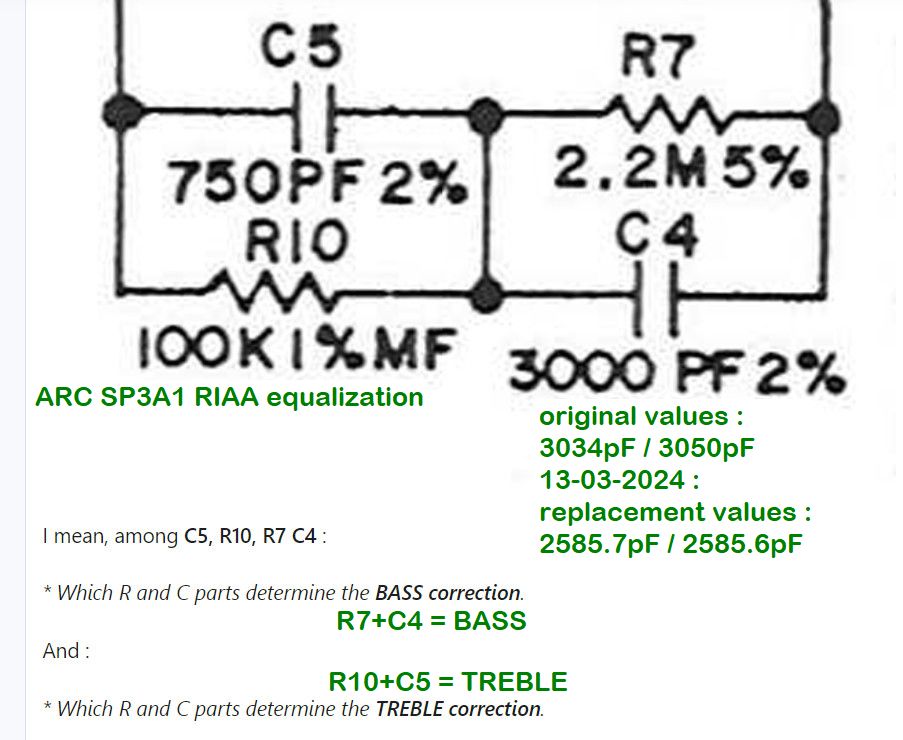
With a slight modification of the RIAA network of my SP3A-1 :

tC6KRb-2024-03-03-012905.jpg


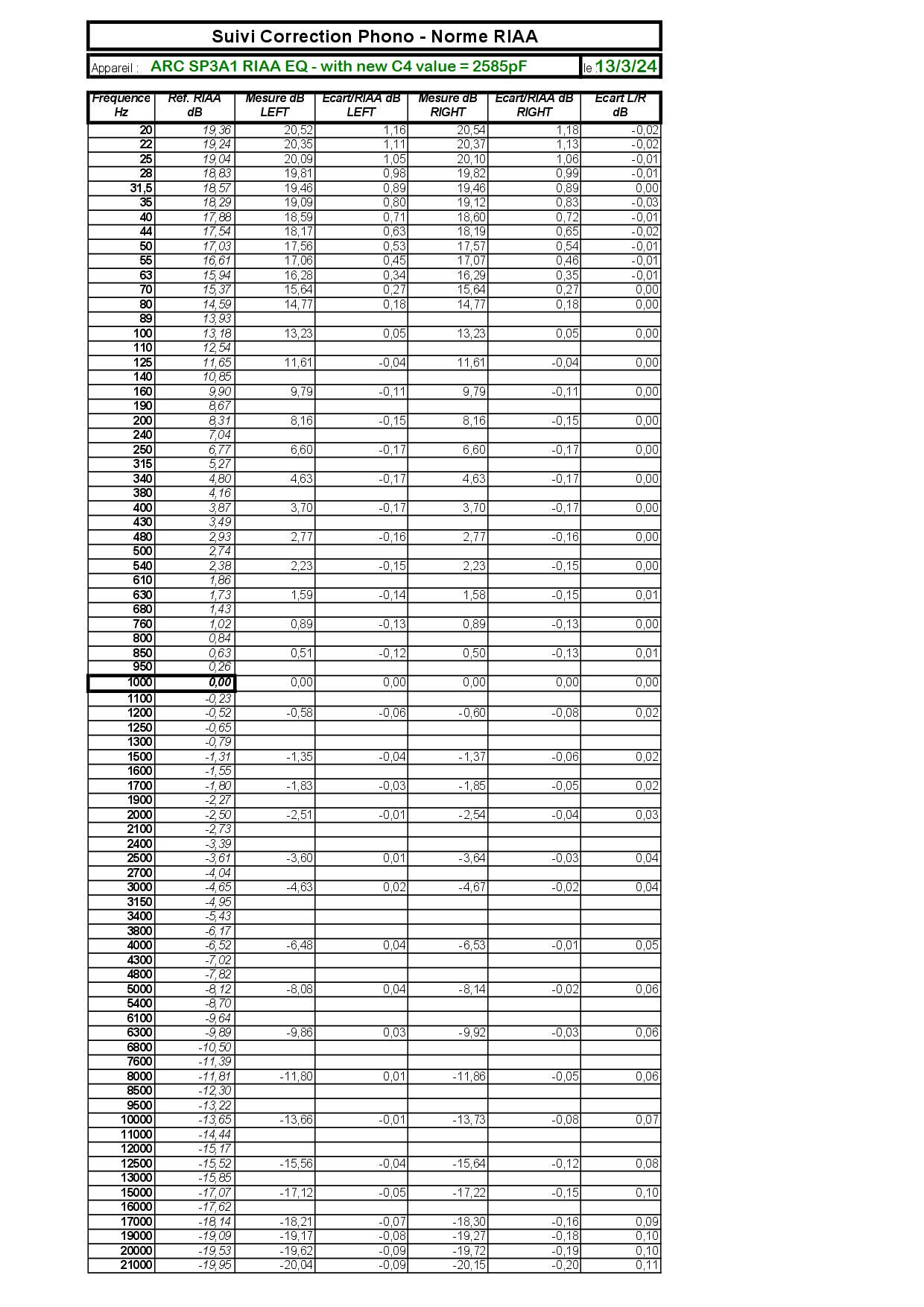
I came to these results which I found very satisfactory - for me, at least ;):

fM6KRb-TABLE-MESURE-RIAA-SP3A1-13-03-2024.jpg

T
 
If you need a volume control…I’ve got Goldpoints in my Foreplay Bottlehead and Tom had a Black Beauty in his SP-3A-1 I restored.

Goldpoint level controls should fit but they are a bit more expensive at $165 for 24-step and $246 for 47-step. They are almost top rated units. @tubelectron selected a Khozmo 48-step unit. Similar in price to the Goldpoint in € plus shipping, tariff and such.

Either should be Alps Black Beauty equals or better and this long discontinued Alps is superior to the Blue Velvet which has only a handful of values left in production.

That's it, exactly @Blue Shadow :) :

BV9HRb-P1190721.jpg


T
 
With a slight modification of the RIAA network of my SP3A-1 :

tC6KRb-2024-03-03-012905.jpg


I came to these results which I found very satisfactory - for me, at least ;):

fM6KRb-TABLE-MESURE-RIAA-SP3A1-13-03-2024.jpg

T
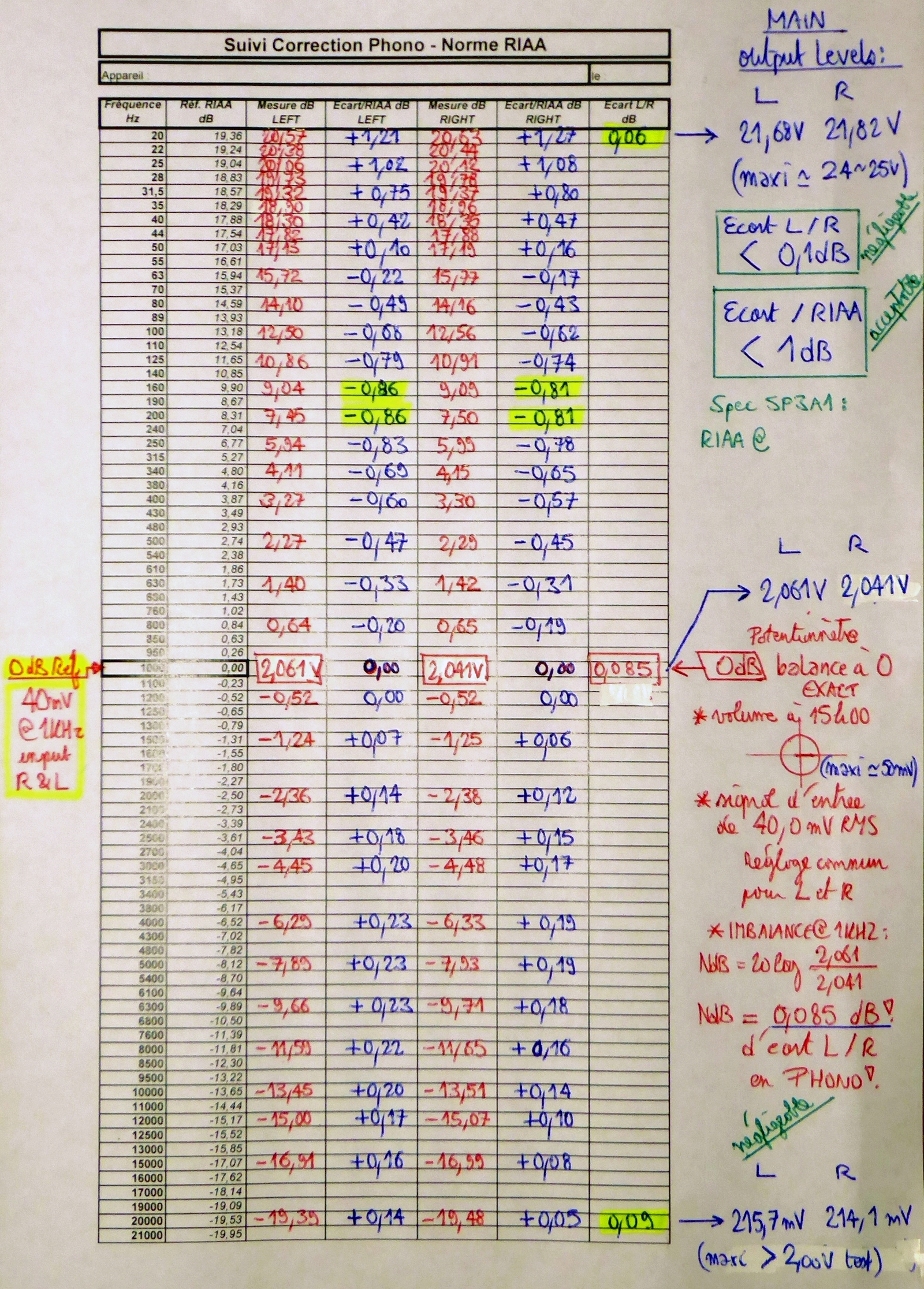
What do the "before" numbers look like? I'm just curious how much of a change this makes. Looks like you're up about +1dB at the bottom, and I'm assuming in stock form it would have been down somewhat?
 
The Goldpoint is the superior option. I've installed both that and a Blue Velvet. I still wish there was a solution with less drilling and the correct shaft length.
 
This schematic was posted earlier in the thread. Is it the correct phono circuit for the preamp under discussion? Which tube types are being used?

Jack

1782228021845.png
 
What do the "before" numbers look like? I'm just curious how much of a change this makes. Looks like you're up about +1dB at the bottom, and I'm assuming in stock form it would have been down somewhat?

Here they are - handwritten, sorry. No huge difference, of course... Let's say that I "recalibrate-rebalanced" the RIAA equalization (see post 53 for the recalibrated measurements, in the same conditions) :

JqdJRb-mesure-RIAA-09-03-2024.jpg


T
 
At a quick glance, it appears your changes made the most significant improvement in the area very generally around 150Hz to 400Hz. Is that correct? I have to say, the original response isn't too bad, probably flatter than most cartridges. That's especially likely if cartridge loading hasn't been properly matched on the bench with a test record. "Normal" loading can easily skew upper frequency response by 5dB or more due to cartridge inductance.

Jack
 
thats the info I was curious about, so easily flat within 1.5dB in stock form and under 1dB from 28hz to 20K. Hardly what I'd call "significant" or whatever spooky language Curcio used to describe it.
 
Back
Top Bottom