• The move to the new server is done. There are some software and database maintenance updates in process. This has us passing the hat around to help out. We appreciate any donations. Seriously, even a dollar helps. The payment page may be found here - https://www.audiokarma.org/support.html

"Unmodding" an ARC SP3 Preamplifier

Was it Curcio that came up with that goofy SS driver board for the ST-70?
I saw a picture a few years back of that silly SS board with a description claiming how much better it was than the original Dynaco rube based driver board.
I just didn't see the point of the thing. I don't remember ever seeing any Curcio mods that I would have wanted to do to an amp or preamp.
 
This is great info. The unit has a 500K control, and I can't find a 500K ALPS replacement. I wonder why ARC chose a 100K pot when 250K ALPS pots are readily available?
Why do you feel it needs replaced?
My mention of unequal volume indicated i did not believe it was a bad control. Did you find out otherwise through testing? Ive been wrong before!
If its needing replaced, i rather pay a premium for the "gooch" than see an original pot in there known for failure. If i have my rathers.
 
If its needing replaced, i rather pay a premium for the "gooch" than see an original pot in there known for failure.
ALPS pots aren't known for failure. They typically last for decades. For that matter, so do most of the mass-produced carbon track pots produced in the '60s and '70s. Everything wears out eventually though, including rotary switches. The advantage to the switched pots is their resettability and tracking precision. Honestly though, I don't hear tracking issues even with most $4 Alpha pots.

Jack
The only pots I've come across that didn't track evenly were either just plain worn out due to age, or the pots Realistic used in there integrated amps and receivers. Both rotory and sliders. I've come across two realistic integrated amps, one that I had bought new in '75. It along with one I got around 8 years ago. Both had volume pots that didnt track evenly. One channel would start passing signal before the other and one channel would have lower volume until around 9:00. The receivers did the same thing even though they had sliders.
I replaced the dual volume pot in the second amp I got and it fixed the problem.
They used cheap junk pots I guess.
I've had two of the fake ALPS blue velvet pots fail. The one just kept turning all the way around, the stop was broken brand new out of the box. The second one became scratchy and had drop outs after just a few months of use.
But most of the existing pots and selectors in older gear worked great after a good cleaning.
 
Same, any new pots I've used, even very cheap ones, track just fine. The ones that were off were decades old. Also mostly US made, I've rarely had problems with Japanese pots from the 70s. Haven't messed with any of their 60s stereo gear to really have any feel for failure rates on those pots. Not sure if pots just got better after the tube era or what.
 
ALPS pots aren't known for failure. They typically last for decades. For that matter, so do most of the mass-produced carbon track pots produced in the '60s and '70s. Everything wears out eventually though, including rotary switches. The advantage to the switched pots is their resettability and tracking precision. Honestly though, I don't hear tracking issues even with most $4 Alpha pots.

Jack
My comment specified the "original " pot having been known for failure. Not the Alps.
 
Same, any new pots I've used, even very cheap ones, track just fine. The ones that were off were decades old. Also mostly US made, I've rarely had problems with Japanese pots from the 70s. Haven't messed with any of their 60s stereo gear to really have any feel for failure rates on those pots. Not sure if pots just got better after the tube era or what.
The worst I've come across were in Realistic gear. Volume controls, tone controls, and selectors. Maybe the pots were made in Taiwan? Some pretty flaky stuff used to come out of Taiwan.
Even in the 90's they were still producing a lot of cheap and counterfeit products.
When I worked at a distribution center, one of the containers from Taiwan was full of counterfeit sun glasses. We had to close it up and it got hauled away to have them all destroyed. The funny thing was they were fakes of some cheap brand to begin with. :rolleyes:
 
Here they are - handwritten, sorry. No huge difference, of course... Let's say that I "recalibrate-rebalanced" the RIAA equalization (see post 53 for the recalibrated measurements, in the same conditions) :
I took a few minutes this afternoon to model the circuit in LT Spice. The result agrees substantially with your physical measurements. I arrived at 2500pF for C4 and 1.8M at R7 to produce flattest response. However, the difference between these values and yours would have no audible impact in the real world. Also, rather than use a chart, I feed the model with a reverse RIAA. There are a few different models of this floating around, and while they are all extremely close, there are minor response differences. I have also noted that not all the RIAA charts published online are in perfect agreement. In any event, this is mostly academic. I have no doubt it would be extremely difficult if not impossible to hear a difference between ARC factory values and the revised circuit. The bottom line is that there are no significant errors, and no reason to modify the ARC phono stage for most purposes.

Jack
 
My comment specified the "original " pot having been known for failure. Not the Alps.
Perhaps I misunderstood the OP. I thought he said the original was ALPS. Regardless, is it known for early failure, or just poor performance after many years of use?

Jack
 
The ARC original is known weak spot. We are talking about a preamp that it’s most used control is, if original, at least 60 years old. I have my old original in the audio extras drawer upstairs but don’t think we need to investigate it at this time. When cleaning didn’t help I just bought what ARC was selling and replaced the controlland the two phono stage caps included with the Alps control.

If I were to replace a volume control today, I’d Gold Point or Khozmo the preamp.
 
I didn't notice any issue with my volume control, and it is the very first model, ARC SP3. Not sure if wear is the culprit as by the looks of it my unit looks very low usage, so maybe the issue is more wear related rather than sitting unused.

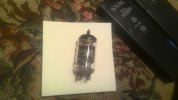
Did these come from the factory with Ampex tubes as that is what was in all the sockets.
 
I didn't know that. I have all eight of them in a box as I checked them and they tested very good, so I removed them and put 8 new Mullard reissues in the unit and planed on saving the originals for if I decided to resell the ARC.

WIN_20260628_14_24_56_Pro.jpg


WIN_20260628_14_23_51_Pro.jpg
 
A bit more on the volume control: the owner originally noted there was a channel volume imbalance, and then later added that he didn't think the gain or volume pot was the culprit. The original 500K pot doesn't have a huge amount of tracking error when tested with an ohmmeter only (as noted, I didn't give it a listen first). It may be OK -- I always return the original parts anyway.

I thought a genuine ALPS would be an upgrade -- they tend to track closely and the "feel" of the control is very nice (that's one way you can tell some of the fakes -- they have a totally different rotational feel). The gain (volume) control is the most used pot in the preamp, and the genuine ALPS have a reputation for great reliability. The guy I'm getting it from is more anal than my G.I. doc -- I'm certain it's not a fake.

I presented the findings and options to the client to make a final decision. My job is to make folks happy; I'll only go to the mat when I think something is critical, and AFAIK this volume pot isn't . . .
 
Last edited:
I presented the findings and options to the client to make a final decision. My job is to make folks happy; I'll only go to the mat when I think something is critical, and AFAIK this volume pot isn't . . .
Forgive me, I was lazy and didn't want to go through the entire thread. What do you think is causing this channel imbalance, if it isn't the volume or balance pot? Or the circuits around those two controls?

Thanks!

:thumbsup:
 
Last edited:
When doing a restore for a customer it seems logical to replace all the known issues associated with a unit, and that volume pot seems to come up a lot. So if you want to get everything on a list to purchase so you can do a timely restore it would seem to make sense to add the pot on the list. He indicated he was unable to listen to the unit due to a number of issues so to gather all the parts to do a complete restore at one time seems sensible to me. I can't speak for the OP but I would rather a tech go for a complete job rather than have to have them do it piece meal and keep having to wait while other issues come up after one another.
 
be easy enough to measure it in circuit to see what its doing. I often use my scope in 'add' mode for this sort of thing. Invert one channel, add them together, make sure the v/div settings match, anything that shows up on the screen is an imbalance. Needs to be fed from a mono source but a Y cable provides that easily enough. If the signal in and out of the volume pot matches, the pot isn't causing balance problems.

whether or not you want to replace it as a preventative is another matter but checking it before replacing things would give a solid idea if thats likely to fix anything or not.
 
Forgive me, I was lazy and didn't want to go through the entire thread. What do you think is causing this channel imbalance, if it isn't the volume or balance pot? Or the circuits around those two controls?

Thanks!

:thumbsup:
I don't know at this point. Wires were cut . . . etc. I have to be able to duplicate and quantify the problem.
 
OK . . . here's my approach on this, so y'all can enlighten me. Hopefully this 70 year-old hack can still learn a few things, although I know I ain't the brightest bulb on the tree. :banana:

Bear with me . . .

A good client sent me an SP3 to work on -- says it has an imbalance problem; wires have been cut; and many of Curcio's mods were done to the unit, but not the full magilla. He reported that the unit makes a lot of noise and vibrates the speaker cones (not entirely sure of the frequency, whether it is subsonics or something else.). The PS can caps are original.

My friend Dave G. has an SP3 and he's very happy with it. I asked him if he did any mods, and he said he changed the volume control to an ALPS (500K) because the original didn't track well, and added a resistor or two for an imbalance with the bass control, IIRC. Otherwise it's stock. He's pretty fussy about sound and he assesses performance of most things using test gear. I conclude the stock SP3 is capable of fine performance -- at least enough to impress Dave.

I unbox and open the unit and the Sprague Orange Drops pop out like plague buboes. WTF was the modifier thinking? Not only do they look bad, they aren't affixed very well, as I noted before (they weren't part of the Curcio mods). So, seeing that the PS caps are original, and noting cut wires (among the various other mods like battery-cable jumpers [a little hyperbole never hurt anyone, right?] I decided not to power it up in that condition.

Having zero faith in Curcio's "improvements", I thought the best approach would be to bring the unit back to stock and then troubleshoot any problems, in case the mods caused any of them.

Given that: a) Dave had a problem with the volume control; b) the client had a problem with channel imbalance; c) the volume pot gets the most use of any of them; d) ARC sells a replacement kit for the original control, and e) the ALPS is considered an upgrade by some, I decided to locate and order a replacement just for that control, in advance of powering the unit. Was that bad judgement? I let the customer decide whether he wanted the ALPS or the original pot if I reinstalled it and it worked, and he chose the ALPS.

I like to think I have good reasons for doing things, but sometimes I do things heuristically and other times "play the odds."

For example, when I am recapping a piece of gear, I often just "shotgun" the project and replace them all without testing. Other times I'll check ESR and capacity before I swap one out. Today I repaired a Marantz MA6100 SS mono amplifier . . . almost every one of the small caps tested bad - I checked each with an ESR meter, as well as the replacement caps which is time-consuming. I did the same for a 2nd unit . . . the smarter thing would have been to just replace and not check unit #2. (The bad caps were almost all Elna brand . . . I've since revised my opinion of their quality over time).

Not all mods are good and not all are bad. The only way to really know is to do empirical testing. Which I am guilty of rarely doing.

In addition to restoring the original circuity, I also made some improvements in the SP3 . . . like replacing the cans; many carbon-comp resistors; and jettisoning the battery cables. I'll lube the controls and then give it a good test and listen.

After I started the thread that the client clarified (or maybe it was only after that I heard what he might have already told me) that he believed the volume control wasn't the culprit for the channel imbalance, and he didn't think the unit had much actual usage, so the parts that usually wear out probably haven't. Had I absorbed that ab initio, my approach might have varied a tad. But then maybe not.

I'll know more once I get everything installed and the testing begins . . .

 
When you say the wires were cut — all the wiring was cut?

What is the status of the unit right now? Have you started restoring it to the OEM specs? Have you decided to do this? And which specific parts are you using for this restoration?

Thanks!
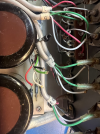
Two wires were cut. There was also a (cut) four-conductor cable going nowhere. See pics. I've completed most of the restoration. I'm using PP devices on the coupling caps and metal oxide power resistors; good quality electrolytics, etc. I think some of the original caps were mylar. Awaiting the ALPS and need to make a few signal wire connections to finish that part.

I'll post final pics.
 

Attachments

  • More loose ends.png
    More loose ends.png
    636 KB · Views: 23
  • No connection L Channel.jpg
    No connection L Channel.jpg
    164.2 KB · Views: 24
Last edited:
All seems reasonable enough, but just before buying a volume control I'd probably still confirm if its the problem before buying one, but after putting it back to stock with fresh caps. Pretty reasonable guess it is, but just in case there is some other problem in addition to the control it would be useful to confirm that first.
 
Back
Top Bottom