


caxton1476
New Member
Now, here is a curious thing.
Just when it seemed harder than ever to discover truly interesting hi-fi stuff at local thrift shops, I stumbled into something unique and fun and worth experimenting with.
Here's what I found.
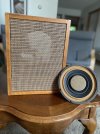
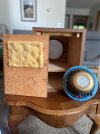
A pair of unbranded, apparently bespoke speakers fabricated from 3/4" furniture-grade plywood, measuring 15.5" tall, 12" wide, 14" deep (that is, front baffle is 15.5"x12"). When I found them in the thrift shop, they were sitting on a shelf. After purchase, I learned they were originally bundled with a matching cabinet that had a couple of compartments, one of which was large enough to hold both speakers. The main compartment of the cabinet also apparently had a shelf with a functioning fan to exhaust heat, but no amplifier was in the cabinet itself. I REALLY want to know what was in there.
The drivers appear to be some kind of triaxial Utah unit from 1962, based on a number printed on the back. The model number is D-35 (I think), and the serial number is 328622. A few online sources suggest the last three digits indicate a production date of February 1962.
Driver dimensions:
Outside diameter: 8"
Bass cone: 7" (including pleated paper surround)
Midrange cone: 4.25"
Tweeter cone: 3"
The paper surrounds seem to be in terrific condition, which is pretty incredible.
As you can see from the photos, the speaker cabinet is a kind of ported design, with a wide port segregated from the main driver compartment by an internal divider.
Where's all this going?
I'd love to preserve as much of these as I can while bringing a few elements up to modern standards. By that I mean upgrading the insulation from ancient fiberglass batts, adding binding posts (note that the speakers originally were wired directly to the driver's own binding posts), and that's about it. Definitely not replacing that gorgeous grille cloth. Other thoughts: a bit of closed-cell or felt between the driver and the baffle, maybe some kind of seal around that removable back panel?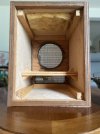
I used to do "respectful restorations" of vintage road bikes that integrated modern gear that was a functional upgrade to bikes that had good bones - e.g. adding better cables, better brake pads, replacing steel rims with alloy rims, etc. The soul of the bike was retained, but the ride experience was improved, as was its basic functionality. (Steel rims are utterly gorgeous when in perfect shape, and also a curse to maintain.)
That's what I want to do here. I want to hook these up to my Sansui AU-555a and play some old Decca record, probably jazz or country or folk, and hear what 1962 heard.
I welcome your suggestions.
BTW - my wife did a little internet sleuthing. These might have been fabricated for a B.C. Krause, who seems to be the founder of the very Iowa-centric convenience store chain called, to the great amusement of so many, Kum-and-Go. We're in Decorah, Iowa, so that tracks. I really wish I could have picked up the main cabinet for these, as well as (can you imagine?) the amp that it housed. Dynaco, maybe?
Just when it seemed harder than ever to discover truly interesting hi-fi stuff at local thrift shops, I stumbled into something unique and fun and worth experimenting with.
Here's what I found.
A pair of unbranded, apparently bespoke speakers fabricated from 3/4" furniture-grade plywood, measuring 15.5" tall, 12" wide, 14" deep (that is, front baffle is 15.5"x12"). When I found them in the thrift shop, they were sitting on a shelf. After purchase, I learned they were originally bundled with a matching cabinet that had a couple of compartments, one of which was large enough to hold both speakers. The main compartment of the cabinet also apparently had a shelf with a functioning fan to exhaust heat, but no amplifier was in the cabinet itself. I REALLY want to know what was in there.
The drivers appear to be some kind of triaxial Utah unit from 1962, based on a number printed on the back. The model number is D-35 (I think), and the serial number is 328622. A few online sources suggest the last three digits indicate a production date of February 1962.
Driver dimensions:
Outside diameter: 8"
Bass cone: 7" (including pleated paper surround)
Midrange cone: 4.25"
Tweeter cone: 3"
The paper surrounds seem to be in terrific condition, which is pretty incredible.
As you can see from the photos, the speaker cabinet is a kind of ported design, with a wide port segregated from the main driver compartment by an internal divider.
Where's all this going?
I'd love to preserve as much of these as I can while bringing a few elements up to modern standards. By that I mean upgrading the insulation from ancient fiberglass batts, adding binding posts (note that the speakers originally were wired directly to the driver's own binding posts), and that's about it. Definitely not replacing that gorgeous grille cloth. Other thoughts: a bit of closed-cell or felt between the driver and the baffle, maybe some kind of seal around that removable back panel?
I used to do "respectful restorations" of vintage road bikes that integrated modern gear that was a functional upgrade to bikes that had good bones - e.g. adding better cables, better brake pads, replacing steel rims with alloy rims, etc. The soul of the bike was retained, but the ride experience was improved, as was its basic functionality. (Steel rims are utterly gorgeous when in perfect shape, and also a curse to maintain.)
That's what I want to do here. I want to hook these up to my Sansui AU-555a and play some old Decca record, probably jazz or country or folk, and hear what 1962 heard.
I welcome your suggestions.
BTW - my wife did a little internet sleuthing. These might have been fabricated for a B.C. Krause, who seems to be the founder of the very Iowa-centric convenience store chain called, to the great amusement of so many, Kum-and-Go. We're in Decorah, Iowa, so that tracks. I really wish I could have picked up the main cabinet for these, as well as (can you imagine?) the amp that it housed. Dynaco, maybe?


