• The move to the new server is done. There are some software and database maintenance updates in process. This has us passing the hat around to help out. We appreciate any donations. Seriously, even a dollar helps. The payment page may be found here - https://www.audiokarma.org/support.html

Upgrading Parasound D/AC-1100 to PCM63P-K

karljansen

AK Subscriber
Subscriber
The Parasound D/AC-1100 is the unit that got me into the late 90s line of Parasound components and was my first external DAC. A local record shop let it go for $75 and I was hooked. Since then I've gone down the DAC rabbit hole, spending untold hours reading about the different chips, R2R vs delta-sigma, vintage vs new, and people debating whether anyone can tell the difference between cheap and expensive DACs (turns out they can). I'm not even sure that I can tell the difference, I just know that I really like the sound of the D/AC-1100 and I love the sound of the D/AC-2000 that I upgraded to a couple of years later.

This brings me to the subject of the PCM63 line of chips. The D/AC-1100 came with a pair of PCM63P-J's (one per channel), which is the mid-grade version, and the higher-end D/AC-1600 came with four (2 per channel) of the top of the line PCM63P-K chip. The improvement in sound between the two chips will likely be subtle and it's possible I won't even be able to tell the difference, but being an obsessive I decided to try to find two vintage "K" chips on ebay. Of course, I also wonder how much better the D/AC-1600 sounds with its 2 chips per channel, but that's a separate comparison.

The big questions:

My understanding is that this is a simple, drop-in replacement that someone like myself with practically zero electronics skills can do myself. Is that truly the case, and is there anything I should be aware of before I swap the chips? Any chance of damaging the unit if one of the chips is faulty? This will only be the second time I have opened something up, popped out an IC, and swapped in something new. In that case it was a firmware chip for a vintage Oberheim rack synth and everything worked fine.

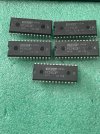
Has anyone here done this upgrade, and if so, how concerned were you with getting sent fake chips? All of the vintage PCM63 chips I could find on ebay are coming from China, and while I did suspect some of them were fake based on the photos and the number of negative reviews, I ended up purchasing two for $100 each from a seller in Shenzen who has sold over 12,000 items and has a 100% positive feedback score. The seller is HIFI AUDIO IC and they appear to specialize in reclaimed DAC chips from vintage gear. Here's a pic of the five PCM63P-K's that were available, two of which I purchased:
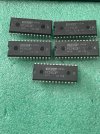
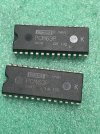
s-l1600.jpg s-l16001.jpg

Scrolling through the seller's other items I get the strong impression that what they're selling is authentic, because it all looks like it really was pulled out of old equipment. Any advice or guidance from fellow AK members with experience in this area is appreciated.

For reference, I've attached the original PCM63 spec sheet which shows the minimal gains in dynamic range and reduced THD I will get and probably not even be able to discern, making the music sound more holographic, spacious, and detailed just knowing I have the K rather than the J chips ;)

Edit: a couple of useful links I found on various forums with comprehensive lists of the different DAC chips and the devices they were used in:


Attachments

Last edited:
Register to hide this ad
In this day and age $200 buys a brand new DAC that’s miles ahead of those Parasound units, J or. K-chips. Just saying.

Any vintage chip coming from China should be suspect. Rumor is some sellers were able to get hold of chips that while original were found to be defective back in the days and never reached distribution channels . The only reliable way to confirm improvements or otherwise after a chip swap is through measurements using an audio analyzer. As for damaging your DAC, it’s not impossible say if the chip has internal short. Good luck.
 
In this day and age $200 buys a brand new DAC that’s miles ahead of those Parasound units, J or. K-chips. Just saying.

Any vintage chip coming from China should be suspect. Rumor is some sellers were able to get hold of chips that while original were found to be defective back in the days and never reached distribution channels . The only reliable way to confirm improvements or otherwise after a chip swap is through measurements using an audio analyzer. As for damaging your DAC, it’s not impossible say if the chip has internal short. Good luck.
I actually did buy a $200 DAC that I haven't received yet: the Fiio K11 R2R ($170). Since it uses R2R architecture on a new, proprietary chip developed by that company (in China, of course) it may not be as good as the Parasound units, or it might end up sounding just as good. I'm interested to find out.

With respect to the used PCM63's, I hadn't come across the rumor about defective chips entering the secondary market. What I'm trying to do is clearly fraught with danger and may not end up being worth the risk, although I did post photos of the chips from the listing and a link to the seller's store with 100% positive feedback on over 12,000 transactions. When I get them in a couple of weeks the first thing I'll do is make sure the two I got match what's shown in the photos, in terms of their markings. Maybe the inevitable next step for me is to get myself a multimeter and test the chips for shorts.

I'm wondering if anyone here has an opinion about that seller and the item I bought based on the seller's store, feedback, and the photos. Any red flags? Has anyone reading this taken the chance of buying these chips from ebay? Before I made the purchase I went down the list of DACs that used the PCM63P-K and searched ebay for non-working / parts only auctions for those devices, and nothing came up.

Here's a photo from an ebay PCM63 listing that screams "fake." It appears to be missing the notch on the left side, and the white printing looks much too bright and new:

probably fake pcm63.png

Compared to the photo from the listing I purchased:

pcm63p-k.jpg

I'm wondering if I just threw away $200 and should hold off on installing the chips either forever, or until I decide to get a multimeter, scope, power supply, and the know-how to test them (which would undoubtedly be the start of a fun and useful hobby). There's also at least one tech in my area who likely has the skills to test them.
 
I know the upgrade path seems fun to do but have to agree with @gvl . The newer DACs offer so much bang for the buck you may want to explore what purchasing options are available on newer models. Old DACs are like old PCs; they are sort of neat but performance wise quite a step down from what is available today.
 
I know the upgrade path seems fun to do but have to agree with @gvl . The newer DACs offer so much bang for the buck you may want to explore what purchasing options are available on newer models. Old DACs are like old PCs; they are sort of neat but performance wise quite a step down from what is available today.
This thread isn't really about me eventually getting convinced to buy an expensive, modern DAC. If a DAC was raved about in the late 90s and everyone thought it sounded magical back then, it should still sound magical now, especially since I exclusively listen to 16bit/44.1k music sources (and my two Parasounds also handle 48k from my Apple TV). The Parasound D/AC-2000 in my main system sounds amazing to my ears, and I don't think my system is likely to sound mind-blowingly better unless I decide to spend a lot more on new speakers.

This is more of a project "for the hell of it" after which I will know more than I did before I started. I've already learned a ton just getting to this stage, such as finding threads showing analysis of 1kHz test tones going through various iterations of the PCM63 chips. It's interesting and educational stuff.

The last sentence of my original post should make it clear what my attitude is:

"For reference, I've attached the original PCM63 spec sheet which shows the minimal gains in dynamic range and reduced THD I will get and probably not even be able to discern, making the music sound more holographic, spacious, and detailed just knowing I have the K rather than the J chips"
 
I know the upgrade path seems fun to do but have to agree with @gvl . The newer DACs offer so much bang for the buck you may want to explore what purchasing options are available on newer models. Old DACs are like old PCs; they are sort of neat but performance wise quite a step down from what is available today.
Btw, as an IT Professional by trade, I don't agree that modern DACs today sound proportionally better than vintage DACs in the way today's personal computers outperform 90s personal computers. The average listener likely can't tell the difference between 16/44.1 material playing through my 1996 Parasound and 24/96 high-res audio playing through a modern DAC, all other things being equal, but no one would be able to tolerate a 1990s computer for today's tasks. Serious listeners of super high dynamic range classical music, maybe, but certainly not with the classic rock and modern jazz I typically listen to.

I'm not sure how readily I could identify different DACs played through my speakers in a blind test, only that one or another sounds pleasing and non-fatiguing to me night after night for weeks, months, or years. In other words, "living with it."
 
Just from a technical perspective the J-chips were perfectly adequate for CD audio quality, and any improvements the K-chips can bring are beyond what the CD digital format allows by itself. I suppose you could make a case for playing 24-bit material using K-chips, but those Parasound units I think use older SPDIF receivers and digital filters that only support 16 bits.
 
Just from a technical perspective the J-chips were perfectly adequate for CD audio quality, and any improvements the K-chips can bring are beyond what the CD digital format allows by itself. I suppose you could make a case for playing 24-bit material using K-chips, but those Parasound units I think use older SPDIF receivers and digital filters that only support 16 bits.
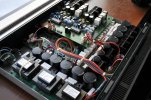
That's a good point, although the Parasounds included a chip for decoding 20-bit HDCDs, which I assume is why the next model up from the 1100, the 1600, utilized two K chips per channel. There's also a German company called Audiotuning.de that sells a drop-in upgrade receiver and filter that allows the 1100 and 1600 to handle 24/96 content. This would be the endgame for my 1100 if the K chips end up working out (and I do have some 24/96 albums in my collection waiting for that day, such as a high-res Dark Side of the Moon). Considering how robust the 1100 is internally, with three power supplies, it would probably hold up against modern DACs with those upgrades:

3890628.jpg
 
I wouldn’t waste my time and money on such a project if the goal is to achieve audible improvements as easier, better performing, and less expensive ways exist today. It is your time and money, and you can do whatever you want with it, but at least do yourself a favor and learn how to evaluate DAC performance with appropriate measurement instruments, as human ear is not very good at picking differences below -90db.
 
The Parasound D/AC-1100 was a very capable DAC in it's day. I used to own one too. While I can't say if the PCM63P-K chip upgrade will make for a noticeable improvement in sound, there's no harm in trying. Especially if you've already purchased the IC's.

Now, when doing the upgrade, I absolutely recommend having the correct chip puller, and have a static safe area to do the work. You have to be properly grounded when working with static sensitive components. Nothing worse than zapping an expensive chip, by not being properly grounded. Order a wrist strap and connecting cable, and attach it to a known ground. I usually use a empty ground socket on a power strip, or the bare metal on a computer case. As to the chip puller, it captures the chip and allows one to pull straight up on it, to pull it from it's socket, without damaging any IC legs. Be very careful with inserting the new chip too. Make sure it's perfecting seated in the IC socker, before applying pressure. You don't want a broken leg, or a leg that doesn't insert properly, and folds up underneath the chip. Just take it slow, and be careful.

Good luck...!
 
The Parasound D/AC-1100 is the unit that got me into the late 90s line of Parasound components and was my first external DAC. A local record shop let it go for $75 and I was hooked. Since then I've gone down the DAC rabbit hole, spending untold hours reading about the different chips, R2R vs delta-sigma, vintage vs new, and people debating whether anyone can tell the difference between cheap and expensive DACs (turns out they can). I'm not even sure that I can tell the difference, I just know that I really like the sound of the D/AC-1100 and I love the sound of the D/AC-2000 that I upgraded to a couple of years later.

This brings me to the subject of the PCM63 line of chips. The D/AC-1100 came with a pair of PCM63P-J's (one per channel), which is the mid-grade version, and the higher-end D/AC-1600 came with four (2 per channel) of the top of the line PCM63P-K chip. The improvement in sound between the two chips will likely be subtle and it's possible I won't even be able to tell the difference, but being an obsessive I decided to try to find two vintage "K" chips on ebay. Of course, I also wonder how much better the D/AC-1600 sounds with its 2 chips per channel, but that's a separate comparison.

The big questions:

My understanding is that this is a simple, drop-in replacement that someone like myself with practically zero electronics skills can do myself. Is that truly the case, and is there anything I should be aware of before I swap the chips? Any chance of damaging the unit if one of the chips is faulty? This will only be the second time I have opened something up, popped out an IC, and swapped in something new. In that case it was a firmware chip for a vintage Oberheim rack synth and everything worked fine.

Has anyone here done this upgrade, and if so, how concerned were you with getting sent fake chips? All of the vintage PCM63 chips I could find on ebay are coming from China, and while I did suspect some of them were fake based on the photos and the number of negative reviews, I ended up purchasing two for $100 each from a seller in Shenzen who has sold over 12,000 items and has a 100% positive feedback score. The seller is HIFI AUDIO IC and they appear to specialize in reclaimed DAC chips from vintage gear. Here's a pic of the five PCM63P-K's that were available, two of which I purchased:

View attachment 3451885 View attachment 3451886

Scrolling through the seller's other items I get the strong impression that what they're selling is authentic, because it all looks like it really was pulled out of old equipment. Any advice or guidance from fellow AK members with experience in this area is appreciated.

For reference, I've attached the original PCM63 spec sheet which shows the minimal gains in dynamic range and reduced THD I will get and probably not even be able to discern, making the music sound more holographic, spacious, and detailed just knowing I have the K rather than the J chips ;)

Whether the chips are genuine will be up to you to tell us. I'm skeptical but your ears are the final arbiter. Personally my D/AC 1100 is just as good as $1k-$1500 dacs I've heard. The key is reclocking the input signal with a quality reclocker like the Audiophonics DigiRescue. The Audiotuning upgraded chips are also recommended.
 
Last edited:
This thread isn't really about me eventually getting convinced to buy an expensive, modern DAC. If a DAC was raved about in the late 90s and everyone thought it sounded magical back then, it should still sound magical now, especially since I exclusively listen to 16bit/44.1k music sources (and my two Parasounds also handle 48k from my Apple TV). The Parasound D/AC-2000 in my main system sounds amazing to my ears, and I don't think my system is likely to sound mind-blowingly better unless I decide to spend a lot more on new speakers.

This is more of a project "for the hell of it" after which I will know more than I did before I started. I've already learned a ton just getting to this stage, such as finding threads showing analysis of 1kHz test tones going through various iterations of the PCM63 chips. It's interesting and educational stuff.

The last sentence of my original post should make it clear what my attitude is:

"For reference, I've attached the original PCM63 spec sheet which shows the minimal gains in dynamic range and reduced THD I will get and probably not even be able to discern, making the music sound more holographic, spacious, and detailed just knowing I have the K rather than the J chips"

if you are looking for an exploration project, you may want to consider a D to D re-clocker or adding a master clock. That may make a larger improvement than a change in chip sets.
 
I’m still using my Parasound HD 1100 every day. I’ve tried a few other DAC’s and the Parasound always sounded more natural and musical than the modern DACs.

If you do the upgrades, please post your results here. I’d love to know how it goes.
 
if you are looking for an exploration project, you may want to consider a D to D re-clocker or adding a master clock. That may make a larger improvement than a change in chip sets.
@wushuliu referred to the Audiophonics DigiRescue above, and I will look into it. My signal flow is older Macbook Pro 2015 > toslink > Behringer DEQ2496 > AES/EBU > Parasound D/AC-2000 (or D/AC-1100) > RCA or balanced out. I would have to switch back to coax s/pdif to use the DigiRescue. Before introducing a reclocker it would be good to find out if there's a jitter problem to begin with, and I don't currently know how to measure that.
 
Whether the chips are genuine will be up to you to tell us. I'm skeptical but your ears are the final arbiter. Personally my D/AC 1100 is just as good as $1k-$1500 dacs I've heard. The key is reclocking the input signal with a quality reclocker like the Audiophonics DigiRescue. The Audiotuning upgraded chips are also recommended.
The fear that's been put into me in this thread about the provenance and authenticity of the chips I ordered is making me think twice about doing it, but if/when I do, unless it sounds really bad it's going to be pretty hard to tell without before and after measurements.

What makes the D/AC-1100 still relevant today is the quality of its analog stage, and that's something you won't find in a cheaper, modern DAC. I also have no less than 8 pieces of the mid to late 90s Parasound gear (have a small system at my office and different options to swap in/out at home), and I like having the complete, matched system.

I did recently order a brand new Fiio K11 R2R DAC for $179 to test out the "$200 DACs today sound better than vintage DACs," theory. It's not delta-sigma, but a brand new, proprietary R2R chip, so I guess that would make it more of an "apples to apples" comparison? Vintage R2R vs modern R2R?
 
The fear that's been put into me in this thread about the provenance and authenticity of the chips I ordered is making me think twice about doing it, but if/when I do, unless it sounds really bad it's going to be pretty hard to tell without before and after measurements.

What makes the D/AC-1100 still relevant today is the quality of its analog stage, and that's something you won't find in a cheaper, modern DAC. I also have no less than 8 pieces of the mid to late 90s Parasound gear (have a small system at my office and different options to swap in/out at home), and I like having the complete, matched system.

I did recently order a brand new Fiio K11 R2R DAC for $179 to test out the "$200 DACs today sound better than vintage DACs," theory. It's not delta-sigma, but a brand new, proprietary R2R chip, so I guess that would make it more of an "apples to apples" comparison? Vintage R2R vs modern R2R?
Have you looked at the upgrade kit on eBay (none mine). It replaces the CS8412 and the PMD100 chips. Doing so adds 24/48KHz support, but you'd loose HDCD decoding.
 
Back
Top Bottom