• Please note that Audiokarma will be offline briefly for updates early on Monday morning, September 28th.

Upgrading Parasound D/AC-1100 to PCM63P-K

Can you elaborate why it is so?
Maybe not elaborate, but same reason an expensive Bryston amp or preamp is superior to a cheap Pyle? You get what you pay for, and the Parasound stuff was not cheap (I know you know what the D/AC-1100 internals look like + I posted a pic above). A lot of the higher end stuff was designed by John Curl, who designed for Mark Levinson and other boutique brands. How is a $200 DAC from China going to compete with that in the analog domain?
 
It has been proven that higher price doesn’t necessarily mean better quality. You just repeat what you read on audio forums. It has a typical output stage with 30 y/o opamps, it gets the job done to meet the spec, same can be said about modern inexpensive DACs.
 
It has been proven that higher price doesn’t necessarily mean better quality. You just repeat what you read on audio forums. It has a typical output stage with 30 y/o opamps, it gets the job done to meet the spec, same can be said about modern inexpensive DACs.
No, I don't "repeat what I read on audio forums." I've come to the "you get what you pay for" conclusion from decades of living life and buying home audio equipment and musical instruments and recording studio gear. I love a bargain and I don't buy expensive stuff just because it's expensive, nor do I lie to myself that the difference in sound quality is "revelatory" after I upgrade something.

From the very beginning of this thread I was self-deprecating, and admitted that this project is for experience and educational purposes, and it's unlikely I'll be able to hear a difference between J and K PCM63s, but that I'll feel better knowing they're in there.

I don't disagree that sometimes higher price does not equal higher sound quality, and I'm a big fan of budget gear such as the Behringer DEQ2496 for strictly digital domain EQ, but really, really cheap equipment below a certain threshold is going to sound and measure worse than expensive gear, up to a point.

For me 90s Parasound is the sweet spot, because I can't afford 2025 Parasound, and I don't think super high-end stuff costing 10s of thousands of dollars is going to sound significantly better than 90s or 2025 Parasound.

At this point it's obvious you're just here to be argumentative and contrarian, not respond to the very specific questions and advice I'm looking for, and want to hijack the thread into a discussion of your own personal gripes.
 
Your DAC is fine and needs no further improvements, especially the ones through questionable components and lack of technical knowledge needed to validate the results. That’s all I’m trying to say here. It may sound harsh but it’s true.
 
Your DAC is fine and needs no further improvements, especially the ones through questionable components and lack of technical knowledge. That’s all I’m trying to say here. It may sound harsh but it’s true.
Ok, and like I said multiple times in this thread, I'm not engaging in this project strictly to squeeze out a tiny bit of additional sound quality. It's an educational project that forces me to open up some gear and leave my comfort zone, and may be leading me in the direction of acquiring component repair skills.

The TOTL Parasound D/AC-2000 is the DAC I use, and the 1100 is currently sitting on a shelf unused in a closet. Here's what you said about the D/AC-2000 in these forums back in 2018:

"The 2000 is one of the best DACs made of its period I hear. I would not think twice if I saw one at an agreeable price. Objectively it is better than the Yggdrasil, for redbook anyway,"

 
What you’re describing is tinkering, not education. If you want education learn how to evaluate DAC performance through measurements before attempting such a project.
 
And yes, I’m still of the opinion these Parasound DACs are fine units that need no further improvement for what they are, they are perfectly adequate to deliver everything that CD format can offer and they will sound nearly indistinguishable from modern DACs. About the only issue is their sensitivity to incoming jitter, so feeding them from a stable source is not a bad idea.
 
Last edited:
What you’re describing is tinkering, not education. If you want education learn how to evaluate DAC performance through measurements before attempting such a project.
It's one step at a time. Just opening up a device, identifying components, using the right tools such as the recommended chip puller, preventing static discharge, and replacing an IC, is progress for me.

My first measurement-related project was acquiring a calibrated measurement microphone (from Sonarworks), loading the calibration file into the REW software, using loopback to calibrate for my particular audio interface (Steinberg UR22 rev1) then taking a number of different readings from different locations in the room, and calibrating the room EQ using the Behringer. The process was worth it and had a very noticeable effect on the sound.

Anything involving an oscilloscope and hardware or individual components is the next frontier for me. What I'm talking about here only moves me closer to that, especially if I get to a point where I can't move forward *without* using those tools. A perfect example would be testing the PCM63s for shorts. Probably a good idea to do rather than just blindly snapping them in and risking damage.
 
It's one step at a time. Just opening up a device, identifying components, using the right tools such as the recommended chip puller, preventing static discharge, and replacing an IC, is progress for me.

Wrong order and higher risk to damage something. To start with DAC measurements you just need a half decent ADC and REW which is free software, no screw driver required. Heck, even state of the art consumer grade E1DAC Cosmos ADCis is less money than those K-chips. Once you are comfortable with basic measurements you can establish baseline DAC performance and start tinkering and then at least try to not make it perform worse. “Sounds good” is a rather meaningless criterion for DAC mods.

PS: your Steinberg Interface is probably good enough of an ADC to get going and it will allow you to at least detect gross reduction in DAC performance, it won’t be precise enough to confirm improvement however.
 
Last edited:
The fear that's been put into me in this thread about the provenance and authenticity of the chips I ordered is making me think twice about doing it, but if/when I do, unless it sounds really bad it's going to be pretty hard to tell without before and after measurements.

Sounds like you've already decided what you intend to hear. If that's your approach then just be happy with what you have and save yourself from nervosa about measurements you are not equipped to conduct. Or just go full Flat Earth and join ASR to learn how to listen by measuring.
 
Last edited:
Sounds like you've already decided what you intend to hear. If that's your approach then just be happy with what you have and save yourself from nervosa about measurements you are not equipped to conduct. Or just go full Flat Earth and join ASR to learn how to listen by measuring.
I haven't already decided what I want to hear, I don't really care what I hear as long as it sounds good after I drop in the K-grade chips. I'll be happy if I don't fry the unit and it still sounds good after installing the chips. The unit has been sitting on a shelf in a closet for two years and since I never sell anything, I might as well "tinker" with it to use gvl's terminology. I originally paid $75 for it.

I also don't care about measurements compared to what my ears tell me. Sometimes it's interesting to go over to ASR and look at measurements for things I currently own, but that forum is not going to talk me out of something that I think sounds good. The gear reviewer Ken Rockwell (I'm sure many here know who that is) called the ASR category of people "measurebaters," and he's not wrong.

I've been recording, mixing, and engineering my own music for over 30 years, with an album released to all major streaming networks. During the mastering process I used measurement tools for EQ and loudness to make sure the files conform to the tight standards the streaming services require for audio content, and also to make sure my ears didn't miss something, but in the end I trust my ears, and I'm told the sound quality of my recording is great.

Let me restate what I'm looking to get out of this post, in addition to what has already been suggested, such as getting a chip puller and a wrist strap to prevent static (thanks for that one!):

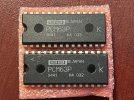
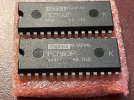
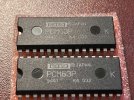
1) Looking at the photos of the chips I bought (2 of the 5 shown, at least), do they look authentic, or are there any red flags?

2) What about the ebay seller I linked to - 12,000 transactions and 100% positive feedback, lots of DAC chips in his store. Chips guaranteed tested. I think the seller looks credible and it's likely the chips I ordered are fault-free and authentic, because there's zero negative feedback from other customers. What do AK members think? Did I overlook something? Has anyone purchased ICs on ebay that turned out to be fake?

3) Has anyone else ever upgraded the PCM63 chips in a DAC or CD player, and how did it go? I doubt I'm the first person to do this.

 
Have you looked at the upgrade kit on eBay (none mine). It replaces the CS8412 and the PMD100 chips. Doing so adds 24/48KHz support, but you'd loose HDCD decoding.
Yes, I've had that company's ebay store and that item on my watchlist for a few years. If this PCM63 chip thing doesn't go down in flames it's very likely I'll order that upgrade. It adds 24/96 support, even better.
 
In other words if your mods lead to high harmonic distortion levels that you somehow like, this will be declared as a successful experiment?
Yes, if I successfully install the chips and the unit doesn't catch fire, and it sounds at least as good or better than before, it will be successful. I am not doing this to chase some obsession with squeezing out a tiny improvement in sound quality, whether determined by my ears or future measurements. I'm doing this, literally, for the F of it.

I just hope the chips are authentic, because if they are then theoretically, based on their specs, it will sound better and the 24/96 upgrade will be more likely to be worth it. Maybe my high-res Dark Side of the Moon will finally knock my socks off.
 
Last edited:
In other words if your mods lead to high harmonic distortion levels that you somehow like, this will be declared as a successful experiment?
Hopefully, the replacement PCM63 chips will be legitimate, if slightly used parts. If so, why would there be a risk of "high harmonic distortion levels". After all, Parasound used the same IC's in other DAC designs.
 
Hopefully, the replacement PCM63 chips will be legitimate, if slightly used parts. If so, why would there be a risk of "high harmonic distortion levels". After all, Parasound used the same IC's in other DAC designs.

Hopefully. And what if not? There were reports of bad PCM chips out of China, they looked legit but were running hot and not performing to the spec.
 
Here's a related update on my DAC journey: Based on an AK member's review here and in other forums, I purchased the FiiO K11 R2R DAC for $159. Until now the vintage Parasound 1100 and 2000 are the only DACs I have personal experience with. I run the digital signal through a Behringer DEQ2496 that has been adjusted based on room measurements, and since it has multiple digital outputs I was able to split the signal to go to both the D/AC-2000 and the K11 R2R and then to two separate inputs on the Parasound preamp.

When sitting in the sweet spot between my speakers and using the remote to seamlessly switch between the two DACs, I was unable to detect any difference in the sound. Even with the K11 R2R in NOS mode, and despite the measured rolloff in the high frequencies, I still could not discern any difference at all. The only headphones I have are Sony MDR-7506s, which are not "audiophile" grade, but I was not able to distinguish between the two DACs with those either.

I'm at the age where I've probably lost some high frequencies in my hearing, but I also have trained ears from a lifetime of recording and mixing original music. The K11 R2R has made me decide to give the Parasound a break.

Still waiting on the PCM63P-K chips to arrive. If the chips are authentic it's very likely I won't be able to tell the difference between chips, or between any of the DACs I currently own. The wildcard would be 24/96 material on the K11 R2R.
 
Last edited:
There’s an opinion that all DACs sound the same, perhaps it’s not so far fetched despite what many people think.

As for NOS, the differences should be audible on material that has enough of high frequency content, so maybe try some of the music that you think sounds bright.
 
The chips arrived today and by all indicators they appear to be authentic. I'm wondering if a better use for them would be in one of those DIY tube DAC kits. Since I don't have any board-level skills I wonder if there's something out there that's already completed except for the PCM63s. I know you can easily buy empty boards pre-laid out for DAC projects. Maybe I could put the K versions in the D/AC-1100 and the extracted J versions in a DIY project. Anyone have any suggestions?

IMG_1191.jpgIMG_1189.jpgIMG_1190.jpg
 
Back
Top Bottom