

You are using an out of date browser. It may not display this or other websites correctly.
You should upgrade or use an alternative browser.
You should upgrade or use an alternative browser.
Using piezo tweeters wisely: a "how to"
- Thread starter Paul C
- Start date
I love those motorolas
I've been using 1005s in several different speakers.
recently however I bought a set of Eminence Beta 15As.
I have to say this with these and a set of 6 inch mids and caps at 2.6uf for the tweeters and 36uf at the mids these are about the most effecient I have use in a long time the 15As are rated at 97db the mids at 95.
the crossovers have adjustable attenuation.
4ohmn 10ohm and 20ohm thru a switch to the tweeters.
the crossover shows -3db 0 +3db positions.
I find it best right in the middle.
the mids come in a little light but this seems to match well for a slight gap between the motorolas and the Eminences. recorded guitars sound excellent.
Bass is clear,strong and not muddy even in a ported box. (tired of the weight of non ported)snares and the rest of the drums are right on the money.
I think I've found what I want in a ported box.
Also I have another speaker set, strictly home use, that has strange Motorola 621s.
they set flat about 5/8 inch thick, no need for a hole except for the leads.
they are piezos. they are in a dual set up, side by side in one package.
a 3 1/2 x 5 inch rectangle (I'll have to try to get a pic)
noticed they are not as sensitive as the 1005s but have a wider sweet spot.
the 1005s seem to have about 90 degree sweep, where as the 621 has about a 130 degree
I've been using 1005s in several different speakers.
recently however I bought a set of Eminence Beta 15As.
I have to say this with these and a set of 6 inch mids and caps at 2.6uf for the tweeters and 36uf at the mids these are about the most effecient I have use in a long time the 15As are rated at 97db the mids at 95.
the crossovers have adjustable attenuation.
4ohmn 10ohm and 20ohm thru a switch to the tweeters.
the crossover shows -3db 0 +3db positions.
I find it best right in the middle.
the mids come in a little light but this seems to match well for a slight gap between the motorolas and the Eminences. recorded guitars sound excellent.
Bass is clear,strong and not muddy even in a ported box. (tired of the weight of non ported)snares and the rest of the drums are right on the money.
I think I've found what I want in a ported box.
Also I have another speaker set, strictly home use, that has strange Motorola 621s.
they set flat about 5/8 inch thick, no need for a hole except for the leads.
they are piezos. they are in a dual set up, side by side in one package.
a 3 1/2 x 5 inch rectangle (I'll have to try to get a pic)
noticed they are not as sensitive as the 1005s but have a wider sweet spot.
the 1005s seem to have about 90 degree sweep, where as the 621 has about a 130 degree

Woofman
Active Member
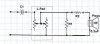
I am going to use a KSN1005 piezo as a super-tweeter, crossing in somewhere in the 8khz range. I will be using an 8 ohm L-pad, and the R1 will be 8 ohms. If I am understanding this correctly, I will also need to use R2 to keep my amp stable. What value should R2 be? And will it affect the crossover components below it? I've attached a schematic for reference.
P.S. I borrowed this drawing from an earlier post, I hope you don't mind.
P.S. I borrowed this drawing from an earlier post, I hope you don't mind.
Motorola Piezo's
Very informative thread. Thanks to the contributors.
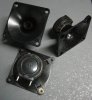
Perhaps someone can comment on the lineage/model of Motorola piezo's in the attached pic.
Details noted:
-Pin connectors instead of solder tabs. Interesting.
-No screws hold the driver halves together, metal spring clips used.
Markings noted/transcribed:
-Blue dot terminal marking
-From back of horn mounting flange, near mounting hole, markings in this arrangement:
15E60617B01
3
- Stamped on back of the each driver near pins: 'B09'
- * There is an additional string of characters (smallest found on the units), on the front face of the 'driver' portion, but so small that I'll need to try again with a loupe, or disassemble one to be able to read them. (the horn obscures the line of sight for the most part).
Very informative thread. Thanks to the contributors.
Perhaps someone can comment on the lineage/model of Motorola piezo's in the attached pic.
Details noted:
-Pin connectors instead of solder tabs. Interesting.
-No screws hold the driver halves together, metal spring clips used.
Markings noted/transcribed:
-Blue dot terminal marking
-From back of horn mounting flange, near mounting hole, markings in this arrangement:
15E60617B01
3
- Stamped on back of the each driver near pins: 'B09'
- * There is an additional string of characters (smallest found on the units), on the front face of the 'driver' portion, but so small that I'll need to try again with a loupe, or disassemble one to be able to read them. (the horn obscures the line of sight for the most part).
Attachments
Last edited:
I've been considering adding piezos to my open baffle rig that I'm putting together. It will have an 8" Tang Band 1808 full-range driver. I could mount the piezo facing up at the top of the baffle, or in a cutout above the full-ranger (possibly in a waveguide). Since its a full range, I'd like to have the piezo start adding in at above about 8 KHz. I'd also like to keep the total impedence at 8 ohms (which is what the full-ranger is), so it would be nice to be able to pad the piezo down and roll it off without adding a "crossover". Any suggestions for me?

VolvoHeretic
Well-Known Member
Ok, I've read this thread a couple of times, and although I wired my 8 late '70's Radio Shack piezos per Altec A7 backwards as in parallel/series, but even still, they sounded great singing outside with 150 watts, I don't think that I need a super tweeter that puts out down to 3500 hz. Any suggestions for a crossover point and maybe a wireing diagram to match my A7's? 8000, 10000 Hz? I just found out I'm deaf above 12000 Hz but I am thinking a Death Star arrangment like this by stealing and molesting my kid's 12" Earth globe.

but I am thinking a Death Star arrangment like this by stealing and molesting my kid's 12" Earth globe.
Last edited:
Piezo
Hi Gordon, after read this thread I wanted to check it on a new HI FI proyect
Where the Piezo will be, more as a super tweeter, from 15KHz and up.
The high band pass will be a 6dB / octave.
Ive tried your sugestion of the drawing, but it seems not to be working, But today I realized why ( I think ) my Vaccum tube low frequency generator have a very high impedance output.
Crossing a 16 ohms resistor brings everything down.
Im gonna try tomorrow using an audio amp between the generator and the tweeter.
Going back to the reason of this contact, what capacitor values do you suggest to start testing your design, having in mind , the 2 resistors involved will be 16 OHMs. ( I had it from time ago ) if it works as you state, Im gonna buy new components.
Thank you for your time and best regards.
David
I went back and looked up one that I had done, for a Powerline on a typical 4x10 horn. I stole part of Paul's graphic, but changed the diagram layout to what I was talking about.
This was for a PA app, from a 10" woofer, so I went with a higher crossover point... IIRC, it was around 4000 Hz. You can scale the caps larger, to have lower crossover points. Changing the cap relative values so that the first one is larger and the second is smaller, will make more of a "gradual" rolloff... while making them "more the same" will result in a flat top-end, with a more pronounced "break-point" near the crossover point (ie, a sharper "knee" to the curve). This can be useful in tuning the horn/driver combo... if there's too much upper treble/lower mids, then make the second cap smaller, while leaving the first one the same (or maybe SLIGHTLY larger)...

Hi Gordon, after read this thread I wanted to check it on a new HI FI proyect
Where the Piezo will be, more as a super tweeter, from 15KHz and up.
The high band pass will be a 6dB / octave.
Ive tried your sugestion of the drawing, but it seems not to be working, But today I realized why ( I think ) my Vaccum tube low frequency generator have a very high impedance output.
Crossing a 16 ohms resistor brings everything down.
Im gonna try tomorrow using an audio amp between the generator and the tweeter.
Going back to the reason of this contact, what capacitor values do you suggest to start testing your design, having in mind , the 2 resistors involved will be 16 OHMs. ( I had it from time ago ) if it works as you state, Im gonna buy new components.
Thank you for your time and best regards.
David

barkerd
Super Member
for what its worth I am resurrecting this thread from the deep . Goes like this : saw some homemade model 14-ish clones for sale . Really good price / trying to put a tube console pull together with something for a friend. The horn is actually a magnavox powerline (which dropped me here) .... whoever made this had strange ideas or no knowledge whatsoever ....... he used a 12" cast basket Pro woofer ...nothing unusual .... and this horn ..... now I get that this model piezo horn goes down to "800hz" (more like 1000) and does not require a crossover .... but the only component in the cabinet is a 6.4mh iron core (1.2 ohm dc res.) inductor ...... woofer is 7.8 ohms dc ....that puts it around 200 hz for the woofer doesn't it ? doesn't sound good , horn needs to be pulled down and I'm hoping with help here I can get a handle on it's crossover needs.

Motorola/CTS/PiezoSource Tweeters
Does anyone out there have any experience with the KSN 1005A tweeters? I spoke with Piezo Source in California today...they confirmed that they bought out CTS in 2005 (who bought out Motorola's line of speakers in the mid '90s). Motorola had the tweeters made in Mexico...when Piezo Source bought out CTS, they moved manufacturing to the Phillipines...still there, according to them. Was able to ID the fakes/cheapos that Paul and others described. Peavey told me the KNS 1005A should be a good match to the original Motorola tweeters in my speakers. Can anyone verify that...I'm a complete dope on electronics...be merciful...
Thanks,
Dick (newbee...
Does anyone out there have any experience with the KSN 1005A tweeters? I spoke with Piezo Source in California today...they confirmed that they bought out CTS in 2005 (who bought out Motorola's line of speakers in the mid '90s). Motorola had the tweeters made in Mexico...when Piezo Source bought out CTS, they moved manufacturing to the Phillipines...still there, according to them. Was able to ID the fakes/cheapos that Paul and others described. Peavey told me the KNS 1005A should be a good match to the original Motorola tweeters in my speakers. Can anyone verify that...I'm a complete dope on electronics...be merciful...
Thanks,
Dick (newbee...

I'm building a speaker cab w/piezo using your info. Thx. I have some other 'live sound' speaker cabs I built with 16ohm woofers and 8 ohm eminence compression horns, horns having 105 sb sensitivity. Obviously way too hot. I Built a crossover then installed potentiometer, but as soon as u dial it on, 1, horn immediately still too hot. I've been studyin ways to tone down these horns further, so that I can use the lpad in the 5+- range, but I'm not learned and unsure. So I thought u probably can help definitively!

jaymanaa
RIP 1961-2018
Thank you Sir, because I'm dredging it up again since I'm working on these DQ10s with the Motorola Piezos. Hey, check this out, I not only know the cat that got Piezos into Hi-Fi (his EE thesis), but I have his S/C433 that took him all the way through college. He told me the only reason he bought the 433 was because it had that silly centering tone, Ha. He told me they were already using piezos for something, but my memory is as short as my, uh, ear lobes, so I forget. Yeah, he gave me the integrated and had put all BB tubes in it back then, and he had a little tiny S/C FM Tuner, and a MPX unit that didn't even have a case, but it was a good one, with IIRC 3 12AT7s in it (just the MPX unit). No TT and no speakers, he said the turn table was his room mates, and the speakers had gotten busted up years ago. Said they were a design out of something like Popular Science or the like. He told me they were huge though (that was back when bigger was better in speakers) and that each one had a bag and a half of cement in the bottom. He said that system was one of the better ones in the dorm, but of course he did right?This thread has been cleaned up and updated.
Nah, this guy was real deal gifted AND it wasn't wasted. He started electronics in Nam, then finished at some pretty fancy college, it'll come to me in a minute I bet. He got right in on the cutting edge of plastics, and would go into a bare assed building, and build a damn plastics plant inside. He had a right hand man "Chris" who's a big old Missouri farm boy for the heavy liftin, but he's got some smarts too and Bill has helped him a ton. I remember when I first started hanging out here, I'd have Bill try to explain PAKs posts to me, but as nice a guy as old Bill was, he didn't suffer fools. If he explained it one time completely, you either got it, or you weren't gonna get it that away. BTW PAK, he oft said you over complicated things dang it! Anyhow, back to the Piezo as a tweeter. I've heard everything from just cut the wire on it and forget it,to replace it with a ribbon that comes in about 12K. WTH do I know, nuttin about speakers at all, and very little about tubes. So I need you speaker smart guys to tell me what to do. Right now, the way I feel about these, money is no object. Danged ol' Kurtgo gave me the whole setup anyhow because someone gave them to him I think after the bottoms barely got wet. I mean it barely got the bottoms wet enough to leave a stain on the grill cloth, but the structure was fine. Whomever he got them from, had just got the cap upgrade kit and new surrounds from DQ, so I'm not sure how they ended up in my living room, but let me say I'm glad they did, and if I have my way,they will be here awhile. Between the two panels and the sub adjustments, etc..., it took me a GOOD tw day to find the optimum position. I've always run horns of one variety or another, and pretty much end up with one really nice spot to sit. With these, you can (I think) make the whole fricken room the sweet spot. Am I right, or not? I stayed up two entire nights (not in a row) relistening to stuff like Sam Bush, Sarah Evans, Reba, Eminem, Whizz Kaliifa, AC/DC, you name it. IMHO they don't really do their best on digital, and my Oppo CDP is real close to as good as my Dual CS5K running a LOMC, AT-OC9ML/II into what I feel is a kinda special MC Head Amp in a Rotel RTC-850. To be honest, I'd likely be running a denon 103M with one of my Hafler Iris Preamps, but the remote control is broke and I ain't yet been able to figure it out. The Rotel just lacks a little gain in the MC stage for the .12 output of the 103M. I had unhooked the Motorolas, but I figure why not hook them back up. If not for me, maybe the hounds will enjoy them.
Oh, btw, these have had the highest WAF by FAR of any speaker that has ever been inside that room. She "said" she loved the black fabric I used to re-grill them, and that she really like the single coat of Cherry stain on the American Oak. These original came white cloth so they got oak, the original dark ones came with Walnut sides. I just put that part in to show off how smart I've become on these bad boys. Not really, they came with every scrap of original paperwork which said that, and lots more useful stuff. The guys theory of ms time correction is kind of out there, but I know what my ears like.
Last edited:
jaymanaa
RIP 1961-2018
I'm building a speaker cab w/piezo using your info. Thx. I have some other 'live sound' speaker cabs I built with 16ohm woofers and 8 ohm eminence compression horns, horns having 105 sb sensitivity. Obviously way too hot. I Built a crossover then installed potentiometer, but as soon as u dial it on, 1, horn immediately still too hot. I've been studyin ways to tone down these horns further, so that I can use the lpad in the 5+- range, but I'm not learned and unsure. So I thought u probably can help definitively!
Far as I know, about any L-Pad will cut your tweet, and you can run one side of the supply through a capacitor for what is the simplest, and IMO maybe one of the best sounding crossovers. We'd need the data sheet from the horn driver to size that cap properly.

70's Rockfan
Rough N Ready
lots of good info here


Nixxuz
Super Member
I actually used some of the "junk" piezo tweets before I settled on the metal domes I'm running now. I crossed them pretty high, as I was just adding a little "sparkle" to some full rangers that do fairly well up to about 13khz. The piezo's were crossed around 10khz. They were the little stick on style you can find for $10 a pair all over Amazon. Rated at a possibly high 100dB. One of the things I liked about them was the fact that a person can just slap some blutack to the back of them and mount them anywhere on the front of the baffle, so it's easy to experiment with location. While my use case was pretty niche, I found they were really pretty good for being $5+ the cost of a decent cap. I understand most people wouldn't use them, based on the fact that I was pairing them with 99dB FR drivers that go pretty high. I'd be very leery of trying to use them as the main tweeter in anything like a 2 way.

Port Entropy
Active Member
I have read through this thread and other sources of information on piezo's and I am feeling a little overwhelmed by all details/options.
I have an obscure pair of speakers with uses a piezo tweeter (I believe the Motorolla KSN 1005a, or possibly a knockoff) and I am thinking about rebuilding/modifying the crossover. They are Griffeth Sound Lab Excalipers and you can see my thread about them here:
https://audiokarma.org/forums/index...labs-excaliper-speakers.895848/#post-13334488
They are 4-way speakers and the piezo fires upward into a deflector to make it omnidirectional. Overall, I really like the sound of the speakers and the piezos sound pretty good, but I think I would like to pad them down a bit, or possibly cross them over a little higher.
Currently, there is a 5 ohm resistor in series before the positive terminal and a 8uf capacitor in series after the negative. Can anyone help explain what is going on with the current crossover and offer any suggestions for what might be the best thing to do here? I'm considering using an L-pad. There are two L-pads already installed on this speaker, but I only use one. So I could bypass the other and free it up for use on the piezo without needing to install an extra one and modify the cabinet.
I have an obscure pair of speakers with uses a piezo tweeter (I believe the Motorolla KSN 1005a, or possibly a knockoff) and I am thinking about rebuilding/modifying the crossover. They are Griffeth Sound Lab Excalipers and you can see my thread about them here:
https://audiokarma.org/forums/index...labs-excaliper-speakers.895848/#post-13334488
They are 4-way speakers and the piezo fires upward into a deflector to make it omnidirectional. Overall, I really like the sound of the speakers and the piezos sound pretty good, but I think I would like to pad them down a bit, or possibly cross them over a little higher.
Currently, there is a 5 ohm resistor in series before the positive terminal and a 8uf capacitor in series after the negative. Can anyone help explain what is going on with the current crossover and offer any suggestions for what might be the best thing to do here? I'm considering using an L-pad. There are two L-pads already installed on this speaker, but I only use one. So I could bypass the other and free it up for use on the piezo without needing to install an extra one and modify the cabinet.
Thanks Paul. This is great information. One question I have, is that while the impedance of the Piezo tweeter is commonly 1000 Ohms, doesn't the impedance roll off to be lower at the higher frequencies? I seem to remember that they have an impedance curve, which rolls off as the frequency increases, which is why they naturally do not need a crossover. Unfortunately, I have not been able to find the spec sheet that shows the impedance curve for the KSN1025 tweeter. This is important, as I'm looking at tri-amping a system, whereby the high end will consist of exclusively KSN1025 tweeters. So while the amps involved will have the frequencies under 1KHz dampened by 30+db, above that they will roll up to full power. If the impedance of the tweeters are a steady 1K Ohm, the amps could be damaged.The only piezo tweeters worthy of high fidelity or pro audio use are the Motorola/CTS units, and of those, only the Powerline Series are suited for pro audio. The ones made by other companies are junk. I have seen them selling for as low as 75c each to dealers. If you pay more than $2 for one made by anyone but CTS, you are being ripped off.
Sometimes it is said that piezo tweeters are "harsh" or "bright". First, if they aren't a real Motorola/CTS unit, they are junk. But with the Motorola/CTS units I have come to see (and others agree) that they have higher sensitivity than the published 92-93 db/wt SPL ratings. They seem to be 3-5 db higher.
I have used the KSN1165a, rated at SPL = 92 db @ 1w @ 1m, with woofers in the 96-97 db range and they seem to have excellent balance. Using the KSN1165a with a 92 db SPL woofer, the tweeter does sound very bright. By reducing the tweeters output by 4 db it matches the woofer very well and makes for an excellent speaker. (more on this later)
Ignore everything you have read about resistors and piezos. Most all are quoting each other and MISQUOTING the manufacturer. Some will tell you to place a resistor in series with the piezo tweeter, some say parallel. And both are wrong.
Years ago with some of the Motorola line, not all, just some, and I have the paper from them about this, Motorola recommended a 20-50 ohm resistor in series with SOME of the tweeters. This gave protection to the amp from high freq (100khz or so) oscillations as well as some protection to some of their tweeters. They did not recommend using resistors for any of the Powerline series, which include the KSN1142a, KSN1165a, KSN1188a, and a few other in the series.
(The Motorola piezo speaker division was purchased by CTS some years ago)
The CTS/Motorola Powerlines were the very high quality ones for pro use, and contained built in protection circuits, quite sophisticated. This protection circuit uses a resistor and thermal breaker paralleled with a tiny light bulb. At about 100 watts the thermal breaker heats up, opens and now the power goes through the light bulb. As the bulb heats up it increases resistance. What this does is give "soft clipping", that is, a sort of compression of the highs. This is very mild and almost inaudible, and certainly not noticable. They burn out about 400 watts. These are once again available through Martin Sound.
http://www.martinsoundpro.com/item.asp?id=340
Anyway, don't use a resistor with the Powerline Series piezos for power protection purposes; it is simply not needed. If you do put a resistor in series (and even Martin Sound says for Lpad use a 20-30 ohm resistor) I say, go ahead, but it will NOT make a difference in sound. Do you know why? Because a piezo tweeter has an impedance of 1000 ohms or greater. If you put a 20 or 50 ohm resistor in series with a 1000 ohm speaker, well, it is a miniscule change in power to the speaker. Duh!
So, how DO you pad down a piezo?
The CTS/Motorola paper says you can put a small CAPACITOR in series with the piezo to reduce the level, and that can work. But if you put an 8 ohm resistor across the terminals (follow this whole discussion now...) now it looks like an 8 ohm load. The piezo will not know the difference, it works off voltage only, drawing almost no power.
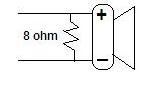
Now, put an L-pad to this 8-ohm load. Make sure you use an 8 ohm L-pad. (or if you use a 16 ohm L-pad, use a 16 ohm resistor) An L-pad is actually two rheostats, one in series with load, one in parallel, and the taper of each is such that the load presented back to the crossover is constant. Now this piezo, plus 8 ohm resistor, plus 8 ohm L-pad looks like 8 ohms to the crossover.
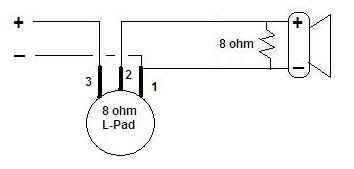
What crossover? Well, now that it is 8 ohms, it needs a crossover to keep from putting unnecessary load on the amp below the frequency produced by the piezo tweeter, power that would be wasted in the L-pad and resistor. A simple cap calculated for an 8 ohm load (or 16 ohm load if 16 ohm L-pad and resistor are used) is all that is needed. For example, for the KSN1165a or KSN1142a, which roll in at 1800 hz, if these were to be crossed in at 2000 hz it works out to 9.9 uf, which is a non standard value. But 10 uf is standard and plenty close enough. If you wanted to use all of the 1800 hz-20 khz available from that piezo tweeter use 11 uf (10 uf + 1 uf in parallel). If you wanted to cross this at 3000 hz use 6.6 uf (5.6 uf + 1 uf in parallel). Etc. Just remember, you can't go lower than the piezo tweeter is capable of going, but you can go higher. Calculate the capacitor using an 8 ohm impedance.
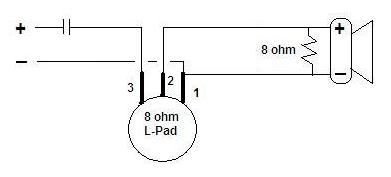
So now with this setup you can not only control the level, but control the crossover point, too.
You may also use a "fixed L-Pad" like this:
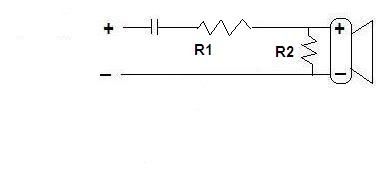
-3 db R1 = 2 ohms, R2 = 6 ohms
-4 db R1 = 3 ohms, R2 = 5 ohms
-6 db R1 = 4 ohms, R2 = 4 ohms
These are approximate, as in, "close enough for jazz".
One caution--Do not try to use a steeper crossover, 12 db/oct, or higher. This is not needed for tweeter protection, and the piezo can react with the inductor in these and produce chirps on occasion.