Bauhausler
Rational Subjectivist
I have found that moving a little air makes a huge difference in the operating temp of a piece of gear. Lower operating temp means longer life. For $20 and 15 minutes work you can make a variable speed fan to add on to existing gear.
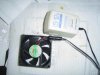
I used a radio Shack universal adaptor that will go from 1.5 to 12V @ 300ma:
http://www.radioshack.com/product/i...origkw=273-1662&kw=273-1662&parentPage=search
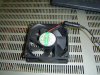
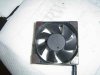
The fan is a 3" 12V 150ma unit I bought in multiples a while back. The adaptor will run two of these at full speed (a LOT of air) or 3 or 4 fans at lower voltages.
There are smaller fans available cheaply, and they can be useful in tight places, but to move the same air they have to run at a higher speed creating much more noise. I find that a larger fan turning slowly will move plenty of air and be inaudible.
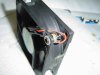
See the pix below.
I used a reamer to open up one of the mounting holes in the 'outflow' side of teh fan body to accept a mono mini jack. Other jack types will fit. The Radio Shack adapter comes with a variety of tips. I hardwired the jack to the fan lead wires. I had to grind the flange thinner to mount the jack because the mounting threads on the jack weren't long enough.
To hold the fan in place I used self adhesive magnetic material stuck on the 4 bottom corners. This is to be mounted horizontally on top of my friend's new AV receiver over the internal heatsinks, so it just needs to stay in place and not vibrate around. If it's to be mounted vertically, more powerful magnets can be glued on and covered in duct tape or felt to prevent scratching.
If you need to run 2 fans for a unit with dual heat sinks, put a second jack in parallel on one fan and to the second fan attach a lead terminated in a mini plug. Plug the adaptor into the first fan and plug the second fan into the first.
Note polarity of connection and direction of flow. By convention, fans have color coded leads and arrows for rotation and flow marked on the frame.
The fan will start and turn on as little as 4.5VDC. I find tha tfull flow is rarely necessary and something like 7 - 9V is adequate, more flow producing more noise and little increase in cooling.
This can be made in a few minutes and will greatly reduce the operating temp of your gear.
I used a radio Shack universal adaptor that will go from 1.5 to 12V @ 300ma:
http://www.radioshack.com/product/i...origkw=273-1662&kw=273-1662&parentPage=search
The fan is a 3" 12V 150ma unit I bought in multiples a while back. The adaptor will run two of these at full speed (a LOT of air) or 3 or 4 fans at lower voltages.
There are smaller fans available cheaply, and they can be useful in tight places, but to move the same air they have to run at a higher speed creating much more noise. I find that a larger fan turning slowly will move plenty of air and be inaudible.
See the pix below.
I used a reamer to open up one of the mounting holes in the 'outflow' side of teh fan body to accept a mono mini jack. Other jack types will fit. The Radio Shack adapter comes with a variety of tips. I hardwired the jack to the fan lead wires. I had to grind the flange thinner to mount the jack because the mounting threads on the jack weren't long enough.
To hold the fan in place I used self adhesive magnetic material stuck on the 4 bottom corners. This is to be mounted horizontally on top of my friend's new AV receiver over the internal heatsinks, so it just needs to stay in place and not vibrate around. If it's to be mounted vertically, more powerful magnets can be glued on and covered in duct tape or felt to prevent scratching.
If you need to run 2 fans for a unit with dual heat sinks, put a second jack in parallel on one fan and to the second fan attach a lead terminated in a mini plug. Plug the adaptor into the first fan and plug the second fan into the first.
Note polarity of connection and direction of flow. By convention, fans have color coded leads and arrows for rotation and flow marked on the frame.
The fan will start and turn on as little as 4.5VDC. I find tha tfull flow is rarely necessary and something like 7 - 9V is adequate, more flow producing more noise and little increase in cooling.
This can be made in a few minutes and will greatly reduce the operating temp of your gear.