• The move to the new server is done. There are some software and database maintenance updates in process. This has us passing the hat around to help out. We appreciate any donations. Seriously, even a dollar helps. The payment page may be found here - https://www.audiokarma.org/support.html

Vintage amps and headphone jacks

You might like the Koss "PortaPro" headphones. They're light, comfortable and they sound spectacular. Koss's lifetime "no questions asked" warranty is unbeatable.

Thanks, I'm pretty covered up in headphones, I have Senn 580s, Etymotic in-ear, and I just got upgrades for my iPod earbuds yesterday - Senn MX-450s. They sound great for earbuds.

Tim
 
I pour over schematics and every vintage receiver I've seen uses the main amp to drive the headphone jack.

I've posted at least one schematic excerpt already here showing the resistor leads and the jack.

On newer gear, many jacks are driven by a dedicated op-amp of varying quality.
 
"Is using the "main amp" to drive the headphones superior, as opposed to an op-amp ?"

In most cases, yes. For one, the impedance of the headphones will not matter for the vintage receiver while it can bog down an op-amp if too high or too low. The former case requires voltage while the latter requires current. A vintage receiver has plenty of both.

However, a headphone amp can be optimized just for headphones so theoritically might have some advantages. I've never tried one.
 
SX-780 is amazing for headphones. Even if it didn't buzz (needs some new caps) my Sansui 7900z just sounds bad through headphones. Worse than no amp.
 
ATH-2? You need to either immediately sell them to me or come join us over at Head-Fi. Seek out the real planar-magnetic headphone nuts on the Orthodynamic Roundup thread, now in its third year.

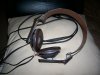
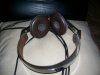
Well I do use them occasionally, so I think I will hang on to them. I did check out the site you provided in your link. I wasn't quiet sure what to think or your reply till I examined the site and reread your post. OK I don't want the post not worth ... without pictures message, so I will attempt to attach a couple of pictures of these (plz accept my apologies for fuzzy picture). I am not sure when I got them likely late 70's early 80's and pretty sure I bought these new. Any idea what I may have paid for these the?

I decided to search to see what I could find about these, I found the operating instructions and the unused registration card.

the operating instructions read like the following;

"The ATH-2 is a high performance, lightweight widerange sterophone on which Audio_Technica has lavished its precision pickup technology. In this planar-wave dynamic system, the spiral voice coil itself form a flat diaphragm that moves the air directly. This new design, which applies physical principles to more closely achieve ideal sound, gives wonderfully accurate music reproduction. The ATH-2 stereo-phone increases your listening pleasure by offering you superb audio reproduction not found with ordinary speakers."

Also it gave instructions on how to use

Technical data per request

"ATH-2 Technical Data
Type: Planar-wave Dynamic
Matching impedance: 4~60 ohm
Output sound pressure level
(S.P.L. 1 kHz, 0dB = 0.0002(?something looks like a u?) Bar/mW): 98dB
Frequency range 20 ~ 20,000Hz
Total harmonic distortion(110dB S.P.L.): less than 0.8%
Maximum permissible input (500Hz, 1 min.): 1,000mW
Weight (not including plug and cord): 200 g
Cord: 2.5m low noise Y-type soft cord (with with 6.3 (something else like small o with line nearly vertical) EIAJ plug)

(These specification subject to change without notice for further improvements.)"

 

Attachments

  • 100_0836.jpg
    100_0836.jpg
    105.6 KB · Views: 12
  • 100_0837.jpg
    100_0837.jpg
    62.7 KB · Views: 10
  • 100_0838.jpg
    100_0838.jpg
    57.8 KB · Views: 16
Last edited:
Also it gave instructions on how to use and the technical data
Great! Thanks for the specs, we'll add them to our database.

I'm trying to talk any planar-magnetic speaker buffs I can find (Charivari, to pick an example entirely at random) to get something like this. Maggies for your head.

Thanks for the photos!

I should also point out, since it's relevant to this thread, that an isodynamic headphone, like a planar speaker, presents an essentially resistive load to the amp, allowing the amp to sound about as good as it's ever going to, and the coherence of the reproduced sound makes an isodynamic a good 'phone to use for sniffing out differences between amps.
 
Electrostatics or electrets for your head are even better.
Stax Earspeakers, e.g.
Oh, don't say that until you've heard a properly modded isodynamic. Near-stat highs with better-than-dynamic-type bass. I say that as the owner of three pro-bias Stax Lambdas, a mighty SR-X Mk 3 and an SR-30 electret job. I'm not saying an isodynamic is better, because there are other considerations, but it is competitive once its moving system has been properly damped.

Besides, you can't plug a Stax into an amp/receiver's headphone out.

One thing that hasn't been discussed is the use of one of the old headphone junction boxes to drive headphones directly from speaker outs, thus bypassing any possible mickeymouse op amps. I use an old Pioneer box, but Koss used to make one too. Headphone junction boxes were more common back when not every stereo component had a headphone jack.

Listening this way separates the hissers from the nonhissers, that's for sure, especially if you use a modern ultraefficient 'phone-- the Grado SR80 being a good example.
 
Last edited:
I had a Vector Research VX-5000 receiver that drove my Sennheiser HD580s to perfection. Plenty of slam without a hint of harshness.
 
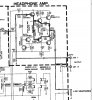
I enjoy listening to headphones from preamplifiers that have headphone outputs. Because preamps can't use the 'resistor from the amp output' method to drive phones they need to have dedicated headphone amp sections. A couple that come to mind are the Sony TA-E7B and the Harman Kardon hk825. I've attached the relevant section from the hk825 service manual, showing the headphone amp schematic. Tuners with headphone outputs would also have headphone amp sections as well.

Steve.
 

Attachments

  • hk phones.jpg
    hk phones.jpg
    108.4 KB · Views: 18
I'll have to check the schematic to see how it's driven, but my Kenwood KA-9100 sounds great driving headphones...my daily drivers (pun intended) are a set of Grado SR-60s
 
In evenings I often listen through headphones through one of my receivers upstairs. The Technics SA 700 sounds pretty good, though it has a buzz in the left channel that doesn't appear when running speakers (haven't found that one yet). Marantz 4300 is the one I really enjoy, not for any particular reason, just does a really nice job on jazz, sucks me right in.

My main system only has a headphone jack on the Sony CDP and I can really do without the sound from that, dry and uninteresting. It is from a variable output and that may have something to do with it, though I'm pretty sure that is an opamp set-up. At any rate, not needed...
 
SteveP,

Your headphone amp looks capacitor-coupled while many vintage amps have direct coupled amps (including the headphone jack.) You can play around with audiophile caps here if so inclined.

Some preamps like my McIntosh C24 and MX113 have a jack but you have to route the power amp output through the preamp to drive them. That does offer the chance to have a speaker selector switch on the preamp, a useful enough feature sometimes, but seems a compromise in theory.
 
find it really hard to believe that the sound of a computer driving the same headphones is better than a vintage amp/ receiver driving them.

This is very believable if your criteria for better sound includes essentially zero background noise, and you will get noise with a lot of vintage receivers, some more than others.
 
I find it really hard to believe that the sound of a computer driving the same headphones is better than a vintage amp/ receiver driving them.
As previously mentioned, you have the noise issue. Treble sounds 'edgy', bass isn't quite as good. That said, my receiver is nothing fantastic or well-remembered, and my computer is a high-end model, which may help some. I've had better experiences all round with my mid-'80s Luxman integrated. Unfortunately, I don't have access to it right now, and won't for some time... a shame.
 
I've listened to computer sound through various receivers and amps a fair amount, since I listen with headphones for at least an hour --sometimes several-- almost every night, use headphones to check all my new purchases on the bench (with computer input, too)), etc... Seems to me that running computer sound through a GOOD vintage receiver or amp sounds better than running it straight from the computer. However, running it through a mediocre or unrestored vintage receiver can make it sound worse.

As for background noise, a properly recapped/restored/adjusted rcintage eceiver or amp will not have audible background noise at any tolerable listening level. IF it does, there is something not right with the gear. OR your power input is very noisy, and you need to improve it )dedicated line, filters, etc..). Of course, if the input (like an average cassette recording) has noise, then you'll hear that. Otherwise, an analog receiver/amp should sound as quiet as a modern digital one.

Also, I would assume the quality of the sound card in your computer would make a difference, but I have less experience with that, since I rarely change sound cards.
 
No op-amps in a Fisher 400.

P1000562.jpg


Good looking Tube receiver, do you have the original protective cover too?
 
Back
Top Bottom