• The move to the new server is done. There are some software and database maintenance updates in process. This has us passing the hat around to help out. We appreciate any donations. Seriously, even a dollar helps. The payment page may be found here - https://www.audiokarma.org/support.html

Vintage Marantz Receivers vs. Tube Amplifiers and Receivers

Interesting Post. Have owned dozens of systems. Tube and solid state. Started in the mid 60s with Eico. Limited funds age 14. My first new receiver was a Fisher 400. 199 close out. My Dad wasn’t happy I robbed the college fund. Nice sounding receiver. Over the years I have had both. Early 90s I got back into tubes with a Dynaco Stereo 70 amp with a PAS4 (?) preamp and tuner. $30 found a second Stereo 70. Ran both using a Pioneer Quad preamp! Sounded pretty good. As mention above tubes do require TLC. Had one of the output tube short out burning out several resistors! While not a super tech, these Dynaco are easy to work on. Figured out the values on the burnt resistors from the circuit diagram. New tubes with soldered in resisters. Worked! Then traded it all for a Mac 4100 receiver. Nothing great. Their receivers (had several) did not thrill me. Did have a Mac 6100 in the early 2000s. Should have kept that amp.

Looking at tubes, I would suggest Fisher. Had several back in the 90s. Had several. Look at the 500s. I regret selling them. One had Roman numerals on its dial. Only seen one. Worked. Was living in an apartment with three systems. Wasn’t seeing much use. Let it go. Today after a major shakeup, I have low powered Marantz. Sold off the 2270 and a 4270. Love the sound of my 2010 ten watter. Plus a 2220B and 4415 four channel. All a nice warm sound. Love the 2010 the best! Good luck OP!
How does the 2010 compare to the Fisher and other tube gear? I've never heard a 2010 but I've heard good things about it, subject of course to the limitations of 10 watts per channel. I have a 2230, a 2235 and a 2270. I like them all a lot. Nice warm, rich sound. Detailed too, once the power supplies were recapped.
 
All it took for me to jump down the tube rabbit hole was an old Magnavox console amp someone gave me. It is smart I think to have some SS gear also though. After doing some resto work on the Magnavox I thought it sounded pretty darn good. So I got to thinking, if a pretty low budget type tube amp can sound this good, what would a better tube amp sound like? So after building a VTA ST-70 and a couple tube preamps I was hooked. Tube amplifiers don't have to be a big hassle to keep alive. But they do demand a bit of attention from time to time. Mostly making sure you don't have a power tube red plating. I've only ever had two tubes do this and they were used to I start with. For the first timer testing the waters I would choose something new like the Dynaco ST-70 or ST-35 either in kit, reassembled, or even restored used. You can always get most of your money back selling them if you don't like them. If you do like how they sound, then maybe think about a Mac, a Rogue Audio, etc.

Thanks. How did you go about learning the basics to be able to work on the Magnavox and later tube equipment?
 
Thanks. How did you go about learning the basics to be able to work on the Magnavox and later tube equipment?
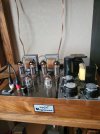
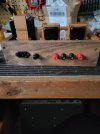
The Tube Forum here on AK was a huge help. There are lots of knowledgeable people there. Some have various schematics showing the few modes needed to get these old console amps to be safe and sound good. I've rebuilt a couple of the Magnavox 175 6V6 amps and a 9303 EL84 amp. You do have to keep in mind your working with high voltage in tube amps. 300+ volts for the Magnavox amps. The electrolytic caps need to be replaced for sure. Also there are a few simple things that need to be dine to make them work stand alone out of the console.
I still have the 9303 amp I did. Its been heavily modified though. It has a SS rectifier now, lots of power supply filtering and an added choke in the power supply along with some changes to the original amp circuit. But you really don't need to go that far at all to get then to sing. I also built a small modified version of the little single ended Magnavox 8600 amp from scratch using a schematic. It's a sweet sounding 3.5wpc.
 

Attachments

  • 20221223_110906.jpg
    20221223_110906.jpg
    119.8 KB · Views: 5
  • 20230205_100800.jpg
    20230205_100800.jpg
    151.4 KB · Views: 5
  • 20230121_123503.jpg
    20230121_123503.jpg
    106.3 KB · Views: 5
The Tube Forum here on AK was a huge help. There are lots of knowledgeable people there. Some have various schematics showing the few modes needed to get these old console amps to be safe and sound good. I've rebuilt a couple of the Magnavox 175 6V6 amps and a 9303 EL84 amp. You do have to keep in mind your working with high voltage in tube amps. 300+ volts for the Magnavox amps. The electrolytic caps need to be replaced for sure. Also there are a few simple things that need to be dine to make them work stand alone out of the console.
I still have the 9303 amp I did. Its been heavily modified though. It has a SS rectifier now, lots of power supply filtering and an added choke in the power supply along with some changes to the original amp circuit. But you really don't need to go that far at all to get then to sing. I also built a small modified version of the little single ended Magnavox 8600 amp from scratch using a schematic. It's a sweet sounding 3.5wpc.
Wow, that's super impressive. If there's a way to begin with something fairly simple and not too expensive, I'd be interested in learning how. Does one save money if you can figure out how to build from scratch? Or does it wind up costing just as much?
 
Wow, that's super impressive. If there's a way to begin with something fairly simple and not too expensive, I'd be interested in learning how. Does one save money if you can figure out how to build from scratch? Or does it wind up costing just as much?
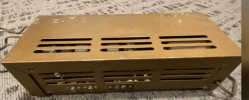
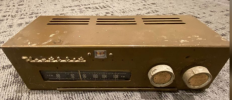
I'm wondering if an old Heathkit like this might be a good place to start. The guy only wants $50.
 

Attachments

  • Screen Shot 2024-07-06 at 12.36.26 PM.png
    Screen Shot 2024-07-06 at 12.36.26 PM.png
    372.6 KB · Views: 4
  • Screen Shot 2024-07-06 at 12.36.16 PM.png
    Screen Shot 2024-07-06 at 12.36.16 PM.png
    403.7 KB · Views: 4
Wow, that's super impressive. If there's a way to begin with something fairly simple and not too expensive, I'd be interested in learning how. Does one save money if you can figure out how to build from scratch? Or does it wind up costing just as much?
Oh no!!!! Designing your own tube amp is as complicated as building your own SS amp. Either go with a kit, like the ST35 ($600) or buy an old used 1960's-ish amp. Finds yourself a small early 60's cheap tube amp and see what you can learn on it. Avoid the newly designed models as they tend to have more semiconductors to deal with.

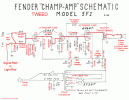
The way I learned was basically looking at schematics and tracing signal paths. The guitar amp sites do have a not of basic info one what each section does.

This could be a new area to learn and explore in audio. It's always great to expand on a hobby.
 

Attachments

  • Tube amp works.gif
    Tube amp works.gif
    84.7 KB · Views: 2
Oh no!!!! Designing your own tube amp is as complicated as building your own SS amp. Either go with a kit, like the ST35 ($600) or buy an old used 1960's-ish amp. Finds yourself a small early 60's cheap tube amp and see what you can learn on it. Avoid the newly designed models as they tend to have more semiconductors to deal with.

The way I learned was basically looking at schematics and tracing signal paths. The guitar amp sites do have a not of basic info one what each section does.

This could be a new area to learn and explore in audio. It's always great to expand on a hobby.
Thanks.
 
Wow, that's super impressive. If there's a way to begin with something fairly simple and not too expensive, I'd be interested in learning how. Does one save money if you can figure out how to build from scratch? Or does it wind up costing just as much?
It really depends on the tube type used, amp design, etc.
An old console amp is a good place to start and learn a few things.
The parts needed to restore them are pretty cheap.
A good soldering iron and a good multi meter will usually be enough to get started as far as tools. Your just replacing worn out capacitors and resistors along with adding some speaker binding posts, etc.
If you decide to get more into it other tools come in handy like a variac.
A dim bulb tester can be helpful. They're cheap and easy to build.
Barter town here in AK has unmolested console amps pop up pretty regularly cheaper than ebay. I've seen some really good deals on them and Dynaco ST-70's, etc. too. I don't even use preamps with some of my amps.
I either just add a volume control to them, or use an input selector with a volume control built in. Most line level sources will push the amp to full output. My ST-70 is just connected to the tape out on my preamp. It takes the source signal right off the selector bypassing the preamp itself.
I added a volume control to the amp. It sounds great like that.
I would add to start hanging out some in the tube forum and read through some threads.
 

Attachments

  • 20240623_130511.jpg
    20240623_130511.jpg
    133 KB · Views: 11
It really depends on the tube type used, amp design, etc.
An old console amp is a good place to start and learn a few things.
The parts needed to restore them are pretty cheap.
A good soldering iron and a good multi meter will usually be enough to get started as far as tools. Your just replacing worn out capacitors and resistors along with adding some speaker binding posts, etc.
If you decide to get more into it other tools come in handy like a variac.
A dim bulb tester can be helpful. They're cheap and easy to build.
Barter town here in AK has unmolested console amps pop up pretty regularly cheaper than ebay. I've seen some really good deals on them and Dynaco ST-70's, etc. too. I don't even use preamps with some of my amps.
I either just add a volume control to them, or use an input selector with a volume control built in. Most line level sources will push the amp to full output. My ST-70 is just connected to the tape out on my preamp. It takes the source signal right off the selector bypassing the preamp itself.
I added a volume control to the amp. It sounds great like that.
I would add to start hanging out some in the tube forum and read through some threads.
Thanks. That's a beautiful piece of gear.
 
It really depends on the tube type used, amp design, etc.
An old console amp is a good place to start and learn a few things.
The parts needed to restore them are pretty cheap.
A good soldering iron and a good multi meter will usually be enough to get started as far as tools. Your just replacing worn out capacitors and resistors along with adding some speaker binding posts, etc.
If you decide to get more into it other tools come in handy like a variac.
A dim bulb tester can be helpful. They're cheap and easy to build.
Barter town here in AK has unmolested console amps pop up pretty regularly cheaper than ebay. I've seen some really good deals on them and Dynaco ST-70's, etc. too. I don't even use preamps with some of my amps.
I either just add a volume control to them, or use an input selector with a volume control built in. Most line level sources will push the amp to full output. My ST-70 is just connected to the tape out on my preamp. It takes the source signal right off the selector bypassing the preamp itself.
I added a volume control to the amp. It sounds great like that.
I would add to start hanging out some in the tube forum and read through some threads.
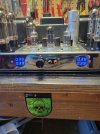
Ah, you bought the LED bias display. Are you running 12AT7's in that? I will be converting my 12AU7 driver board to the octal 6SN7's
 
Ah, you bought the LED bias display. Are you running 12AT7's in that? I will be converting my 12AU7 driver board to the octal 6SN7's
No, it's the newer 12AU7 board. When I installed the meters I adjusted the bias with one of my meters and found the LED meters read just a bit low.
I set the bias to .40v, and the meters read .39v. So if it drifts from .39v I'll just adjust it back to .39v. I almost went with the 6SN7 board when I bought the kit 12 years ago. I wish I had now. But the 12BH7 in the center socket does sound good.
 
No, it's the newer 12AU7 board. When I installed the meters I adjusted the bias with one of my meters and found the LED meters read just a bit low.
I set the bias to .40v, and the meters read .39v. So if it drifts from .39v I'll just adjust it back to .39v. I almost went with the 6SN7 board when I bought the kit 12 years ago. I wish I had now. But the 12BH7 in the center socket does sound good.
Get the 12AU7 to 6SN7 adapter. You will be surprised at the improvement by just changing the gain tube. The phase tubes add almost nothing to the sound, so the AU7's are fine for that position.
 
I recently connected the pre-outs on my SS Marantz 2230 to a Magnavox 9303 tube amp, played through a pair of KLH Sixes. All I can say is wow. The 2230 sounded great on its own, but the tube stage brings the instruments and vocals into the room in a solidly present, three-dimensional and textured way.
 
Posting again in this thread because I just found my first tube gear. A Fisher 500, which is mono. Posted a new thread in the Fisher forum. Still have the Marantz units. I don't intend to sell them. But I'm very excited to hook this thing up to an appropriate speaker (or set in serial or parallel, if I decide to go with a pair), and get my first taste of the tube experience.
 
Back
Top Bottom