The "Magdale" baffle is finished. $20 worth of plywood. I can swap the vintage paper tweeters (Magnavox used two) for a vintage horn. It is not pretty. All other wood is scrap. If I love it I could cover the front with grill cloth and trim the edges with nice hardwood. But let's not put lipstick on this thing until we know if it is a pig that has a nice voice!


You are using an out of date browser. It may not display this or other websites correctly.
You should upgrade or use an alternative browser.
You should upgrade or use an alternative browser.
"Vintage" Mono Speaker Project
- Thread starter Pondoro
- Start date


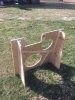
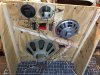
The back of the baffle, braced like crazy. Magnavox used 1/2" Masonite in the 1950's and early 1960's, this beast is far stiffer. The base panel is 1/2" five-layer plywood but it is doubled near the tweeter cutout and braced with pine stringers everywhere else. I could support the edges and stand on it. I am not going to do that Wharfdale sand-filled thing. The leg panels will add even more stiffening. Everything is glued except the leg panels.
I have spent much of my life designing stiff structures. The naked plywood board would want to bend along a line that passes through the centers of the two woofer cutouts. That diagonal brace, fights that flex. The panel would also want to bend along a vertical line that passes through the center of the large woofer and the center of the tweeter cutout. The diagonal brace and the double-thick region below the tweeter cutout fights that flex. The two vertical braces for attaching the leg panels stop flexing along any horizontal line, with the leg panels attached they are very stiff. I could add a brace beneath the 15" woofer cutout or above the 10" woofer cutout, or I could just stop.
I have spent much of my life designing stiff structures. The naked plywood board would want to bend along a line that passes through the centers of the two woofer cutouts. That diagonal brace, fights that flex. The panel would also want to bend along a vertical line that passes through the center of the large woofer and the center of the tweeter cutout. The diagonal brace and the double-thick region below the tweeter cutout fights that flex. The two vertical braces for attaching the leg panels stop flexing along any horizontal line, with the leg panels attached they are very stiff. I could add a brace beneath the 15" woofer cutout or above the 10" woofer cutout, or I could just stop.
Attachments

Last edited:
Whoa! I had never heard of Mondrian, you are correct. I may consider that, you can buy Piet Mondrian wrapping paper! First the speaker has to justify it's existence as a mono project.Well, that totally doesn't suck. Seems a shame to cover it. Some Piet Mondrian art on the front would be snazzy.
Biggles
I am listening to it now and I am really impressed. Note the obvious water marks on the 15" woofer? The console it was removed from showed no damage! In my next post I will describe my circuit versus what Magnavox did. I am listening to The Beach Boys "Pet Sounds" from a mono CD. Next up is a Benny Goodman CD "BG in Hi-Fi", also mono. I have never heard an expensive mono system nor an open baffle system, I really like what I hear.
Attachments

OK - the circuit. Magnavox shipped a single Belvedere console with one 15", one 8" and two 4" speakers. You could buy one mono console or buy two and have stereo. In each speaker the 15, 8 and two 4" speakers were all in parallel, but a 16 mfd capacitor was in series with the two tweeters. The two woofers were about 5.6 ohms, but are in parallel, the tweeters 3.2 ohms each. Thus the impedance was very low. The two woofers ran full range and the two tweeters would have less effect at low frequencies because of the crossover. Magnavox was not in the business of shipping stuff that blew up on day three, so I expect the amp was happy with this very low impedance. But I only had enough speakers for one mono channel and I was less comfortable with building a super low impedance speaker that someone might use indiscriminately . And I do not have a mono amplifier. I do have 6-10 CDs that are recorded in mono - not "mono remastered to stereo" actual mono CD's. So I wired my speaker as follows: One channel has the 15" woofer and one 4" tweeter with a 12 mfd capacitor in series. Crossover frequency is 4150-ish. The other channel has the 10" woofer (I do not have an 8" Magnavox speaker but I did snag a 10" Magnavox speaker) it also has the a 4" tweeter with a 12 mfd capacitor in series. The music is clearly not stereo, the source CD is mono and the four speakers are all on top of each other. So the system is a weirdly bi-amped mono system. Listening is a pleasure so far. Remember I used Magnavox 1960-ish speakers but copied a Wharfdale open baffle speaker. I can confidently state that Magnavox should have done one like this. I am driving it with a solid state amp because it has more protection but now that I have more confidence I will soon transition to a vintage tube amp..
Last edited:

Hey,
I sorta read your intro post how the crossover was setup, and I read the above. You mention DC resistance. If you used your multimeter set to the ohms setting to measure DC resistance on the driver's, that measurement is worthless for designing crossovers. You can use the nominal impedance stamped on the back of the driver. But even that isn't where you want to be. What you want to do is but the DATS speaker tester system to generate impedance data vs frequency. This will tell you exactly what impedance your driver is at which frequency spread you want to use. Then you use math to calculate which capacitors and inductors to use.
Generally speaking the nominal impedance of the driver is close enough. But the DATS is an excellent tool to have. It's affordable, easy to use, and it'll generate that impedance data in less than 2 seconds with one button push.
Biggles
Travelling again. I did not have time to really dig in to this speaker, I just sat back and enjoyed it. It is enjoyable. I next need to listen to it on a tube amp of the same era, I have two of those. Then compare specific songs versus modern stereo speakers. Voices and instruments sounded good during my non-critical listening. Only one downside noted so far - Phil Spector (who loved mono) used a lot of xylophone/glockenspiel. The xylophone sounds muted. Now during his heyday Phil's natural customers were probably listening to him on a car radio with one 6x9" speaker or a portable record player. So what I hear may be better than what they heard. Next I need to go back and listen to these songs with "real" speakers. I will also compare standup bass, bass guitar, piano, horns, etc. But I am leaving town for several days. I can't bring a 3-foot square speaker and a tube amp!
Home from my trip and I am listening more closely to Benny Goodman, the mono album "BG in Hi-Fi." The two 4" tweeters do great with the trumpets and clarinet. The tenor sax seems to come from all four drivers, and when I put my head next to each speaker I indeed hear it coming every speaker. The bass is muted but I believe the bass was mixed to be that way, a foundation, not flashy. I will listen again on my stereo system, but my recollection is of smooth, understated, bass there as well. I think this album was mixed for upper middle class guys with big Magnavox (or whatever manufacturer) consoles, mono or stereo. The fit seems perfect. The speaker does not impress in any area, the way a subwoofer or super tweeter or extremely imaging stereo pair might. The speaker just fits this music.
Last edited:
Now I am listening to the same Benny Goodman disc on my stereo Klipsch Heresy speakers. Comparisons:
1) I cannot hear the tenor sax in the woofer with my head right next to it on the Klipsch. Remember the Magnavox and Wharfdale designs ran the woofer full range, Klipsch seems to keep the tenor sax out of the woofer. The internet tells me that a tenor sax goes down to 104 Hz, but I cannot hear it in my Klipsch woofer. The mid-horn is sitting there inches from my ear so it is difficult to isolate the woofer.
2) The clarinet leads sound great on both speakers. Benny (were he still with us) would be happy to know that his fans listening to him on large Magnavox consoles heard him in his full glory. The clarinet does not sound "live" on either system but it sounds darned good.
3) The trumpets sound better on the Heresy speakers than on the Magnavox paper tweeters. It is more obvious that two or three trumpets are playing in unison.
4) Bass is less on the Klipsch speakers! But I need to note - I do not level match. I played the music through my mono speaker at the volume that made me happy. I listened to several songs. Then I turned the volume to zero and swapped speakers to the Klipsch. I increased the volume until I was happy. Benny Goodman is dominated by clarinet and sax and trumpets. So at the volume that makes me happy with the Klipsch speakers the bass is lower. This implies the Klipsch has more high end - no surprise, we are comparing a three way speaker with horns to a 1.5 way system with two 60-year-old paper tweeters. If I was playing heavy metal at maximum volume I have no doubt that the Klipsch's would have more bass. But I reject level matching for the type of comparison that I do - I play every component at the volume that makes me happy, then I ask, "What instruments do I hear and how do they sound?" BG is not a purveyor of heavy bass. Eventually I will listen to some rock music and then the bass guitar will have it's day. Also some Count Basie and Frank Sinatra, where the standup bass will have it's day.
I should eventually repeat these comparisons with modern speakers. But my purpose is not, "Which speaker is better?", my quest is to see how happy a 1960's mono speaker can make me.
OK - Phil Spector released a CD retrospective of his work called, "Back to Mono." I listened to The Ronettes' "He's Sure the Boy I love." The "Magdale" does have more bass, with it's single 15": woofer, than the Heresy's. Also the long sax solo was evident in the woofers of the Klipsch speakers (remember I was surprised the sax didn't seen to appear in the Klipsch on a Goodman cut. I need to go back to Benny Goodman and listen again. The tambourine sounded much tighter and well defined on the Klipsch versus the Magdale. Ronnie Spector's voice was amazing on both speakers. The twin 4" tweeters have proven themselves on both Benny Goodman's clarinet and Ronnie Spector's voice. I need to listen again and just listen to the drums..

Ned5
New Member
I have a similar Magnavox console speaker setup that I'm renovating. This is the last bit of work on this old turntable only unit w/ 185 amp. The 7" alnico midrange was cone-damaged so I'm replacing entire speaker (could not find replacement cone). I just want the original console to work by itself. 185 amp was replaced with Audio Note Kit3 clone board (two 12ax7 driving two 6sn7 driving four 6v6). What is the best way to wire the mono speaker system which was mono (one 15", one 7" and two 4" drivers). Can I just connect the 2 channels together and feed a crossover network?