• The move to the new server is done. There are some software and database maintenance updates in process. This has us passing the hat around to help out. We appreciate any donations. Seriously, even a dollar helps. The payment page may be found here - https://www.audiokarma.org/support.html

Vintage Power Vs. New Power ?

I have a hard time accepting they published a 7 wpc power number for this receiver. They would have never sold one back in the 70's if they did. From the digging I did, JC Penny put out a number of 45 wpc for this receiver. But I suspect that was peak power, and a more realistic number would be about 20 to 25 wpc.

Regards
Mister Pig


I have a JC Penney (though not MCS branded) Model 3201 "fm/am stereo tuner amplifier" mighty big name for a small "receiver" but I digress.
Bought it new in 1976.
From the spec sheet...
Power Output PMPO 20W X 2
RMS (10%) 7.3W X 2
 
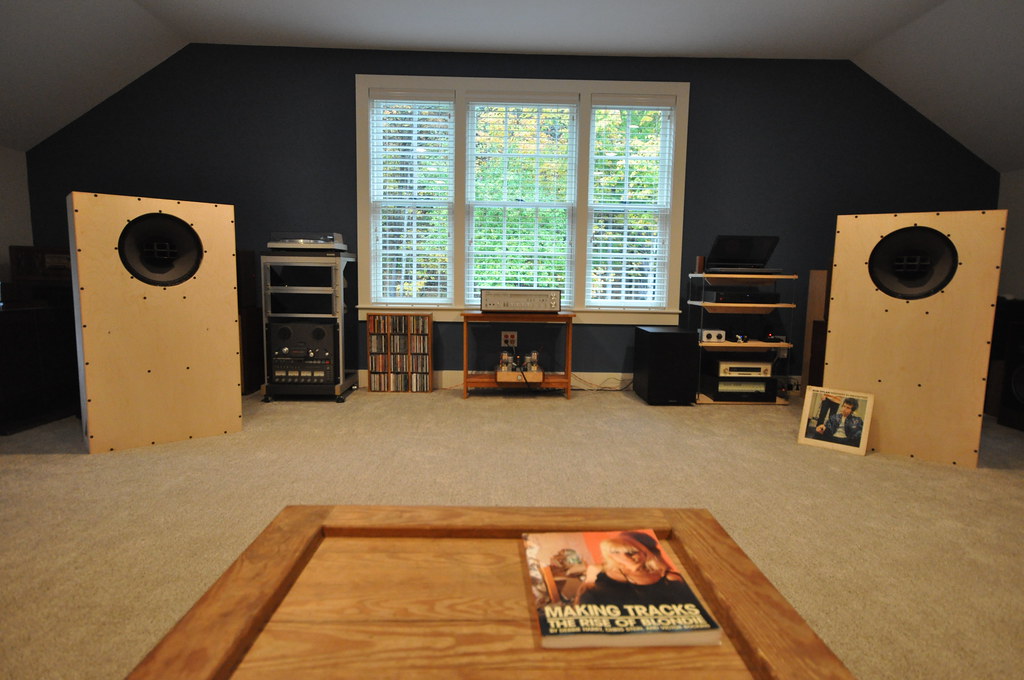
Just as an aside -- how far one can go on "7 watts [per channel]" depends totally on:

1. The quality of those seven watts.
2. The loudspeakers used with them.


3.5 watts per channel (actually probably less than 3 wpc at <1% THD) in use here-- no problem.

DSC_8060 by Mark Hardy, on Flickr
 
Hmmm...............so much for following the axiom relating product number with suggested wattage.:idea:


For the most part that holds true for MCS branded JC Penney audio amps and receivers..
As mentioned mine is not labelled MCS , it is labelled JC Penney
 
For the most part that holds true for MCS branded JC Penney audio amps and receivers..
As mentioned mine is not labelled MCS , it is labelled JC Penney


I might have their smallest "receiver" made.
I also have two of their biggest receivers, the 3125 which are indeed MCS.
 
Just as an aside -- how far one can go on "7 watts [per channel]" depends totally on:

1. The quality of those seven watts.
2. The loudspeakers used with them.


3.5 watts per channel (actually probably less than 3 wpc at <1% THD) in use here-- no problem.

DSC_8060 by Mark Hardy, on Flickr
If 7 watts can handle decent speakers of that size, it is definitely time to for me to bone up on speaker specs.:idea:
 
I might have their smallest "receiver" made.
I also have two of their biggest receivers, the 3125 which are indeed MCS.

That is supposed to be a very nice one.
I recently bought an MCS 3285 at a local thrift but have delayed buying speakers for it as favorable reviews for the unit have pretty much warned me that extracting the best audio performance will require very good speakers- and I do not currently have sufficient knowledge about speakers to make a proper decision.

I didn't expect that the smaller unit might perform better than anticipated.
 
That is supposed to be a very nice one.
I recently bought an MCS 3285 at a local thrift but have delayed buying speakers for it as favorable reviews for the unit have pretty much warned me that extracting the best audio performance will require very good speakers- and I do not currently have sufficient knowledge about speakers to make a proper decision.

I didn't expect that the smaller unit might perform better than anticipated.

If possible go out and listen to speakers before buying.
Depending on your area Craigs List might be a good place to look.
Thrift stores and garage sales as well.
Brick and mortar stores if there are any close enough to get to.
If you find something of interest it's ok to ask for opinions here at AK.
 
The other day I was talking to someone who is related to the music industry and he was telling me that vintage stuff, for the punch it delivers even at low wattages, seem to work much more on Class A than modern stuff, whatever that means.

Additionally, modern stuff that is pumped to the market every year, at least "consumer grade" stuff, always seem to be both very optimistic and misleading in the sense many times the buyer is unaware that RMS is what matters not peak power and that most amplifiers will not have the cojones to drive, for example, 4Ω loads for extended periods of time.
 
I don't exactly know what your link is saying in relation to your statement, but focus on this quote from the following article

"In 1974 the FTC instituted a ruling requiring audio power and distortion ratings for home audio equipment to be measured in a defined manner with power stated in RMS terms."

Here's the article: http://nobleamps.com/measuringpower.html

Basically, before this ruling, watts ratings was the wild west. Any manufacturer could use whatever method they chose for stating their amp's power rating They could use RMS, peak, PMPO or whatever else they chose. This means that a lot of advertised watts were well let's just say "overinflated".

The FTC ruling in 1974 specified what method b used to get power ratings to keep everyone on a level playing field. A lot of 100 watt amps were now 20 watts. Is this what you're referring to?

But, as for that 7 watts sounding remarkably loud, most speakers use only a watt or two to play at room filling levels on music. It's only when played painfully loud that more are needed on a steady basis. It's the musical peaks that demand the extra watts. Of course, speaker sensitivity has a lot to do with this.

as for loudness and watts, it's not as simple as it seems. Three decibel change in loudness is barely noticeable. To achieve a three decibel change in loudness requires twice the power. An apparent doubling of loudness requires ten times the power. Here's a link to help explain it

.http://www.gcaudio.com/resources/howtos/voltageloudness.html

Finally, those watts on speakers are the maximum power they can safely handle on a continuous basis. it has no bearing on how loud they play or how good/bad they sound.


That system was used for a long time, may still be in effect.
But I seem to recall that when Home theater style amps/receivers came into vogue the rating system was changed for them?
 
Get a pair of Paradigm Atoms or Titans - small bookshelf speakers. They will sound nice with 7 watts if you don't push the amp too hard, and are very affordable used, and almost as common as dust, so not hard to find.
 
If possible go out and listen to speakers before buying.
Depending on your area Craigs List might be a good place to look.
Thrift stores and garage sales as well.
Brick and mortar stores if there are any close enough to get to.
If you find something of interest it's ok to ask for opinions here at AK.

I may yet post a thread asking about speaker brands vs. their product lines.

I have checked speaker donations in thrift stores while searching for cassette decks.
After inputing the brands and model numbers into Google, most thrift speaker queries either garner little information or bad comments on audiophile threads
( kinda to be expected - the owner gave 'em away, after all.....;) )

I may do more checking in the Chicago Craigs List .
Brick and mortar stores now cater to theater audio and I am not certain how the modern ( center speaker ) components may match up with my current audio gear and 40 year old "stereo store" memories about speakers.:idea:
 
Get a pair of Paradigm Atoms or Titans - small bookshelf speakers. They will sound nice with 7 watts if you don't push the amp too hard, and are very affordable used, and almost as common as dust, so not hard to find.

Certainly seems a good place to start looking.:thumbsup:
 
The other day I was talking to someone who is related to the music industry and he was telling me that vintage stuff, for the punch it delivers even at low wattages, seem to work much more on Class A than modern stuff, whatever that means.

Additionally, modern stuff that is pumped to the market every year, at least "consumer grade" stuff, always seem to be both very optimistic and misleading in the sense many times the buyer is unaware that RMS is what matters not peak power and that most amplifiers will not have the cojones to drive, for example, 4Ω loads for extended periods of time.

Thanks for that Class A reference.

May prove to be very useful for researching / learning about current and past vintage speaker systems--- as well as viewing eye popping pricing on modern Class A speakers.:yikes:
 
I may yet post a thread asking about speaker brands vs. their product lines.

I have checked speaker donations in thrift stores while searching for cassette decks.
After inputing the brands and model numbers into Google, most thrift speaker queries either garner little information or bad comments on audiophile threads
( kinda to be expected - the owner gave 'em away, after all.....;) )

I may do more checking in the Chicago Craigs List .
Brick and mortar stores now cater to theater audio and I am not certain how the modern ( center speaker ) components may match up with my current audio gear and 40 year old "stereo store" memories about speakers.:idea:

Using a smart phone to research a product when it's right in front of you is not a bad way to go.
This coming from a guy who doesn't have a cell phone....

Chicago is a good area for gear.
CL is nice because most times you can audition the gear and it takes the danger of shipping out of the picture.
You will find something sooner or later.
 
That system was used for a long time, may still be in effect.
But I seem to recall that when Home theater style amps/receivers came into vogue the rating system was changed for them?

I have been seeing some 1980s vintage Home Theater amplifiers showing up in Goodwill stores- they are surprisingly ( compared to modern ) low wattage units
 
Thanks for that Class A reference.

May prove to be very useful for researching / learning about current and past vintage speaker systems--- as well as viewing eye popping pricing on modern Class A speakers.:yikes:

Speakers are not classified by operating classes, that is suitable for amplifiers but I won't even try to go there since when you start reading about amplifier classes it gets very technical very fast...
 
Using a smart phone to research a product when it's right in front of you is not a bad way to go.
This coming from a guy who doesn't have a cell phone................
You will find something sooner or later. .......................

A smart phone is surprisingly handy for checking in the store................though I have noticed some Chicago area stores are close to library branches with WiFi and sometimes pack a laptop and USB drive in case I need to download service sheets from HiFi Engine.com for the item in question.

I really need to upgrade to a faster phone as my Android is starting to show it's age during downloads- hence the added laptop.

One thing about thrifts- I know from experience that if I do not like what I see, something better will appear withing a month.
 
Back
Top Bottom