
Netty
New Member
I do want to know more - what is required and what does a worn out stylus look like?Your pictures are beautiful, however this magnification level won't tell you anything about stylus wear.


I do want to know more - what is required and what does a worn out stylus look like?Your pictures are beautiful, however this magnification level won't tell you anything about stylus wear.
Oh, careful there, because spec styles can very well change over time. And frequency response without an additional "qualifier" (like for example +/- 3 dB) for example is not very meaningful, anyway - so that the choice of published values can be considered as somewhat arbitrary.
To give you an example, the AT150MLX was specified for 10 Hz to 30 kHz, but with its nude ML tip (on gold-coated boron rod) and low(er) inductance generator (with comparable data as the older, CD4-optimised generator variant used for example for your AT14Sa and AT15Sa) there wouldn't appear to be a good reason, why its frequency response should be more limited than the frequency response of those older CD4-capable models.
Another example would be the AT440ML/OCC, which was still specified for 5 Hz to 32 kHz (despite only sporting a higher inductance generator variant!) - while its direct successor, the AT440MLa, which is hardly any different, was merely specified for 20 Hz to 20 kHz, but that still without an additional qualifier, so that there is no obvious reason for that change of spec.

I do want to know more - what is required and what does a worn out stylus look like?


Yep. I actually still have my original AT-15Sa that I bought new around 1978. Because I have multiple styli, I'm still using the original stylus. Sounds awfully good.AT-15Sa, if i was not mistaken, was the top of the line for Audio-Technica MM cartridges back then.
Perhaps the current comparable model is the AT-150Sa , which I would expect to be even better.
The AT-150Sa (and other AT cartridges, and other current MM and MC catridges) are also able to reproduce beyond 45KHz, so there's no big deal about that frequency response.
AT-15Sa, if i was not mistaken, was the top of the line for Audio-Technica MM cartridges back then.
Perhaps the current comparable model is the AT-150Sa , which I would expect to be even better.
The AT-150Sa (and other AT cartridges, and other current MM and MC catridges) are also able to reproduce beyond 45KHz, so there's no big deal about that frequency response.
Oh, careful there, because spec styles can very well change over time. And frequency response without an additional "qualifier" (like for example +/- 3 dB) for example is not very meaningful, anyway - so that the choice of published values can be considered as somewhat arbitrary.
To give you an example, the AT150MLX was specified for 10 Hz to 30 kHz, but with its nude ML tip (on gold-coated boron rod) and low(er) inductance generator (with comparable data as the older, CD4-optimised generator variant used for example for your AT14Sa and AT15Sa) there wouldn't appear to be a good reason, why its frequency response should be more limited than the frequency response of those older CD4-capable models.
Another example would be the AT440ML/OCC, which was still specified for 5 Hz to 32 kHz (despite only sporting a higher inductance generator variant!) - while its direct successor, the AT440MLa, which is hardly any different, was merely specified for 20 Hz to 20 kHz, but that still without an additional qualifier, so that there is no obvious reason for that change of spec.
Greetings from Munich!
Manfred / lini

A playback system that can achieve real output to 50KHz, versus one that only can get 20KHz, means that there is more bandwidth, and thus the rise time is higher as well. This should have an impact on transient or impulse reproduction.

I can report AT VM540ML works great playing CD-4 records. AT VM95SH also works well on CD-4.TOTL was actually the AT20SLa but I don't believe it was any different than the 15Sa, they were off the same line but hand selected. I have a 15Sa with a JICO stylus and quite like it.
I'm one of those nutters who actually attempted (and succeded) to get CD-4 working on my setup and I have, with aforementioned cartridge. I have heard that the AT440MLa and 440MLb were tested to work with CD-4 (from reading over at QuadraphonicQuad) but I do not know if anyone's tested it with the newer versions. I believe the VM540ML would be the closest thing to a direct replacement to the 440MLb but I do not know if that has been successfully tested on CD-4 yet as while it's been out for a few years, I haven't been keeping up on my reading as my rig works now which was my main goal. AT's spec only list it to 27kHz however; I'd bet it will go higher but they just don't seem interested in spec'ing them high enough to officially support CD-4 (one would assume they don't want someone like me with an actual CD-4 rig to return the cartridge because it doesn't support an almost 50 year old obsolete format. the AT15Sa and AT20SLa were officially listed at 45kHz and 50kHz respectively.)
https://audiokarma.org/forums/index.php?threads/at15sa-vs-at20sla.618613/
I have no experience with the more modern cartridges other than an Ortofon OM-10 and it was years between owning that and the AT15Sa so I can't directly address the main subject of this thread.
If anything though, we can credit CD-4 with bringing us, out of necessity, the Shibata stylus and as a result we still today enjoy various fine-line designs that are refinements thereof...
Mostly irrelevant: yesterday I stopped at Value Village on my way home from work and picked up my second CD-4 LP ever (that wasn't a test record, that is.) Guess I'm gonna have to get the quad rig set back up again now won't I? Or at least hook my CD-400 to the AVR in the living room.
RobRoy - COOL! and thanks for your info. Have you been able to directly do listening comparisons to newer cartridges? and if you have which, and how did they compare.Yep. I actually still have my original AT-15Sa that I bought new around 1978. Because I have multiple styli, I'm still using the original stylus. Sounds awfully good.

just wondering what is QQ?some guys at QQ
just wondering what is QQ?
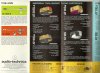
Nice brochure - I got my AT-14Sa after hearing it at the stereo shop when I bought my first pair of Infinity Quantum's, and picked up the 14Sa to use for 2-ch I never have gotten into CD-4, or Quad, but did go into the various AC-3 and surround variants.1975 brochure
thanksQuadraphonicQuad.
Sadly, my ears today are not good enough to do reliable comparisons. I also actually avoided doing comparisons many years ago. I spent more time comparing equipment than actually listening to the music. I just enjoy the music now. All of my stuff is "good enough" for my ears now.RobRoy - COOL! and thanks for your info. Have you been able to directly do listening comparisons to newer cartridges? and if you have which, and how did they compare.
Oh and how do the styli compare and what are they? when I first read you post my brain was thinking you had different carts but you actually said styli - so you have probably used the 15Sa all along.
Thanks
this makes me think then that an ATN20SS's ATN20 will work in the 15Sa? Also did you have the opportunity to compare the sound of the JICO with an original ATN15? Is the JICO a Nude Sibata?the AT20SLa but I don't believe it was any different than the 15Sa, they were off the same line but hand selected. I have a 15Sa with a JICO stylus and quite like it.
I can strongly relate - same for me. I have recently renewed my interest in my vinyl gear that I had way back in 1979 mostly because I really could hear the difference back then - but sold all my vinyl collection to go to colledge and did not want to move it arround several time in that period. And now I wanted to revisit what I have long known was the superiority of really great vinyl productions. And have dusted of the turntables and bought some new direct-discs. So, I to am noticing that my ears don't hear as much difference as I remember that there was. but the DD's do still sparkle a bit more than CD's through my system.All of my stuff is "good enough" for my ears now.

I have both early and newer AT cartridges, and would say that, notwithstanding the trends to lower compliance and higher inductance, the biggest difference is in the construction. Early models are constructed like bathtubs, with the electrics inserted through the open top which is then sealed with a thin metal plate. Newer cartridges are more compact, rigid, monocoque-ish type of construction . Between the two, the modern ones have a cleaner, less euphonic, more accurate reproduction, whereas the older ones are more euphonic, likely due to a more flimsy style of construction.I have two vintage Audio Technica cartridges from the 80's - the AT-14SA and the AT-15SA with respectively the ATN14 and the ATN15 both Shibata Nude styli. The specifications of these older vintage cartridges are showing better frequency responses lower tracking force and very good voltages & impedances as compared to even very expensive new cartridges manufactured today in 2023 - Can someone with ACTUAL experience with both vintage and new models - tell me if the old ones or the new ones actually perform better. Both how they sound and especially how they protect the vinyl grooves. And maybe why? I do think maybe the reason for some of this is that the materials used in manufacturing these are problematic in today's environmental requirements - thanks.
I'm asking to know if I should consider buying a newer cart or stick with what has been working for me pretty well. I do know when I upgraded to these back in the 80's from a sure M95ED these rocked my world, and have been since.
Definitely a thoughtful and thought provoking answer. Had to look up 2 of your words! Thanks for that, makes some sense. Suggestive to do the compares thyself. After all the ear of the beholder is what it is all about. Cool. Those are pretty cool words too!I have both early and newer AT cartridges, and would say that, notwithstanding the trends to lower compliance and higher inductance, the biggest difference is in the construction. Early models are constructed like bathtubs, with the electrics inserted through the open top which is then sealed with a thin metal plate. Newer cartridges are more compact, rigid, monocoque-ish type of construction . Between the two, the modern ones have a cleaner, less euphonic, more accurate reproduction, whereas the older ones are more euphonic, likely due to a more flimsy style of construction.
It's hard to say between the two which is more desirable. I think older records might favour the old construction as they evolved together; newer ones may be better suited to modern records cut from digital masters direct to metal blanks. Apart from that, the newer ones have a wider selection of affordable, quality OEM needles and so have a brighter future going forward.