I'm in the market for a better turntable/cartridge. I'm fairly new to the vinyl game, i've had a technics 1210 mkV, and now a Pro-ject RM5se with blue point no 2 cartridge and speed box. I haven't had the table long, but now the rest of my setup is upgraded and it's got me wanting for more performance. I will be using it with a McIntosh Mc275 amplifier <new>, McIntosh c2300, Sonus Faber Domus Concerto Speakers <upgraded possibly soon, considering Auditor's etc>, and a REL 305 sub. I will occassionally use my Magnepan MGIIC and Dahlquist DQ10 speakers with this setup. I have checked out the VPI Classic with a Dynavector Cartridge <maybe the 20, I recall it was around 800$>, and was very impressed. I thought it more than held it's own with some sort of crazy Clearaudio 60k$ table when compared briefly. I also heard a Pro-ject Perspex with a Sumiko Blackbird through a very different set up at another dealer and thought it sounded nice, but it's hard for me to really compare the two because of the different set ups. I have never heard the Linn but will check out my friend Mark's soon. I've never heard a Rega. I'm open to any suggestions and observations, I don't have a set budget, but probably would like to keep things under 5k. I'm open to new and used, but these are the tables that have piqued my interest. Have any of you guys have experiences to share, or advice? I will admit that I do like my fare share of bass, and also that I can't stand warbly piano's!


You are using an out of date browser. It may not display this or other websites correctly.
You should upgrade or use an alternative browser.
You should upgrade or use an alternative browser.
VPI Classic, Rega p5, Pro-ject Perspex, used Linn etc Purchase advice
- Thread starter Stacked
- Start date
Register to hide this ad

Tedrick
Infinity-phile
There's a couple of threads on here detailing the experiences of several AKers who took the plunge on a VPI Classic.
Based on those threads, if I were in your shoes, I'd get the Classic with a Dynavector 17D3 or DV20X and be done with it. You'll not likely get the 'table upgrade bug again for a LOOOOOONG time (but I won't make the same statement about cartridges...there's so many interesting ones out there :yes .
.
Based on those threads, if I were in your shoes, I'd get the Classic with a Dynavector 17D3 or DV20X and be done with it. You'll not likely get the 'table upgrade bug again for a LOOOOOONG time (but I won't make the same statement about cartridges...there's so many interesting ones out there :yes
.
thunderroad
Life begins at 140 mph.
It sounds like you've got some pretty good turntables now with the Technics and Project, so IMHO you would have to make a substantial step-up to get a really tangible improvement. To me that would be either a new VPI Classic or a used Merrill-Scillia 'table, either the MS2 or MS21. I would also pop for the best Benz MC cartridge that I could afford.
Stacked,
You should definitely listen to a Rega P5, or even a P7 and see what you think.
Personally, I am not a fan of the VPI house sound....
Also consider a suspended table, like a Michell Gyro SE MKII with something along the lines of a Rega RB700 arm. Those two will cost about $3400 for both (the Michell is $2500, and the RB700 is $900), and that will leave about $1500 for a cartridge.
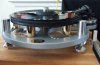
Here's my Michell and SME V....
You should definitely listen to a Rega P5, or even a P7 and see what you think.
Personally, I am not a fan of the VPI house sound....
Also consider a suspended table, like a Michell Gyro SE MKII with something along the lines of a Rega RB700 arm. Those two will cost about $3400 for both (the Michell is $2500, and the RB700 is $900), and that will leave about $1500 for a cartridge.
Here's my Michell and SME V....
Attachments
I'd buy the Classic. Wait, I did! The only upgrade I'm considering is moving to one of the cartridges Tedrick mentioned, or one of the other MC's that other's have tried on it. I'm currently running a 10x5, because I wanted something with high enough output to run directly into my vintage tube preamps if I chose to. But now that I have the table I'd like to play around with more cartridges as I'm having so much fun with it, and I have a step up transformer anyway so why not? It's a fantastic turntable. It's easy to set up. I was kind of turned off by the seemingly million things you could do with a Linn (others love that aspect of it, of course).
If you like bass and can't stand warbly pianos I think this might definitely be the table for you. Deep, articulate, sometimes startlingly dynamic bass response. It sounds very quick, and speed is very accurate.
I've not heard the Rega P5 (but have heard lesser Regas) but I have to tell you, I have no interest in looking at any other turntable.
If you like bass and can't stand warbly pianos I think this might definitely be the table for you. Deep, articulate, sometimes startlingly dynamic bass response. It sounds very quick, and speed is very accurate.
I've not heard the Rega P5 (but have heard lesser Regas) but I have to tell you, I have no interest in looking at any other turntable.

TerryO
Super Member
I'm in the market for a better turntable/cartridge. I'm fairly new to the vinyl game, i've had a technics 1210 mkV, and now a Pro-ject RM5se with blue point no 2 cartridge and speed box. I haven't had the table long, but now the rest of my setup is upgraded and it's got me wanting for more performance. I will be using it with a McIntosh Mc275 amplifier <new>, McIntosh c2300, Sonus Faber Domus Concerto Speakers <upgraded possibly soon, considering Auditor's etc>, and a REL 305 sub. I will occassionally use my Magnepan MGIIC and Dahlquist DQ10 speakers with this setup. I have checked out the VPI Classic with a Dynavector Cartridge <maybe the 20, I recall it was around 800$>, and was very impressed. I thought it more than held it's own with some sort of crazy Clearaudio 60k$ table when compared briefly. I also heard a Pro-ject Perspex with a Sumiko Blackbird through a very different set up at another dealer and thought it sounded nice, but it's hard for me to really compare the two because of the different set ups. I have never heard the Linn but will check out my friend Mark's soon. I've never heard a Rega. I'm open to any suggestions and observations, I don't have a set budget, but probably would like to keep things under 5k. I'm open to new and used, but these are the tables that have piqued my interest. Have any of you guys have experiences to share, or advice? I will admit that I do like my fare share of bass, and also that I can't stand warbly piano's!
With that budget, you might want to look at this:
http://www.welltemperedlab.net/welltemperedlab/
It's what I have...Ok, actually mine's the original preproduction prototype, but very similar:yes:
Read the reviews, but I can tell you right now that it's very good.
BTW, Here's a Blurb:
Amadeus Wins The Absolute Sound Golden Ear Award
The Well Tempered Amadeus has received “The Absolute Sound, 2009 Golden Ear Award” as a follow up to the excellent review it received in The Absolute Sound earlier in the year.
“Amadeus reaches stratospheric heights of performance at a moderate price”
Best Regards,
TerryO
Last edited:


Another vote for the Classic, but with at least a Benz Ace on it....it made a Linn owner who had the same cartridge on his LP12 seriously think about one...besides, it's cheaper than some of the Linn upgrades...if I had the bucks I, too, would get rid of my Linn for one....
And, made in USA if that matters to you, to me it does.
And, made in USA if that matters to you, to me it does.
I'm leaning towards the classic, probably with a dynavector. There is a well tempered dealer locally that also sells rega that I'm going to check out, although aesthetically speaking the well tempered turns me off. I wonder where I could hear the Mitchell? Very cool looking. To throw another table in the mix there is a thorens 124 for sale locally, anybody heard one of those? Also I'd like the table to not be very fussy with set up once it's set up.
Michell, not "Mitchell" tables are great, well built devices...but, I would think that with any suspended table that you must start taking into account whether or not you have a suspended vs. slab floor, and how good your equipment rack is...the suspension is there to help ameliorate external and internal noise sources/vibration and really forms a system with whatever it is sited upon....
OK, looking back at your budget, a Classic with a Benz Wood S would be an absolute killer combination...
I know what the Dynas sound like and the Benz carts, and have owned a Glider and currently own an older Wood, the H2O, and the Benz compliments the VPI's neutrality with a Grado Statement like warmth, but with a clarity that the Grados just can't seem to attain....the new Fritz Geyger stylus profiles used by the Benz "S" series has really made these cartridges something that really has to be heard...
And, no hum problems, impeccable quality control, every one I test exceeds factory standards, and i haven't had one come back that wasn't due to accident....
I also like the more shrouded nature of the Ace and the Wood series over the Glider, I HATE those way too exposed cantilevers they have, like the Blue Point Special, the Blackbird, and the Clearaudio MM series...I've trashed a few and just do not want to even have one in my system ever again!
OK, looking back at your budget, a Classic with a Benz Wood S would be an absolute killer combination...
I know what the Dynas sound like and the Benz carts, and have owned a Glider and currently own an older Wood, the H2O, and the Benz compliments the VPI's neutrality with a Grado Statement like warmth, but with a clarity that the Grados just can't seem to attain....the new Fritz Geyger stylus profiles used by the Benz "S" series has really made these cartridges something that really has to be heard...
And, no hum problems, impeccable quality control, every one I test exceeds factory standards, and i haven't had one come back that wasn't due to accident....
I also like the more shrouded nature of the Ace and the Wood series over the Glider, I HATE those way too exposed cantilevers they have, like the Blue Point Special, the Blackbird, and the Clearaudio MM series...I've trashed a few and just do not want to even have one in my system ever again!
Last edited:

jn229
Super Member
There's a couple of threads on here detailing the experiences of several AKers who took the plunge on a VPI Classic.
Based on those threads, if I were in your shoes, I'd get the Classic with a Dynavector 17D3 or DV20X and be done with it. You'll not likely get the 'table upgrade bug again for a LOOOOOONG time (but I won't make the same statement about cartridges...there's so many interesting ones out there :yes
Stacked; Great advice, 'BE DONE WITH IT'. It will get you off the upgrade merry go round.
To throw another table in the mix there is a thorens 124 for sale locally, anybody heard one of those? Also I'd like the table to not be very fussy with set up once it's set up.
In my opinion, the Classic is a modern response to what many in the DIY crowd loves about the sound of tables like the TD-124. The pacing and timing of the music, the drive of a big high torque motor driving a heavy platter. I'd love a TD-124 to compliment my Classic, but only after it's been modded with a heavy birch laminate plinth and a more modern arm. In fact, I was thinking about going that route before getting the classic, but the prices of TD-124s and a new arm are such that you really wouldn't be saving much by choosing it over the VPI Classic. Which, by the way, is not fussy at all. The only thing I had to do to mine in the past couple months was readjust the azimuth on the uni-pivot arm, as it had become slightly off somehow. Took 5 minutes. There's no suspension to deal with, it's pretty much set it and forget it, and just listen to music.
Michell, not "Mitchell" tables are great, well built devices...but, I would think that with any suspended table that you must start taking into account whether or not you have a suspended vs. slab floor, and how good your equipment rack is...the suspension is there to help ameliorate external and internal noise sources/vibration and really forms a system with whatever it is sited upon....
<SNIP>
Any turntable forms a system with whatever it is sited upon, non-suspended like VPis and Regas, or suspended like Michells and Linns. Both systems need isolation from subsonic seismic resonances.
My experience with both unsuspended tables and suspended tables is that the unsuspended one can be very detailed and have all the PRAT stuff, but also can sound dry, analytical, and "closed-in". This has been how VPIs sound to me in my limited experience with them (only have heard Scouts and Scoutmasters). My Rega sounded a bit this way as well, but not as much as the VPIs I've heard. It got a lot better when I put it on an inner tube to provide some seismic isolation.
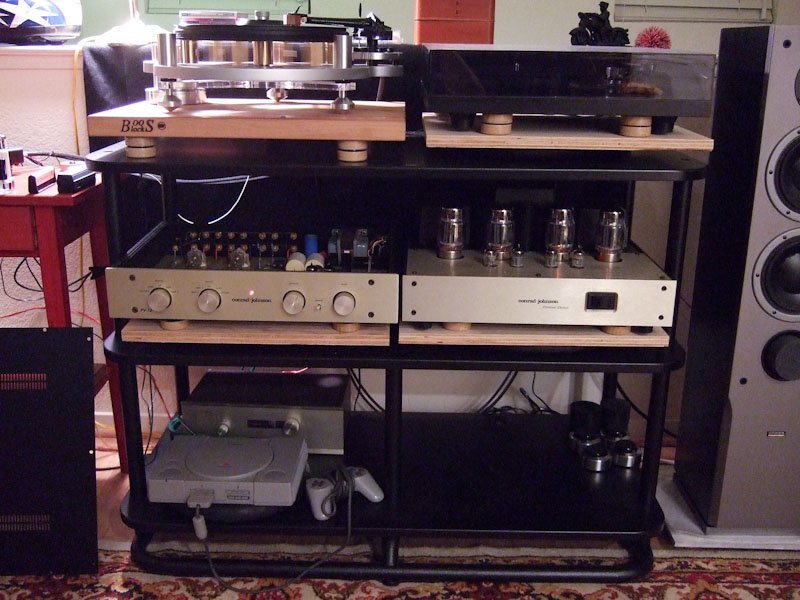
The suspension provides seismic isolation from subsonic frequencies and provides a marked improvement in sound, with the sound being much more open, airier and dimensional and natural-sounding. My Michell Gyro is on a suspended floor on a relatively inexpensive rack, and it sounds wonderful, very natural, musical and easy to listen to with excellent detail. Set up is really easy, an once you've got it set up, it's leave it alone and listen to it. I haven't touched mine in the 8 mos. since I bought it. Here's a picture from earlier this year. The Rega is on the right, it's sitting on a board resting on an inner tube.
Comparing to unsuspended tables with the suspended Michell, the Michell sounds fuller, more open, airier, with more full-bodied, liquid and natural presentation. You'll have to decide for yourself where your sensibilities lie.
If you do decide on a VPI, I'd recommend put it on a board resting on top of a inner tube. Another photo of the current set-up is attached.
Attachments

Comparing to unsuspended tables with the suspended Michell, the Michell sounds fuller, more open, airier, with more full-bodied, liquid and natural presentation. You'll have to decide for yourself where your sensibilities lie.
If you do decide on a VPI, I'd recommend put it on a board resting on top of a inner tube.
I have never heard the Scout series, but several reviewers mention the VPI house sound, and how the Classic leans much more towards neutrality than previous VPIs. Again, I've never heard another VPI.
I will say that it sounds open and airy, and full bodied but not overtly so. I don't sense an added lushness to the sound, but it is very full sounding. The bass response on this table is fantastic. It all just depends on what you like, of course. The Michell is just another flavor to choose from, a very capable one. I personally will never own a suspended deck again (at least not as my main table..I already own a few) but I happen to really like the sound of non suspended tables, which I only discovered recently.

cmb3366
Well-Known Member
My suggestion is to do your best to either do extensive auditioning of all the tables you're looking at, or even do an in-home demo, and let your own ears decide.
Having owned a mid-range Pro-Ject, I feel safe in saying any of the tables you're looking at will be a solid step up. I have never heard a VPI, so I cannot comment, but when I was in the market I borrowed a used Linn LP-12 with RB-900, and a P5 from my dealer. I ended up liking the Rega best, so thats what I bought.
Do some demo's and go with your gut/ears.
Having owned a mid-range Pro-Ject, I feel safe in saying any of the tables you're looking at will be a solid step up. I have never heard a VPI, so I cannot comment, but when I was in the market I borrowed a used Linn LP-12 with RB-900, and a P5 from my dealer. I ended up liking the Rega best, so thats what I bought.
Do some demo's and go with your gut/ears.
Any turntable forms a system with whatever it is sited upon, non-suspended like VPis and Regas, or suspended like Michells and Linns. Both systems need isolation from subsonic seismic resonances.
My experience with both unsuspended tables and suspended tables is that the unsuspended one can be very detailed and have all the PRAT stuff, but also can sound dry, analytical, and "closed-in". This has been how VPIs sound to me in my limited experience with them (only have heard Scouts and Scoutmasters). My Rega sounded a bit this way as well, but not as much as the VPIs I've heard. It got a lot better when I put it on an inner tube to provide some seismic isolation.
The suspension provides seismic isolation from subsonic frequencies and provides a marked improvement in sound, with the sound being much more open, airier and dimensional and natural-sounding. My Michell Gyro is on a suspended floor on a relatively inexpensive rack, and it sounds wonderful, very natural, musical and easy to listen to with excellent detail. Set up is really easy, an once you've got it set up, it's leave it alone and listen to it. I haven't touched mine in the 8 mos. since I bought it. Here's a picture from earlier this year. The Rega is on the right, it's sitting on a board resting on an inner tube.
Comparing to unsuspended tables with the suspended Michell, the Michell sounds fuller, more open, airier, with more full-bodied, liquid and natural presentation. You'll have to decide for yourself where your sensibilities lie.
If you do decide on a VPI, I'd recommend put it on a board resting on top of a inner tube. Another photo of the current set-up is attached.
The VPI Classic has a suspension/isolation built in its HRX feet and uses its great mass to good effect. With spring suspended tables, (like my Linn and others that have a non-damped type spring suspension, in contrast to the type of suspension exhibited by the Oracle Delphi's slightly damped springs) used in older homes, one must be careful about footfalls and the transmittal of those vibrations to the table, witness the use of wall mounts for many tables in just such instances....a solid, heavy mass table is less prone to oscillations that the relatively large vertical vibrations that some suspended floors deliver can cause, which may actually be more akin to a trampoline than a solid foundation, can deliver to the table...proper siting here is sometimes impossible without the wall shelf...
The VPI Classic is also unflinchingly neutral...an Ortofon 2M Black sounded almost screechy while a Benz Ace S sounded warm and comfortable...I also think your audition of the Scout and Scoutmaster may have been with cartridges other than Benz and may have led to that conclusion...i.e., I couldn't stand them either with various Dynavectors, the Grado Sonata was less than impressive and hummed, and after trying so many Benz cartridges and hearing just how each and every one of the Swiss made Benz just seemed to work so damn well on them have always tried to direct folks to them...the Gingko isolation bases on the Scout and Scoutmaster also took their performance and musicality up a big notch, too...even on a glass shelved heavy steel rack spiked to a concrete slab floor, but the choice of interconnect cables between the deck and the phono preamp can also tailor that sound...like by not using stuff like Nordost Tyr, for example, you don't need that amount of detail augmentation with these decks!
VPI's Classic is one of the most un-romantic, neutral tables I have ever heard in my 45 years of playing and working with analog things....as much as anything, careful system matching is essential with the VPI, and you can tailor the table from being an extremely cold and clinical machine to one with a warm, golden glow by careful selection of cartridges, interconnect cables, and phono stages...
I do like the Gyro, a lot, and have set up/assembled numerous ones, but still prefer the dead nuts simplicity of the VPI...plus, removing the arm for replacing a cartridge consists of unplugging the little Camac connector and lifting the arm off the table...the alignment jig supplied by VPI also makes cartridge set up and alignment easy even for a neophyte....
I also believe you about the Michell's sound in comparison to the Rega...while I may be a Linn owner, fan, and tech, I never "got" the Rega line...I set them up, I repair and service them, but just never have liked their house sound...in fact, I recently took a P-5 and using the exact same cartridge as I used on the Classic, set on the very same Finite Elemente stand with the same electronics, found that the P-5 lagged far behind the Classic in detailed musical recovery, in warmth, in PRAT, and the VPI was just plain flat out more musical....it took inserting a Stillpoints equipment stand under the Rega with the Stillpoints isolation feet and the Rega TTPSU, to make the P-5 anywhere near as good as the VPI and with those tweaks the Rega was far away more expensive...in other words, with a stand assembly that cost upwards of $1100 and a power supply that cost in the $500 vicinity, you're in the nearly $3k ballpark before cartridge to get lesser performance...and even then the arm would have done a helluva lot better with an Incognito rewire and a Michell counterweight...
The Rega arms (once suitably modified and rewired for all but their TOTL RB1000) are the best deal in their analog line...but, you can buy a Rega table, use it for a while, and as long as you keep all the packing and don't screw with the table, it will still have decent trade in or resale value...therefore they can present a not too onerous purchasing decision...
But if you're going to spend that kind of bucks over here in the States, where the Regas are not as economically feasible as in the UK, then I seriously tell folks to look to the American turntable companies as their best bang for the buck today. Even the Well Tempered is no longer made here but in China...bummer....which just leaves VPI....
Last edited:
All of this is great information! I'm starting to find out about places and people in the Austin area to check out turntables. I went last night to an audiokarma members house last night to hear his setup which was a linn lp12 with ittok arm and Lyra scala cartridge, ear phono pre, quad 63's, McIntosh c220 pre amp and McIntosh mc275 amplifier, and I was very impressed with the improvement in prat over my project turntable, and the amount of bass improvement. The only thing that turns me off is having to tweak it a bit to keep going. It was a truly great sounding setup. It saddens me how expensive the new linns are though to get a well appointed one. Turns out the thorens turntable sold years ago but Austin stereo hasn't updated their site, so that option is out. Thus far the classic seems like the best fit for me, and I'm glad I got a chance to hear it before I moved out of Santa Monica. I wish there was a local vpi dealer, closest one I've seen is in Houston. I prefer to buy local. I am goi g to go check out some of the other shops around town, two of them carry rega and one also has rega, so I'll give them a listen.

pbda
Super Member
Another vote for the VPI Classic. I am running mine with a Benz Micro Glider SL cartridge and find the sound to be neutral, with very dynamic bass and a crystalline nature to the treble that is exceptional in comparison to other turntables that I've heard.
I am also very fond of my LP12; a very different sound, with a somewhat more liquid midrange. First impressions are that the Linn is more of a "tuning mechanism" for the music, while the Classic more accurately portrays what is in the grooves.
I am also very fond of my LP12; a very different sound, with a somewhat more liquid midrange. First impressions are that the Linn is more of a "tuning mechanism" for the music, while the Classic more accurately portrays what is in the grooves.