• The move to the new server is done. There are some software and database maintenance updates in process. This has us passing the hat around to help out. We appreciate any donations. Seriously, even a dollar helps. The payment page may be found here - https://www.audiokarma.org/support.html

VU meter explanation

dm465531

New Member
Hi I was wondering if some one could clear up something for me. I have a mc2105 running through a C34v powering Zu Audio DW. These are relatively efficient speakers and I was wondering if some one could clarify the VU meters for me. After reading the manual:

"-0 In this position of the meter range switch, the amplifier will deliver 100 watts when the meter indicates +3dB, with meter indication of "0", the amplifier delivers 50 watts, with a meter indication of 3dB, the amplifier delivers 25 watts; and a meter indication of -10dB, the amplifier delivers 5 watts. (A meter reading of +3.2dB indicates 105 watts power output.)

-10 In this position of the meter range switch, the amplifier will deliver 5 watts output when the meter indicates "0". With a meter indication of —3dB, the amplifier delivers 2½ watts output and a -10dB meter indication, the amplifier delivers ½ watt.

-20 In this position of the meter range switch, the amplifier will deliver ½ watt (500 milliwatts) when the meter indicates "0". With a meter indication of —3dB, the amplifier delivers ¼ watt (250 milliwatts) and a -10dB meter indication the amplifier delivers 50 milliwatts"

When playing music through my TT the meters do not move at all when set to "0" and move some at "-10" and much more at "-20". Why is this? The volume is usually set to the 10 o'clock position. Are the meters saying that the amp is out putting less than 5 watts when set to the "0" position? I am just trying to understand how the meters work and I assume that they would function differently when using less efficient speakers?

Thanks for any help.

Dave
 
Register to hide this ad
Why is this? The volume is usually set to the 10 o'clock position. Are the meters saying that the amp is out putting less than 5 watts when set to the "0" position?

The meters are functioning exactly as they should and the readings you are observing are correct in relation to the output levels as stated in the owner's manual.
 
It seems you are trying to correlate power out with the signal provided to the VU=volume unit meters. This will be a difficult correlation to make since the signal need not be high to produce power out to your speakers. Perhaps if you get a power meter that reflects your speaker load, you will "see" the measure you are more interested in monitoring.

REF: A volume unit meter or standard volume indicator is a device displaying a representation of the signal level in audio equipment. The original design was proposed in the 1940 IRE paper, A New Standard Volume Indicator and Reference Level, written by experts from CBS, NBC, and Bell Telephone Laboratories. Wikipedia
 
You are correct 50, that in its most simple iteration a VU meter is simply a voltmeter that is showing (through a voltage divider) the voltage level of the output and therefore not accurately displaying power. As the load impedance varies, the power varies inversely. Explaining as a purely resistive load if your 8 Ohm speaker dipped to 4 Ohms (R) the VU meters would show the same voltage (E), but the current (I) would be double and therefore if the voltage remained the same the power (P) would be double. (P=I*E). VU meters are designed for low-level signal without varying loads, were designed for recording / studio / etc. use.

McIntosh meters aren’t pure volt meters driven from a voltage divider on the output. McIntosh develloped meter drive circuits, which evolved further over the different generations of amplifiers and are a more true representation of the actual power output. I believe that you can read the patents to get a better explanation.

As caddy responded above however, your meters are doing what they were designed to do, and will give you a decent (if not completely perfect) representation of the power delivered to your speakers. They are not VU meters.
 
The meters are functioning exactly as they should and the readings you are observing are correct in relation to the output levels as stated in the owner's manual.

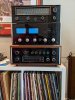
Thanks. I am just trying to understand how they work. I am waiting on my dads 71 JBL L100's to be refinished and can hook them up to the amp. I assume the meters will behave differently, per the instruction manual description. Here is a pic of the system BTW, MR75, MC2105, & C34V.
PXL_20220107_204512859.jpg
 
Thanks. I am just trying to understand how they work. I am waiting on my dads 71 JBL L100's to be refinished and can hook them up to the amp. I assume the meters will behave differently, per the instruction manual description.

They won't behave any differently nor should they. The meters simply register the amount of power being delivered at the moment. The range switch changes the sensitivity so as to make readings more viewable at lower output levels. The meters on the MC2105 & MC2505 are calibrated for dB and not watts which makes readings somewhat cumbersome but they are correct.

When the meters register +3dB, the output is 100W, 10W and 1 W with the range set at 0 dB, -10dB and -20dB positions respectively. Output power is halved for every 3 dB reduction and when the readings drop from +3dB to 0 dB (for example) the output is 50W, 5W and 0.5W for the same range settings.
 
Last edited:
OP - the "0db" scale is the least sensitive. The "-10dB" scale is 10 decibels more sensitive and the "-20dB" scale is 20 decibels more sensitive. Basically, you're adding 10dB of sensitivity as you change scales from 0 to -10 and then again from -10 to -20.
 
A point that has not been mentioned is that while you paid for 100 watt amp, you aren't likely to use more than about 10 watts unless your speakers are inefficient power hogs.
Those experienced in measuring such things know that the average person listening to music does so at under 10 watts of real power.
We own and seek out enormous power amps. Bigger power, more output devices and less distortion, it's all great fun, but doesn't change the fact that you're only using a small percentage of the available grunt.

As has been mentioned the meters are probably pretty accurate.
The people who have us convinced we need more than 50 watts of power, we should be questioning their accuracy.
 
A point that has not been mentioned is that while you paid for 100 watt amp, you aren't likely to use more than about 10 watts unless your speakers are inefficient power hogs.
Those experienced in measuring such things know that the average person listening to music does so at under 10 watts of real power.
We own and seek out enormous power amps. Bigger power, more output devices and less distortion, it's all great fun, but doesn't change the fact that you're only using a small percentage of the available grunt.

As has been mentioned the meters are probably pretty accurate.
The people who have us convinced we need more than 50 watts of power, we should be questioning their accuracy.

Thanks yeah I understand about the power consumption, and the Zu's are pretty efficient and easy to drive. I am thinking of trying some magnapan LRS and they are 4ohm, 86db sensitivity. I assume the 2105 would be enough for them.
 
Thanks yeah I understand about the power consumption, and the Zu's are pretty efficient and easy to drive. I am thinking of trying some magnapan LRS and they are 4ohm, 86db sensitivity. I assume the 2105 would be enough for them.

In that case the MC2105 may well not be enough.
 
Yeah that is what I was worried about. Can always get another amp, recommendations? Do want to use the 2105 with the JBl L100's though.

MC2205, MC2255, MC7270, MC7300 is what I'd be looking at. Plus you'll have the benefit of (logarithmically calibrated) watt meters which will help keep your eyes busy. :D
 
I go back to when Wendell demoed the LRSs for me on a "prototype high-current 300WPS" amplifier and felt that he heard some clipping during the demo, I'd recommend MC7300 minimum.

Better still would be MC2500, 2600, 602, 452, 462, ... several mono amps in the high-power high-current high headroom category also.
 
Seriously I hope the speaker selection is not being based on how much power they're able to gobble up.

It should also be kept in mind these speakers have finicky placement requirements and unless able to fulfill them to the letter, I would not contemplate them any further. Additionally the LRS is likely going to need a subwoofer for the best LF response which is another item one should be prepared to add.

There are many other excellent speakers out there without having to go down this potential "rabbit hole" of more powerful (and costly) upgrades and specific placement considerations.
 
Seriously I hope the speaker selection is not being based on how much power they're able to gobble up.<<snip>>

Quite the opposite caddy. I'd more likely recommend speakers that can deliver the full dynamics of ones musical choices within the parameters of a 120Wpc MC2105, but if the OP is set on buying a pair of LRS I feel he should know that running them at what I considered a normal SPL range with dynamic classical music can require more than the aforemetioned high-current 300Wpc amplifier could deliver.

That and the need for subs to deliver below (IIRC) 50Hz, and a good powered sub at that, is the reason I changed my mind on buying the LRS. Well, that and the whole 3' from the back wall and highly directional thing, I was ready to buy a pair and received my email that they were ready to ship, cancelled.

There are people who LOVE their maggies, the first ones I heard were way back in the '70s on McIntosh power. I have however found after several types of panel speakers that panel speakers don't work well with my listening style nor do dipole speakers agree with my analytical belief that only direct first-arrival sound is accurate.
 
Last edited:
Quite the opposite caddy. I'd more likely recommend speakers that can deliver the full dynamics of ones musical choices within the parameters of a 120Wpc MC2105, but if the OP is set on buying a pair of LRS I feel he should know that running them at what I considered a normal SPL range with dynamic classical music can require more than the aforemetioned high-current 300Wpc amplifier could deliver.

I agree and it's not necessary to get a pair of power hungry speakers to do it is all I was suggesting- along with passing on what owning and setting up a pair of this particular model speaker will likely entail. The post didn't sound as if the LRS is a consideration the OP is necessarily wedded to but maybe I'm wrong.

Like yourself, I was favorably impressed with a pair of MP .7 I demoed at A/C a few years ago and was seriously considering pulling the trigger on them until I realized there was no way I'd be able to accommodate their placement requirements nor was I interested in getting involved with subs.
 
Back
Top Bottom