

You are using an out of date browser. It may not display this or other websites correctly.
You should upgrade or use an alternative browser.
You should upgrade or use an alternative browser.
Watts per channel, RMS... overrated?
- Thread starter hnash53
- Start date

frommerstop
Super Member
I don't have anything to add about how much wattage is enough, or too much... seems to have been covered pretty well already.
As for modest powered, but fine sounding receivers, I give my vote to the old Advent 300.
As for modest powered, but fine sounding receivers, I give my vote to the old Advent 300.
charles 1973
Super Member
Back in the late 70's/early 80's there was a Canadian company that used their amps Current Rating to distinguish between 3 models. All were rated at 100 wpc. There concept was that 99% of the speakers out their could be driven to very satisfying SPL's with 30v RMS & 50v peak, as long as there was enough current. That company was called Audio Design, and it was far ahead of it's time with respect to stereo amp design, IMO besting the more popular Canadian made Brystons of their day in terms of sound quality, and their ability to drive any speaker made.
The 10A model was good for most speakers in the 4 - 8 ohm range. While it delivers the same power into those loads as their 30A, cost is reduced due to a much smaller power supply, fewer or smaller output devices, and less heat sinking. Why pay for all the extra current capability if you don't need it. The 30A would drive those few speakers who's impedance nearly shorts out the amp, absorbing the entire output of it's huge power supply threw it's equally large heat sinking. The 20A was in between in cost and current delivery.
I have their PA100, the predecessor to the A line. When I had accidentally shorted out the speaker outputs, once the welding stopped it continued to play as if it was just part of the music. This model will still drive a 4 ohm speaker in bridged mono mode (many are limited to 8 ohms in bridged mono), where it produces 350 w RMS @ 8 ohms.
Most vintage amps/receivers, and a few New ones are stable into a 4 ohm load. Very few are FTC tested at 4 ohms however, so to be on the safe side, when operating a 4 ohm speaker with these amps/receivers, I keep them about 3 db under full power to insure that it will not run out of current, And to allow it to safely operate 4 ohm speakers as long as required.
Last edited:

restorer-john
Addicted Member
The issue is, I've never seen a 'high current capability' amplifier that specified it capability in amperes to actually specify how long it can deliver said amperes. As we all know, the short circuit (momentary) current potential of a big, heavily filtered PSU is enormous, but the continuous current capability is hugely less, as the rails sag, the caps discharge and all we are left with is a rapidly heating output stage and a transformer flux density dropping like a stone.
That is why, the true heroes of 'high current' are the Pro gear, the likes of which are used by many of the AK 'heavy hitters' systems around here.
That is why, the true heroes of 'high current' are the Pro gear, the likes of which are used by many of the AK 'heavy hitters' systems around here.

Seppo
Super Member
The issue is, I've never seen a 'high current capability' amplifier that specified it capability in amperes to actually specify how long it can deliver said amperes. As we all know, the short circuit (momentary) current potential of a big, heavily filtered PSU is enormous, but the continuous current capability is hugely less, as the rails sag, the caps discharge and all we are left with is a rapidly heating output stage and a transformer flux density dropping like a stone.
That is why, the true heroes of 'high current' are the Pro gear, the likes of which are used by many of the AK 'heavy hitters' systems around here.
Thanks, interesting. E.g. my Onkyo A-9070 advertises High Instantaneous-Current Capability (HICC) of up to 100A (Asia and Oceania):
http://www.intl.onkyo.com/products/hi-fi_components/amplifiers/a-9070/index.html
or 80 Amps (North America):
http://www.onkyousa.com/Products/model.php?m=A-9070&class=Reference&source=prodClass
but HICC itself is not well defined. It does have four 15k microF caps, and weighs 40 lbs, so there is some heavy tech inside, i.e. it is not all marketing, but still, no independently measurable definition for the amperage claim.
Well, all I know the amp sounds great and is able to drive my Infinity RS-IIIa's (4-8 Ohm impedance) speakers w/o a sweat.
Age old argument here for sure, no clear answer on this, all comes down to what the listener wants and their choice of equipment. Say at one point in the day your listening to FM and have a set of bookshelf speakers hooked up to either a 15/30wpc receiver or even a large 200wpc amplifier, and the volume level is around say 80-85db, in either case your not using much power. Okay thats fine, but say you also drive a chevette with a 454 BBC dropped in, but the speed limit is still the same, but who cares? sometimes you wanna drop the hammer or twist the dial up, whatever, maybe i like to watch the cones of my speakers flail around until they end up on the floor, whatever floats your boat. I know what OP is getting at, but I myself, I'm not sure I could deal with having just one system or that one receiver and that one set of small speakers.
Age old argument here for sure, no clear answer on this, all comes down to what the listener wants and their choice of equipment. Say at one point in the day your listening to FM and have a set of bookshelf speakers hooked up to either a 15/30wpc receiver or even a large 200wpc amplifier, and the volume level is around say 80-85db, in either case your not using much power. Okay thats fine, but say you also drive a chevette with a 454 BBC dropped in, but the speed limit is still the same, but who cares? sometimes you wanna drop the hammer or twist the dial up, whatever, maybe i like to watch the cones of my speakers flail around until they end up on the floor, whatever floats your boat. I know what OP is getting at, but I myself, I'm not sure I could deal with having just one system or that one receiver and that one set of small speakers.
Actually, you may be using quite a bit of power...it depends on the sensitivity of the speakers and the dynamic range of the recording you are listening to (and also how far you are from the speakers).

ConradH
Lunatic Member
I've never seen good justification for very high current amplifiers. Current flows as a result of applied voltage and the impedance of the load. Most speakers have rising impedance with frequency, so you'll probably never challenge the current capabilities of an amp there. Somewhere at the low frequency end there's usually an impedance dip. If it goes low enough, large currents can flow. I've heard reference to speakers that dip to 2 ohms and below, but if you don't have something like that and don't play music with high levels in that region, those high currents will never flow. IMO, most "high current" amplifiers are never called on to deliver high currents in the real world. It's more of a headroom or "just in case" sort of thing.
Flat panel speakers like electrostatic have impedance dropping with frequency when frequency increases.I've never seen good justification for very high current amplifiers. Current flows as a result of applied voltage and the impedance of the load. Most speakers have rising impedance with frequency, so you'll probably never challenge the current capabilities of an amp there. Somewhere at the low frequency end there's usually an impedance dip. If it goes low enough, large currents can flow. I've heard reference to speakers that dip to 2 ohms and below, but if you don't have something like that and don't play music with high levels in that region, those high currents will never flow. IMO, most "high current" amplifiers are never called on to deliver high currents in the real world. It's more of a headroom or "just in case" sort of thing.
I would also like to have untapped headroom rather than make amplifier clipping when power demand increases.

holyman772
Super Member
...And by the way, it's my understanding that the EPI 150s with the new woofs/tweets have a sensitivity of about 88dB. From my reading, that's middle-of-the-road in term of sensitivity. Sure, if money is no object, one can purchase 95+dB speakers.
I read through this entire thread today and one thing jumped out at me that was not covered by other contributors pertaining to the comment above about cost = high sensitivity. To the OP, I think typically the opposite is true, that your most expensive, well engineered speakers (cabs/drivers/components, etc.) are less efficient that their middle of the road or even entry level counter parts. One can get very efficient speakers for very little money. If this is a perceived barrier for you to consider more efficient speakers at some point then rest assured it should not be.

Brian
An Old Geezer
Flat panel speakers like electrostatic have impedance dropping with frequency when frequency increases.
I would also like to have untapped headroom rather than make amplifier clipping when power demand increases.
And most electrostatic makers do not recommend either high current or high power amps as they will arc or even melt. With these, too much power can be more damaging than too little. The Janszen designs went so far as to specify the maximum voltage before meltdown. The Nines were 49 volts that translated to be almost using the McIntosh MC250/2505 as the largest amp as it put out that voltage.
The large Z824HP had the same maximum voltage but could withstand higher instantaneous power due to being a later panel design.

mhardy6647
Lunatic Member
Flat panel speakers like electrostatic have impedance dropping with frequency when frequency increases.
I would also like to have untapped headroom rather than make amplifier clipping when power demand increases.
... as Brian noted, many if not most (full-range) electrostatics won't appreciate high power, especially at high frequencies -- to which the cavalcade of arc'ed tweeter panels in Quad ESL-57s offers (literally) mute testimony :-(
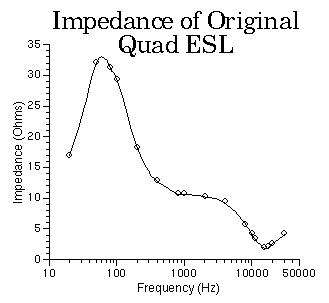

As amplifier loads, ESLs like the original Quads are in essence large capacitors -- not the easiest load for a marginally stable amplifier to drive.
Full-range ESLs tend to be the supermodels of loudspeakerdom -- gorgeous and beguiling but high maintenance ;-) (but everybody should spend some quality time with 'em*)!
 Paramours and Quada 112413 by mhardy6647, on Flickr
* the Quads that is; no comment on supermodels...

hnash53
Super Member
I read through this entire thread today and one thing jumped out at me that was not covered by other contributors pertaining to the comment above about cost = high sensitivity. To the OP, I think typically the opposite is true, that your most expensive, well engineered speakers (cabs/drivers/components, etc.) are less efficient that their middle of the road or even entry level counter parts. One can get very efficient speakers for very little money. If this is a perceived barrier for you to consider more efficient speakers at some point then rest assured it should not be.
I've gotten quite the education as I've read through all the posts here... never expected where this has led me. Indeed, holyman72, I see that efficient speakers are able to be had for reasonable amounts of money. The post of mine where I mentioned speaker efficiency was made in response to someone else sort of "knocking" my EPI 150s and their sensitivity (or lack thereof). Somewhere along the line, I got into my head that "increased speaker efficiency" = higher cost." Guess that's not the case. Thanks for pointing that out.
After totally re-habbing my EPI 150s, I was so enamored with their sound that I've never entertained the thought that perhaps there's something out there that might even sound better... and at reasonable cost. (And perhaps I don't want to... otherwise, I'll start chasing speakers!)
Thanks for all the comments and education you've provided me!!

Splatter Pak
High-End Scrounger
Splat's recent amp experience:
A few weeks ago, I took receipt of a modded Phase Linear 700B which was making the rounds of the membership of another audio forum. You might say it was beta testing. A previous member had smoked his CV's, so I was a bit nervous hooking it up to my Vandersteens (Model 2C). The amp peaked at a bit less than 500 watts, and it sounded glorious - the sound was agile, fast, quick, crisp, dynamic, or just plug in your favorite stereo mag adjective.
After the amp went home, I replaced it with a more modestly-watted (70 wpc) Cyrus 2 with its optional PSX power supply. The system still sounded very good, and I only wish I had done some blind testing between the two amps.
Yes, sheer watts is good, but should we not also consider things like:
rise time
slew rate
max current
max headroom
single vs multiple power supplies
the number of pots, switches, and contacts the signal must pass??????

whoaru99
Epic Member
I would also like to have untapped headroom rather than make amplifier clipping when power demand increases.
As would everyone.
The point remains though, if your speakers don't present an impedance that facilitates high current capability to do its thing then high current capability is a moot point.
Splatter Pak
High-End Scrounger
Just curious....how did you measure the peak of 500 watts?
I didn't measure - I was told by the fellow who modded it.

Judas Priest
Super Member
My QSC GX5 puts out 500W/ch. I know when I get there when the clip LEDs start to flicker 
restorer-john
Addicted Member
And the blue lights flicker on the police car out the front when they respond to a domestic noise complaint...
kidding.
kidding.
My QSC GX5 puts out 500W/ch. I know when I get there when the clip LEDs start to flicker

Hope you didn't think that I was knocking your speakers -- nothing at all wrong with EPIs, they can sound quite nice. I've owned a few pair, and they were one of the speakers that got me messing around with speaker repair in the first place.The post of mine where I mentioned speaker efficiency was made in response to someone else sort of "knocking" my EPI 150s and their sensitivity (or lack thereof).

Enjoy your stuff and your music.:thmbsp: