• Please note that Audiokarma will be offline briefly for updates early on Monday morning, September 28th.

Wharfedale W70 project

leesonic

Captured on security camera...
Subscriber
I picked up some Wharfedale W70 drivers from MisterFishey a while back, along with some Russian oil-filled capacitors for the tweeters. I also have some empty Polk Monitor 12c cabinets, which, if I sourced the crossovers, woofers, tweeters and passive radiators separately, would cost more than if I went and bought a complete pair. I was thinking of making a new baffle for these cabinets, and putting the whole lot together.

I have the internal measurements of the W70 cabinets, these are 22-7/16" x 19-6/16" x 11" making an approximate volume of 4782 cu. in. From the external measurements of the Polk cabinets taken off the internet, and assuming 3/4" thick walls, I estimate the internal measurements to be 37-1/2" x 14-1/2" x 10-3/8", giving a volume of 5641 cu. in. approximately. I will get more accurate measurements once I pull the cabinets out of my storage unit. While I am making a new baffle, it will be relatively easy for me to put a partition in to reduce the cabinet volume.

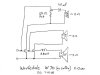
My one concern however is the midrange driver. When I hooked all the drivers up to test them, it seems like the mid doesn't handle deep bass very well, it would distort a lot sooner than the woofer. As you can see from the crossover schematic below, Wharfedale ran this "midrange" full range. I'm wondering, should I put a capacitor in series with it to reduce the low frequencies getting to it? I know my AR9LSi speakers had an 80uF cap in series with the 8" midbass, would something like that work? Should I increase the size of the inductor in line with the woofer to match?

This raises another question. The original W70 speakers had all the drivers in the same ported cabinet, presumably with the midrange moving in phase with the woofer to reproduce whatever bass it could. If I roll off the low frequencies from the midrange, will it now try and work as a passive radiator, even though it's inside a ported cabinet? Should I make a sub-enclosure for it? I could use this to reduce the volume inside the cabinet. If I make a sub-enclosure, should I do anything about the surround? The surrounds on both the woofer and midrange are porous cloth, so if I put the midrange in a sealed sub-enclosure, would this cause a problem with any pressure waves inside being forced out through the surround. I know some AR woofers have cloth surrounds that turn porous, and the fix here is a light coating of Permatex gasket sealant.

Lots of questions I know, but I'm just kicking some ideas around.

Lee.

W70drivers.jpg

W70caps.jpg

W70Xover.jpg
 
Last edited:
Register to hide this ad
One thing to consider is that there are 2 arrangements for the W70s. Some, like mine use a 12mfd cap. It might be an earlier version that uses the larger. I subbed in a 4 mfd and can not hear a difference. Also, my tweeter is in a separate enclosure and not open to the other drivers.

PIO caps require burn in, you may still need some time on them.

These speakers are quite amp sensitive, especially with the midrange to woofer transition. What amp did you use? I have found a decent number will create the issue you observed. Also, try turning the drivers 180 degrees as they may have settles and no longer be centered, a not uncommon affliction for these drivers when sitting for long periods unused.
 
My advice is build them to original spec and then mod from there. Otherwise you won't know if you are delineating from the original design and making it worse.


Sent from my iPhone using Tapatalk
 
Very Interesting!

I like the way you think!

I'm a big fan of early Wharfedales. I've got (no suffix) W60s and W90s, but I've never heard W70s. First thing I notice about the Polk cabinets is, no ports. If I recall correctly, all the early Wharfies are ported. That being the case, I don't think the porous surrounds are a real issue. (I haven't touched mine, although I've taken pains to seal the cabinets, and the driver mountings. Sound great.)

I suggest you put a hole in your new baffles for a port. Don't see how those early wharfie drivers could work in a sealed cab. I have nothing to offer about port diameter and length. Don't know the original spec. As Canuckaudiog has suggested, you might be best to replicate the original set up in the Polk cabs. But....., I'd be tempted to leave the Polk cabs undisturbed, and see if the LF drivers like the additional cabinet volume. The Super 3 tweet has its own little box anyway.

As for the crossover, if your schematic is right (and assuming 8 ohm drivers), it looks like the LF driver starts rolling off at about 1600 hz. If you're concerned that the mid-woofer is getting too much low frequency, how about a 100 uf cap, to keep out stuff below (say) 220 hz? Just a suggestion. I wouldn't try anything bigger than 4 uf for the tweets. (About 5 khz).

I look forward to hearing about your progress. "Wharf on Garth!"
 
What a shame you are on the wrong coast.

I have a pair of teak cabinets from the Radio People of Hong Kong which are beautifully made and are, as I understand it, sanctioned editions of the
W70s.

Could make you a great deal on them, but shipping them would be $$$
 
Last edited:
Drat!

Just pulled the Polk cabinets out of storage. They measure (internally) 30 x 14-1/4 x 9-1/4, making the internal volume 3954 cu. in. approx, not quite up to the size of the cabinets these drivers were in originally.

Guess I'll be making some cabs then...

Lee.
 
I did some more calculating on the Polk cabinet. If I added an extra 3/4" by extending the baffle, which I would have to do anyway to mount new drivers, the volume increases to 4275 cu. ft. approx, which is getting closer to the 4782 of the Wharfedale cabinets. Going on the formula for adding damping material to the inside of the cabinets, I get the volumes as follows :

Minimal (+5%) 4488.75
Normal (+10%) 4702.5
Heavy (+20%) 5130

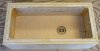
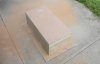
So if I stuff it with somewhere between normal and heavy damping, I should get the same volume as the Wharfedale cabinets. With that in mind, I set about the Polk cabinets. Here you can see one with all the fake vinyl stripped off, I used a heat gun to help.

W70project01.jpg

Here is is again, only this time with the baffle cut out.

W70project02.jpg

I glued some 3/4" MDF over the old baffle.

W70project03.jpg

Using one of these tools in my router...

W70project04.jpg

...I was able to trim the edges flush.

W70project05.jpg

W70project06.jpg

I got one driver hole cut, but I overheated my 1/4" router bit when it slipped down in the chuck. Still, it was getting late, and I'd already done all the calculations I needed.

W70project07.jpg

My routing skills aren't quite up to cutting little notches for the driver mounting hole lugs. Instead, I chose to route a larger circle to sink the driver into, and then cut a smaller hole. It looks a bit like the way Dynaco mounted their woofers in speakers like the A25 don't you think?

W70project08.jpg

One thing I'm wondering though. The original Wharfedale cabinet used a port 1-7/8" diameter by 8 inch long. In hindsight, would it be better to use two ports, or a single larger port to reduce the possibility of port noise (chuffing)? I can't remember how to calculate ports, if I use two instead of one, with the same diameter, don't they have to be twice the length or something?

Lee.
 
Last edited:
I am no expert on the subject but I would think that two small ports would create more chuffing not less because of the smaller diameter of the ports the air has less diameter to excape. Please take this info with a grain of salt. Just thinking out loud here........
 
I am no expert on the subject but I would think that two small ports would create more chuffing not less because of the smaller diameter of the ports the air has less diameter to excape. Please take this info with a grain of salt. Just thinking out loud here........

Maybe I didn't word it correctly. What I actually thought about doing is using either two ports the same diameter, or one larger diameter port. I couldn't remember if there was an easy formula when doubling up on the ports, ie. from a single port 2" diameter to two ports 2" diameter, you double the length.

Very nice routing work. Looks Pro!

Thank you! I wanted to try and route out the outer frame diameter, and then cut little "ears" into it for the mounting lugs. You might notice another 12" hole drawn on that cabinet, that was where the woofer was supposed to go. The first hole I cut was for the tweeter, and then I routed the "ears", but they didn't look as clean and neat as I wanted them to. So I made that hole bigger for the woofer. I am using the excellent Jasper circle cutting jigs, sold at Parts Express.

Lee.
 
Hey,

I too enjoyed your router work, I'm behind you in skill and practice level. I've got a pair of '59 Super 12's and Super 3 tweeters I'll be mounting to a homemade baffle here in the near future. Unfortunately, my woofers have webbing in the cast. I won't be able to surface mount them. I was able to get a hole saw for the Super 3's, but will have route the hole for the 12's.

I need to get back on my stick and get these babies taken care of. My restored Scott 222c should be back on Friday, not ready yet.

Biggles
 
Several things to consider here. Brian raised many interesting points. I wonder about the lack of the sand-filled rear panel, which was essential in it's backwave-cancellation and non-resonant properties (Basically just two plywood boards sandwiched together with a space in between for the layer of dry sand).

Also, does that mid need an isolator on the back of it, as was the case with the tweeter? And I believe the W70 only had one port. Not 100% sure, but I think so.

What Brian said about rotating the mid 180* may very-well be the reason it's distorting at higher volumes. After 50 years, that heavy magnet can get offset (which compromises the voice coil structure in some way, causing the driver to distort at higher volumes/excursions), and rotating it 180* is often enough to fix the problem. Apparently common with W70 midwoofers.

Does anybody know the displacement in cubic feet for the ported W70? Those W70 drivers are from the ported version, right?

The W70 must be a damn-nice speaker, especially with tubes. I have first-generation W90's and W60's, both in ported cabs with alnico drivers, so I can imagine how nice Brian's alnico W70's sound (He just put oil caps in his). Those drivers have that special something that makes you want to listen for hours and hours. They have that true "breath of life" sound that a small number of non-electrostatic/non-planar speakers possess. Brands like Goodmans, Altec, Bozak, University, etc., and that's the sound I'm after. Wharfedale seems to have the perfect amount of warmth, at least for me. I spent all afternoon yesterday listening to things like Marvin Gaye's "What's Going On" and Al Green's "Greatest Hits". That Fisher/W90 combination is otherworldly, especially with the Fisher restore and the oil caps in the W90's. Back in '09, I had an idea in my head about my "dream sound" and my supposed dream system, but this is so-totally-beyond that now. I just want to swim around in a big pool of this sound and do the backstroke.
 
Last edited:
Several things to consider here. Brian raised many interesting points. I wonder about the lack of the sand-filled rear panel, which was essential in it's backwave-cancellation and non-resonant properties (Basically just two plywood boards sandwiched together with a space in between for the layer of dry sand).

I will be bracing the front to back panels before the final assembly. Whether this will be as good as a sand-filled rear panel, I don't know.

Also, does that mid need an isolator on the back of it, as was the case with the tweeter? And I believe the W70 only had one port. Not 100% sure, but I think so.

No, none of the W70s have the mid in it's own box, and I've looked a lot of pictures of them. The W70 has one port measuring 1-7/8" in diameter by 8". I got this and the internal cabinet dimensions from roger federer. No, not THAT Roger Federer, unless he's here on AudioKarma in between tennis matches.

What Brian said about rotating the mid 180* may very-well be the reason it's distorting at higher volumes. After 50 years, that heavy magnet can get offset (which compromises the voice coil structure in some way, causing the driver to distort at higher volumes/excursions), and rotating it 180* is often enough to fix the problem. Apparently common with W70 midwoofers.

I have no way of knowing which way around these were installed in their original cabinets. If the mid sounds like it's having a problem, I will try rotating it.

Does anybody know the displacement in cubic feet for the ported W70? Those W70 drivers are from the ported version, right?

Displacement given in my first post.

Lee.
 
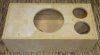
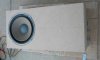
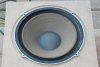
Did the mid and tweeter routing and cutting this afternoon.

W70project09.jpg
W70project10.jpg
W70project11.jpg
 
Last edited:
Nice looking project, and I really like many of those Wharfedale drivers. Even though MDF grabs a sharp screw thread really well, I'd suggest spending a few bucks and providing attachment of the drivers with machine screws and T-nuts for a more heavy-duty installation.
 
That's looking very sharp! Are you using a jig to cut those circles?

I agree. Those are looking really-nice for sure.

I don't know exactly why, but Wharfedales are the only drivers I've come across that don't appear to be restricted to any particular application. In the book I have, it talks about a man Gilbert Briggs met on a trip to the states (His very-first, I think) who built a custom mono speaker system that had Wharfedale drivers (all ranges) aiming out the front, sides, AND top, and the system impressed Briggs so-much that he wrote about it in one of his books and included a drawing of it as well, and they remained lifelong friends. And if you look at that Super 3, they have it pointing all sorts of ways in various models. The only stipulation seems to be that it needs to be off the floor quite a bit. In otherwords, put the tweeters at eye-level (when seated in the listening spot), and you'll have the sweet, airy highs getting to their intended target. When demo'ing them at events/dealers, they would have them on the optional pedestals, as that height is ESSENTIAL for any of their front-firing tweeters from Wharfedale's classic days. Great drivers though. I mean, I'm listening to a Beck album from 1999, and it sounds awesome. It SHOULDN'T, you know?

Here's wishin' ya' good luck on this. I bet you'll be able to place those cabs horizontally AND vertically. Their woofers, mids, and tweeters don't mind being on the same plane as each other.
 
Last edited:
Really nice!

About your comment:

"I have no way of knowing which way around these were installed in their original cabinets. If the mid sounds like it's having a problem, I will try rotating it."

I've found that there's usually a thin layer of dust in the fabric surround of the drivers, which I assume indicates the bottom of the original orientation. On the other hand, yours are so clean, I can't see any telltale at all in your pictures. :scratch2:
 
That's looking very sharp! Are you using a jig to cut those circles?

Yes, a Jasper circle jig I bought from Parts Express.

I've found that there's usually a thin layer of dust in the fabric surround of the drivers, which I assume indicates the bottom of the original orientation. On the other hand, yours are so clean, I can't see any telltale at all in your pictures. :scratch2:

Good idea, I see the dust on all the drivers, so now I can install them 180 degrees out.


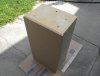
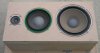
I did the other cabinet tonight. Don't ask me why the MDF is a slightly different color.

W70project12.jpg
 
Last edited:
Back
Top Bottom