• The move to the new server is done. There are some software and database maintenance updates in process. This has us passing the hat around to help out. We appreciate any donations. Seriously, even a dollar helps. The payment page may be found here - https://www.audiokarma.org/support.html

What caused the decay of the U.S. auto manufactureres

Is that 10 speed the one that's shared with Ford? According to comments I've seen online (regarding Mustangs) Ford had problems early on but seems to have mostly ironed them out.
Yes it is. The latest generation is indeed getting better but they're not as reliable as they should be yet. I just bought a low mileage 2014 Silverado (72k) and I'm going to hope for the best with the 4L80E six speed it has. I'll be servicing it very soon just for peace of mind.
 
Yes it is. The latest generation is indeed getting better but they're not as reliable as they should be yet. I just bought a low mileage 2014 Silverado (72k) and I'm going to hope for the best with the 4L80E six speed it has. I'll be servicing it very soon just for peace of mind.
Should be fine the trans went out in my work van at 159 k
 
Right! Having a high school friend that got a 69 fastback in the early 70s with the semi high performance motor (225 hp I think) to replace his MG-A, we grew up with real Mustangs. But Ford has always played games with the mustang branding ... that sad little 4 cyl Mustang II (pinto based - 1973-78) was a shameful example. The ones with the 2.8l V6 were reasonable, while the 302 V8 versions were fun but excessive ;) But they sold a ton of the Mustang IIs, America liked them.
The Mustang II was designed to compete against the Toyota Celica. And Ford's sporty reaction against the fuel crisis, and increased fuel prices. And more sporty compact, and fuel efficient. Do consider the era in which the Mustang II was new in. The succeeding Mustang III in 1979 was where horsepower and performance got gradually added back in as the platform moved along.
 
Camaro went fast in a straight line, handling, suspension, and brakes were primitive on a good day. Camaro is a muscle car. Going fast in a straight line, is where Camaros are happiest doing.
Starting in 2005, Ford finally gave the Mustang a chassis that had some serious handling potential. I own a 2007 Mustang GT Steeda Q335. Steeda set it up to be mainly a road course car but it runs the 1/4 mile in the low 13s with ~105 mph trap speed. Mine was sold new by a Ford dealer with the modifications installed. It handles incredibly well and I'll drive it until I can not longer work a clutch. I would love to put a twin screw blower on it but can't bring myself to modify a somewhat rare car that came that way when sold new.
 
...and the Mustang II (along with the Pinto) got rack and pinion steering before the Corvette.
 
Knowing that in fact the qualty wasn't so good in those years, this film makes me feel a kind o funny. But I do apreciate the "Cadillac"'s that where managed to be good manufactured in those years. I do have a respect for some old made U.S.A. cars

 
Knowing that in fact the qualty wasn't so good in those years, this film makes me feel a kind o funny. But I do apreciate the "Cadillac"'s that where managed to be good manufactured in those years. I do have a respect for some old made U.S.A. cars
IMO, up until the mid to late 1970s, the US automakers overall made vehicles with terrific body styles.
 
U.S.A. had what is called the Malaise Era. "G.M." took it quite hard and made some really bad stuff and bad management decisions - including that downsized "Cadillac" - seen one pun : "Here is your ´´Cadillac´´. "No sir, I think that's my ˝Buick˝".
"Ford" took it better, trough all that in the late '80's made some very modern looking cars, but with really bad transmisions.
Dont' know too much about "Chrylser" Corporation a.k.a "Mopar".
In the '90's, there where some good cars, some bad ones.
But even before the crisis of the 2009, U.S..A. made cars wheren't the dream that they used to be and the source of inspiration that they used to be. "Lincoln" made some nice models in the early '000's, "Cadillac" camed with that ugly 'Escalade', but... no more of that power of American cars. O.k., the Europeanens and the Japanese made some good cars, some not good, but which still had the looks, but I don't think this is the only reasons that caused the decay of U.S.A. auto manufacturers.

The 77-79 coup Deviles were fantastic vehicles ! 425 were bullet proof that was a very successful first downsizing caddy’s and of all the full size GM vehicles ! Then came the 80s yikes but most had recovered by the 90s and early 2000s
 

I sayed the decline of the manufactures, not the industry per se.

The 77-79 coup Deviles were fantastic vehicles ! 425 were bullet proof that was a very successful first downsizing caddy’s and of all the full size GM vehicles ! Then came the 80s yikes but most had recovered by the 90s and early 2000s

The oil crisis and the E.P.A. regulation?
"Ford" semeed to took it better, except those bad transmisions.

I don't like the sqaure looks of the things. But that boxy style of U.S.A. cars, was good looking.
 
Intresting thing: "Harley-Davidson" did managed to keep some fans. "Indian" is coming back. I know, they are motorcycles, but they managed comparing to the automobile industry to kept a certian image, even abroad U.S.A.
 
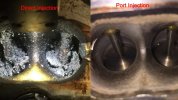
The comments about direct injection just reinforced my realization of how little percent I know of everything that's under the hood today. You made me run to google what's in the 2024 Coyote V8 in my Mustang - turns out it has both direct and port injection. I'm sure there must be lots to discuss about advantages/disadvantages of just this one design aspect.
Direct injection seems to cause a lot of carbon build up on the valve stems. Most companies that use DI have problems with the engines after 50K or so and many have to have the cylinder heads pulled and cleaned out. Port injection puts the fuel into the intake port and keeps the port and valves clean, DI puts the fuel right into the combustion chamber, while the exhaust gas re-circulatory system (EGR) pumps crankcase vapors into the port clogging them up. Ford has solved this issue by using both DI and Port injection at the same time... more power from the DI and clean valves from PI
DI vs Port.jpg
 
My 3rd Gen Lexus GS350 had DI and Port injection when it was launched in 2007. Does this mean Ford is that far behind if they are just now using both? Not trying to be a wise ass, but this solution to carbon build up has been around for quite some time. Obviously, it costs more to take this approach, or to come up with designs that eliminate certain failure modes.

All car manufacturers have had their quality and design issues in the last 40 years, some more than others. Corporate culture is a big part of who.s on top and who isn't.
 
What applied back then still applies in 2025. CAFE continues to wreak havoc on the industry. Small turbo engines in big trucks, cylinder deactivation, auto start/stop, low friction oil rings, lighter pistons and con rods, are used to chase an extra mpg but in fact reduce engine life and cost customers and manufacturers dearly.
Engine if serviced regularly last about 4 times as long as they did in the 50s. Not uncommon to have a 500000km engine still in a car. At 80000 kms 50s engines needed rings, valves and all new sealing surfaces. Maybe had a lot to do with modern oils but the old engines didn't last very long. Yes you can tell me about the 1000000 mile engine bit that is so rare it isn't worth repeating.
 
Back
Top Bottom