
• The move to the new server is done. There are some software and database maintenance updates in process. This has us passing the hat around to help out. We appreciate any donations. Seriously, even a dollar helps. The payment page may be found here - https://www.audiokarma.org/support.html

What do you pay for electricity per kWh these days?

I hate the price of electricity!!!

Southern CA Edison has $0.353 /kwh. $0.24 off peak and $ 0.58 peak.
I ended up with solar on roof and SCE pays me an insignificant change.
Hoping the solar is worth it in the end.

In Romania we have around 1,1-1,3 Lei (Lions) per k.W.h. An U.S.D. or Euro is around 5 Lei. So around 20 (Euro) Cents. Might not sound much, but if you earn around 600 $/Euro per month here it's consider an acceptable sallary (wage). 1,000 is good.
I want to be able to consume 200-300 k.W.h. per mont without paying much. 400 in the winter.
 
I have two homes! One is deep in the mountains of Central Nevada The house is off grid and uses D.I. water for the batteries! Cost maybe 5 dollars a month. The 2nd home in Lennox, SD and the cost is 12.41¢ per kWh.
 
It's weird because I think it has been hotter this year but my electric bill hasn't gone up. For this same period last year my bill went up less than $2.

I don't know why because nothing's changed with my house and if anything I have been home more than I was last year so I would have thought it would have made it higher because of that too. :confused:

$347.48 is high enough for me.

For those of use whose bill has doubled -- and those of us paying 30 cents plus per KwH( aka New Jersians and Californians :)) -- your post about power prices being no problem kind of reminds me of this "Far Side" cartoon :):)

the-far-side-cateen-advertisement.jpg
 
Last edited:
For those of use whose bill has doubled -- and those of us paying 30 cents plus per KwH( aka New Jersians and Californians :)) -- your post kind of reminds me of this "Far Side" cartoon :):)

That's one of the reasons why I don't live in New Jersey anymore. I have twice the home I had up there for half the price here in Tennessee.

A few years ago I was offered a job in San Diego but after doing my homework decided to pass on it because I didn't want to live in poverty making six figures.
 
That's one of the reasons why I don't live in New Jersey anymore. I have twice the home I had up there for half the price here in Tennessee.

A few years ago I was offered a job in San Diego but after doing my homework decided to pass on it because I didn't want to live in poverty making six figures.
Yeah, making six figures in a seven figure town is a drag!

I used to make 2 trips a month to SD, and in 2013 it looked like a nice place to relocate to. By 2024, it had become an overcrowded mess that even lots of money wouldn't solve. They can't fix the traffic, and over crowding.
 
I just bought the Tapo power monitor outlets for the princely sum of $17 for two (aka a little 1/2 a day's electricity at current rates). They allow you to monitor electricity with an app and they're made by TP-Link, so it should be secure (unlike some generic products). I put the outlets in and am already learning a LOT about our usage.


So with the Tapo above I am able to monitor and diagnose a large part of our electric usage. My old theater room is now my son's racing sim rig room. To run sim (iRacing) requires a "mini-Cray" :):( PC -- high performance graphics and CPU. I expected it to use a lot of power while being used (measures around 700 - 850 watts when in use). I didn't expect it to use as much as it is when it's not active.
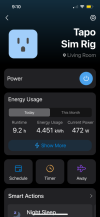
It uses around 472 watts while not active, and that drops to 338 watts when I turn off the audio system. So the audio system is using about 138 watts when it's turned on but there is no load. The audio is a Yamaha Aventage RX-A880 (used as a preamp) and a McIntosh MC-7106 -- I didn't expect them to use 138 watts at "idle" (on but no audio). The rest remaining 338 when idle is the computer and four monitors.

So it looks like a baseline of 472 watts has been running around the clock -- raising to 700-800 when he's using the sim. Enabling "automatic sleep" on the computer or monitors can cause problems with the sim, but I'll start having him just shut everything down when he's done for the day which should save considerable.

I have another Tapo monitor on the dehumidifier in the basement to see how much it's using. These plug monitors are super helpful.

IMG_2008.png

IMG_2007.png

IMG_2005.png
 
Coastal Orange County, CA (So Cal Edison)
On Peak (5-8pm wkdy). $0.73791
Mid Peak (5-8pm wkend). $0.53800
Off Peak (12a-5p & 8p-12a) $0.33938

I have 7,628Wh of solar generator capacity across several portable units -like a Bluetti Elite 100 or EcoFlow- that I use to manage costs by time of use, and in case of power outages. They are not normally connected to solar inputs, but the mains/grid. They charge Off Peak and run stuff during On Peak periods --like my network rack, son's desktop, air purifiers, audio/visual equip, and freezer. My On Peak usage in August was 43kWh.

In combo with smart plugs, their onboard management software works really well. The Bluetti units have a 10ms cutover time in UPS mode. We can run all electronics for 5-6 hours in a power outage and can run the freezer, lighting and charge phones for days.
 
Coastal Orange County, CA (So Cal Edison)
On Peak (5-8pm wkdy). $0.73791
Mid Peak (5-8pm wkend). $0.53800
Off Peak (12a-5p & 8p-12a) $0.33938

I have 7,628Wh of solar generator capacity across several portable units -like a Bluetti Elite 100 or EcoFlow- that I use to manage costs by time of use, and in case of power outages. They are not normally connected to solar inputs, but the mains/grid. They charge Off Peak and run stuff during On Peak periods --like my network rack, son's desktop, air purifiers, audio/visual equip, and freezer. My On Peak usage in August was 43kWh.

In combo with smart plugs, their onboard management software works really well. The Bluetti units have a 10ms cutover time in UPS mode. We can run all electronics for 5-6 hours in a power outage and can run the freezer, lighting and charge phones for days.
Ideally, you should have a minimum of 5 kW of self-generated power from photovoltaic panels.
 
Coastal Orange County, CA (So Cal Edison)
On Peak (5-8pm wkdy). $0.73791
Mid Peak (5-8pm wkend). $0.53800
Off Peak (12a-5p & 8p-12a) $0.33938

I have 7,628Wh of solar generator capacity across several portable units -like a Bluetti Elite 100 or EcoFlow- that I use to manage costs by time of use, and in case of power outages. They are not normally connected to solar inputs, but the mains/grid. They charge Off Peak and run stuff during On Peak periods --like my network rack, son's desktop, air purifiers, audio/visual equip, and freezer. My On Peak usage in August was 43kWh.

In combo with smart plugs, their onboard management software works really well. The Bluetti units have a 10ms cutover time in UPS mode. We can run all electronics for 5-6 hours in a power outage and can run the freezer, lighting and charge phones for days.

That's good food for thought. I probably don't need battery since we have flat rate (30 cents a KwH). In NJ, according to AI, without any licensing or code or electrician, you can plug up to 1200 watts solar (panels plus inverter) into an outlet and whatever you produce will offset your usage.

If you are producing 1000 and consuming 1200 watts, you only pay for 200 watts. If you are producing 1000, but using 500, then the 500 is free but you don't get any credit for the 500 excess (because you don't a solar agreement with the power company) - I could of course charge a battery system.

1200 watts is not bad for a simple plug and play solar -- it looks like it's about $600 for 3 400-watt panels plus another $200 for an inverter -- $800 in total. If i could find a place to hide those panels, I might be inclined to do that. If I was generating 1200 watts, that would save about $45 a month. Still takes 1 1/2 years to pay off, but not bad, and I like the idea of offloading the grid.
 
Ideally, you should have a minimum of 5 kW of self-generated power from photovoltaic panels.
I wouldn't mind having that capability, but it's quite an investment. Incentives these days seem to be for storage, rather than generation like previous years. Being in a coastal adjacent locale my electric bill isn't astronomical. We do not use a lot of cooling or heating and last year my total electric utility tab was just a little over $1900. I did the math in 2017 on a solar installation and it didn't pan out for me. But, if I did have solar generation I could run heat pumps relatively cheap. I have two FAUs and would need two heat pump units, so up-front capital costs are not insignificant.
 
That's good food for thought. I probably don't need battery since we have flat rate (30 cents a KwH). In NJ, according to AI, without any licensing or code or electrician, you can plug up to 1200 watts solar (panels plus inverter) into an outlet and whatever you produce will offset your usage.

If you are producing 1000 and consuming 1200 watts, you only pay for 200 watts. If you are producing 1000, but using 500, then the 500 is free but you don't get any credit for the 500 excess (because you don't a solar agreement with the power company) - I could of course charge a battery system.

1200 watts is not bad for a simple plug and play solar -- it looks like it's about $600 for 3 400-watt panels plus another $200 for an inverter -- $800 in total. If i could find a place to hide those panels, I might be inclined to do that. If I was generating 1200 watts, that would save about $45 a month. Still takes 1 1/2 years to pay off, but not bad, and I like the idea of offloading the grid.
1.5 years is not bad at all. In my area I would need to pull a permit for any permanent solar panel installation, regardless of the size, and ensure proper bonding and grounding, etc. I do have only 300w of portable panels (for shtf) and the battery units (solar gens) are self-contained with charge controller, inverter, and BMS. My batteries are mainly as a power backup solution and the time of use management is a side benefit.

Edit: I would guess you would realize something less than 1200w of generation with that setup, so payoff period might be a little longer. And, you might need a switch between your panel to isolate from the grid in case of a power outage. Otherwise, your panels could energize the grid if I am understanding correctly...
 
Last edited:
1.5 years is not bad at all. In my area I would need to pull a permit for any permanent solar panel installation, regardless of the size, and ensure proper bonding and grounding, etc. I do have only 300w of portable panels (for shtf) and the battery units (solar gens) are self-contained with charge controller, inverter, and BMS. My batteries are mainly as a power backup solution and the time of use management is a side benefit.

Edit: I would guess you would realize something less than 1200w of generation with that setup, so payoff period might be a little longer. And, you might need a switch between your panel to isolate from the grid in case of a power outage. Otherwise, your panels could energize the grid if I am understanding correctly...

I've only superficially looked at it, but NJ (being among the highest rates for electricity in the US, and highest rates for RE taxes/income tax) apparently is actually one of the best for solar reimbursement. It look like they give the you full 30 cents (which is broken up to roughly 10 cents "delivery", 20 cents "supply" cost) for any excess solar if you have a full solar system and agreement.

For the under "1200 watts and under" exception (no agreement or permit needed) plug and play option, I think you will energize the grid with any excess, but you don't get paid for that, you only benefit from the real-time usage you are offsetting.

I agree that I'd probably get less than the 1200 watts real-world. I may dip my toe in the water with a single 400-watt panel if I can find a quality reasonably priced micro inverter if I can find a good place to put the panel. I may start a separate thread on this topic to get feedback about equipment.
 
I've only superficially looked at it, but NJ (being among the highest rates for electricity in the US, and highest rates for RE taxes/income tax) apparently is actually one of the best for solar reimbursement. It look like they give the you full 30 cents (which is broken up to roughly 10 cents "delivery", 20 cents "supply" cost) for any excess solar if you have a full solar system and agreement.

For the under "1200 watts and under" exception (no agreement or permit needed) plug and play option, I think you will energize the grid with any excess, but you don't get paid for that, you only benefit from the real-time usage you are offsetting.

I agree that I'd probably get less than the 1200 watts real-world. I may dip my toe in the water with a single 400-watt panel if I can find a quality reasonably priced micro inverter if I can find a good place to put the panel. I may start a separate thread on this topic to get feedback about equipment.
Photovoltaic panels can be mounted on balconies or fences, not just on roofs or ground-based supports.
 
Back
Top Bottom