• The move to the new server is done. There are some software and database maintenance updates in process. This has us passing the hat around to help out. We appreciate any donations. Seriously, even a dollar helps. The payment page may be found here - https://www.audiokarma.org/support.html

What limits volume and causes clipping?

LHorn

AK Subscriber
Subscriber
Is the pre-amp or amp responsible for the volume limit and clipping...or a combination of both?

Trying to figure this out on my system...which I'm currently running the pre-outs from my R-117 receiver to my Crown amp...with the receivers internal amp unplugged. So normally if using the receiver with pre-outs to mains the volume limit is around the 10-11oclock range. So when using it as a pre-amp only and the Crown is set to wide open...is this 10-11 range still the limiting factor..assuming the Crown can take it? Is the 10-11 range on the pre section of the 117 always the limit no matter what its driving..ie..if I crank it to say 12-1 range and the amp has no problem with it am I still overworking the pre section?

I have the Crown input sensitivity set at the 1.4v setting and the clip light never comes on. The only time it did flash is when I had it set at the .7v setting. I never got a clear answer on that setting as I dont know what the 117 output actually is...so I leave it on the 1.4v setting.

So when the clipping lights come on...is it the pre-amp or the amp causing it? Oh..and if it matters this is assuming the same speakers being used and they can take it and more..

I'm not that good at explaining things but here it is anyway.
 
Register to hide this ad
Regarding the preamp clipping the signal, that would make the sound distorted. There is no way that we will be able to tell you remotely whether the preamp is clipping the signal, but it is not simply a function of where the volume control is set. The amount of signal coming out of it is also dependent upon the input signal. With nothing coming in, the output should be zero (everything, though, is imperfect, so there will be some noise, though it may not be enough to be audible, so the output will never truly be absolutely zero when it is on).

As for the settings on your power amp, again, the amount of its output power is dependent upon the input signal, and it may be that with the 1.4v setting you will not be able to get the full power of the power amp with your current preamp. If you never see the lights clip even with the volume control all the way up, with a high level input (say, for example, a loud passage on a CD), then it is likely that you are not able to get the full power out of it with that setting.
 
So cranking the pre will only result in distorted signal..that wont cause clipping. I have the Crown set at 3/4 volume from the max on the 1.4v and I can use R-117 as I would normally if using just the receiver alone with no problems. If I switch to the .7v setting..then I have to be more careful where I set the Crown at...and at around the same levels thats when it will start lighting up the clipping light. What happens if its on .7v and it should be on 1.4v? Is there a way to measure the pre's output with a simple MM?

It's not a problem as I dont crank it to its limits often..dont need to..I'm just trying to figure out the which and why's of it all so I dont damage my old 117.
 
Clipping is distortion of a signal, of a specific type. A preamp can clip a signal, if the input to it is high enough and it "tries" to amplify the signal more than it is capable of doing without clipping. If it is clipping, the sound will be distorted, regardless of how the power amp is set (and consequently, regardless of how high or low the volume is in your room). You can hear distortion of this type when you play some rock music in which a guitar is overdriving an amplifier; Jimi Hendrix is a good example of this, where the distortion is part of the music. Or the Beatles Revolution (not Revolution 1 on the white album). In those cases, the distortion is, I think, from tube amplifiers, which will be a bit different from the sound of clipping with a typical transistor amplifier. (But it does illustrate the fact that clipping, in itself, does not destroy tweeters in speakers. What destroys tweeters is too much power going to them.)

In order to know how things should be set, it would be a good idea to read the manuals to both the preamp and the power amp, to see what level the output is on the preamp, and match that for the input setting on the power amp, and also adjust the levels on the power amp.

In my case (which is irrelevant to your case, because both my preamp and power amp are different from yours), I have my power amp with its level controls all the way up, and its input setting to its most sensitive. I do not know if I can drive my power amp into clipping or not, because I have never turned the volume control all the way up on my preamp. And if I could drive my power amp into clipping (and did so), my speakers would probably already be destroyed, because the amplifier's rated power is well above what the speakers are rated to handle.

With your system, if you set the input of the Crown to 1.4v and its level controls all the way up, can you get the clipping light to come on? (Don't destroy your system with playing too much with this; if you try this, be very gradual with turning up the volume on the preamp with a signal that is at a fairly constant level.) If you can get the clipping lights to come on with the 1.4v setting, then that is almost certainly the better setting for your system. If not, it still might be, depending on how close to getting the maximum power of your amplifier you can get at that setting.
 
Last edited:
So cranking the pre will only result in distorted signal..that wont cause clipping. I have the Crown set at 3/4 volume from the max on the 1.4v and I can use R-117 as I would normally if using just the receiver alone with no problems. If I switch to the .7v setting..then I have to be more careful where I set the Crown at...and at around the same levels thats when it will start lighting up the clipping light. What happens if its on .7v and it should be on 1.4v? Is there a way to measure the pre's output with a simple MM?

It's not a problem as I dont crank it to its limits often..dont need to..I'm just trying to figure out the which and why's of it all so I dont damage my old 117.

If you crank the preamp to the point it is distorting, it is most likely distortion resulting from clipping.


Here is what you do....

Turn the level controls on the Crown amp (presuming there are level controls, down far enough that you're not blowing out the windows or your ears when you crank up the pre amp volume.

Now play your loudest source and start turning up the preamp volume until you hear distortion or doesn't sound right. Turn down the levels on the Crown amp if you need to. You're not trying to see how loud it gets, you're trying to find the maximum "clean" point of the preamp volume.

Once you find that max clean point, back off a little so you have some cushion.

Once you have that point set, now turn up the level controls on the Crown to make it the about as loud, or a bit more, than you'd normally ever go.

Once there...

Do the amp clipping lights never flash and it's not loud enough...but levels on the amp turned high as they go? If so, probably want to go to the 0.775 setting on the amp and repeat all the above from scratch.

Do the amp clipping lights flash occasionally? No big deal.

Do the amp clipping lights flash regularly? If so, you need a bigger amp or more sensitive speakers or to settle for a little lower volume.

Once you have that all dialed then then just go back to running the volume as you normally did...except now you know that you don't necessarily have to stop at 10-11. You understand now the max clean point of the preamp and you have scaled net gain of the power amp to accommodate that volume control range.
 
I have a newer Crown, it has a set input sensitivity, no choice on mine. I called them to ask what preamp output level to use as my NAD preamp has "normal" and "high" output options.
Crown told me to use the "high" preamp out option on my preamp.
As many Crown amps are for "pro" use they work well with higher input levels, or at least that is my understanding. I'm sure I will be corrected if wrong.
I run the Crown gain all the way up. My preamp volume control is usually around 9:00 and it's plenty loud enough for me, and my speakers are not real efficient at around 85/86 Db.
 
Is the pre-amp or amp responsible for the volume limit and clipping...or a combination of both?
Power amp 100%

The relative position of a volume control is irrelevant. It varies widely with source output and preamp gain. The variable sensitivity switch is there to provide flexibility for low gain sources.

When an amplifier is fed (more than) enough voltage to produce maximum power, it will clip.
 
Last edited:
The Mac circuit is not a compressor circuit per say. It compares the input to the output and when the wave shape changes by more than 1.5 to 2.0 % then it reduces the drive to restore an identical match to the wave form. Only when you over drive the amplifier more than about 50 % of the time does the sound start sounding limited like using a peak limiter. If your speakers can handle the many times the HF energy increase caused by clipping then you are very fortunate. People with good HF hearing don't like the sound either. I have seen many an Altec, JBL and Klipsch professional system destroy high frequency drivers when Crown and BGW amplifiers were driven in to clipping due to feed back, dropped microphones over zealous sound mix techs and low AC mains voltages. The professional Sound systems I installed with Mac amps and later QSC amps with a form of power guars saved owners of clubs, Discos, Auditoriums, meeting halls etc. 100's of thousands of dollars by having a form of power guard or Urei peak limiting. I have repaired enough Altec EV and JBL professional stuff to know it works, Home owners would come in crying when their valuable speakers failed because of turning up the volume because the saved a little bit of money by buying Marantz, Yamaha, Hafler, ARC, Crown, Dynaco, Threshold, Levinson, Acoustat, and other amplifiers when we as store policy would warn them to be ever vigilant. Mean while Mac owners with advanced circuits rarely and I mean very rarely had issues. I know we all love our distortions, I do. But I don't go looking for distortions. Thats why most of the time I operate my system with 20 db of head room and for HT at least with 6 to 10 db of head room. No chance of distortion there. But unless you have accurate meters or Power Guard how do you know. When you can hear the distortion its all ready to late.,
 
The rest of us just turn down the gain when we hear clipping. No dancing lights required. :)

And the last thing I want in an amplifier is a compressor circuit to restrict dynamics just because some fools can't hear clipping!

This is my method as well. If it starts to sound bad/compressed/distorted/etc. either you're clipping, the speakers are being over driven or your ears can't take any more SPL. Whatever the case, turn it down before something gets damaged. Even as a kid who did like to crank up music a bit, I've managed to keep my amps, speakers and ears in good shape.

I suppose it is useful in the OPs case that he has clipping lights. That way he can tell if it's the pre passing distortion for whatever reason or if his amp is running out of steam. I've never tried using a receiver pre out before, it's possible that it can't drive the amp cleanly though it seems unlikely.
 
Ok..great info guys...I appreciate it. Just to be clear this system puts out more and beyond what I ever could withstand and its never been distorted. The only time I noticed the clip lights is when I had it on .7v...and they barely flickered with no distortion and it concerned me..so really I could run it either way. My main concern is taking care of the 117's pre section because it is old and due for a tuneup. Like I said I'm just trying to understand this in general.

I have had the Crowns maxed out volume wise with no problem..I just feel safer keeping it backed off a bit for my speakers sake. I have one Crown running my 250's and one for my 240's. On the 240 amp I have it set at 5/8 of max...my reasoning being the 240's are rated at 300 watts and the 250's are 400 watts. The Crowns are 500 watts each. When I approach the 10 oclock mark on the 117 it is starting to animate my house...some songs I even have to back it off from that. If I really wanted to get crazy I can bridge the Crowns for 1500 watts...but I really dont need it.

I will try out what you guys suggested and see how it goes. And Twiiii...while I would love to have some 4430's or DD 67000...I would still hang on to my Ti's. That money would go to some Mac equipment...right after I hit the lottery.

Oh one other thing...I have two pair of pre-outs...one on a Y cable that feeds both Crowns...the other goes to the active sub. I know the sub doesnt pull much but does running two amps divide the output volts between them? Does this stress the 117 any if running both at the same time?
 
Turning the volume higher on the preamp doesn't stress it out, per se, like an amplifier putting out more. The preamp puts out a voltage signal at very, very low current.


Also, what do you mean with the Crowns backed off a bit? The level controls only change the net/apparent gain, they are not power controls/power limiters, per se.
 
On the Crowns they are called gain controls..one for each channel. They are numbered from 0 to 10..so I set mine at 8 for the 250's and 7 for the 240's. I dunno..I have read somewhere that some people dont like having the gain maxed out for some reason. Maybe an issue if their speakers wont take the amp full throttle. If I am playing music at a loud but not excruciating level and turn the gain all the way up from 8 to 10 I cant tell a difference in SPL.
 
Again, the knobs are not power controls/power limiters. It just takes more input signal to get any given amount of power out as the level controls are turned down.

The primary reason to keep the level controls lower is to facilitate using higher setting from the source/preamp. Doing so gives better signal to noise ratio and it also give more usable range/resolution of the volume control.

As a general rule of thumb, higher setting of the source/preamp and lower setting of the amp is advantageous for the aforementioned reasons vs. lower setting of the source/preamp and higher setting of the amp.

That you can't tell some if any difference changing levels by some amount isn't unusual. A 3dB change is twice the power but only a small difference in apparent volume. Takes 10dB change (10x power) to sound about twice as loud.
 
Last edited:
On the Crowns they are called gain controls..one for each channel. They are numbered from 0 to 10..so I set mine at 8 for the 250's and 7 for the 240's. I dunno..I have read somewhere that some people dont like having the gain maxed out for some reason. Maybe an issue if their speakers wont take the amp full throttle. If I am playing music at a loud but not excruciating level and turn the gain all the way up from 8 to 10 I cant tell a difference in SPL.
on all my amplifiers that have gain controls, they are at maximum, unless I'm level matching two different efficiency speakers.

the gain controls (on your amps) are meant to be at maximum, unless there's a valid reason not to do so, they are utterly unlike the preamp/receiver volume control. You're not 'saving' anything by running them lower, in fact, you run the risk of clipping the input signal by overdriving it with the preamp/receiver, which will cause distortion regardless of actual db output of the amp.

What @Pyrrho suggests is imo the best way.

all my carver pro amps have clipping limiters, which do what @twiiii is talking about with Mac amps, (turning input down until the waveform is no longer clipping) and on all of them, I have them enabled. the manual is very clear on this point it says 'it works, it saves speakers, use it.' Not really pertinent here, as I guess crown amps don't have this feature.
 
The primary reason to keep the level controls lower is to facilitate using higher setting from the source/preamp. Doing so gives better signal to noise ratio and it also give more usable range/resolution of the volume control.

That! That is along the lines of what I read awhile back and why I dont have the gain controls maxed out...it may have even been in one of your post.

@jazzmans ...This is the only protection the Crowns have listed...it doesnt say if it does anything to correct for clipping..like throttle back.
From the manual...
Protection against short circuits, no-load, on/off muting,
RF interference. Stable into reactive or mismatched loads.
Voltage Gain for it is 33dB

@bowtie427ss ..Thanks..yep I'm working on that.

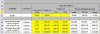
I dont understand this chart for it either. I get the Line current amps column...but what is the Power in and out columns? So at 1/8 Power @8Ω it has 325 watts going IN to the amp and is putting OUT 62 watts? It is rated at 500 watts per channel @8Ω.
upload_2020-4-12_17-22-24.jpeg


I will have time tomorrow to do some more experimenting so I will get back to you guys on what it actually does with what settings.
 
This is on the Crowns website FAQ's....

Should I have the level controls on my amplifier turned all the way up?

It depends on the system and how much gain you have prior to the amplifier. The level control can be thought of as an input attenuator. It does not limit the power available from the amplifier. With the level controls turned down the amplifier can still reach full rated output power, it just takes more drive level from your mixer to achieve it. Generally, you should set the mixer's individual channel fader and master gain to 0 dB, then adjust the amplifier level controls to the desired sound level.

How do I determine the best input sensitivity setting?
The input sensitivity setting is a function of amplifier gain. You will want to match it with the output level of whatever is before the amp in the audio chain (i.e. preamps, mixers). For amplifiers with a 0.775V position, this positions corresponds to a 0 dBu level. The 1.4V position corresponds to a +4 dBu level. The 26 dB position is a fixed gain position. The 26 dB position is also the lowest gain position, and will usually work well with output levels of +10 dBu (2.5Vrms and above).
 
What that chart is telling you is with an 8 ohm, typical music playing, with the volume turned up so the clipping indicators occasionally flicker, the average power output is roughly 62 watts per channel, and the amp is drawing an average of 325W from the wall.

Under that condition the amp is putting out peaks of its rated power or even a bit more and drawing higher peak power from the wall.

Your amp cannot put out 500 watts continuous power with music (that is unless you like a horrific amount of distortion/clipping) because it must have power to cover the peaks that occur in music. This peak to average is typically figured around 1/8 to 1/10 duty cycle, so to speak. Meaning, if you wanted an amp that could actually produce 500W continuous average power playing music, you'd need an amp that is rated 4000-5000 watts per channel.
 
Back
Top Bottom