• The move to the new server is done. There are some software and database maintenance updates in process. This has us passing the hat around to help out. We appreciate any donations. Seriously, even a dollar helps. The payment page may be found here - https://www.audiokarma.org/support.html

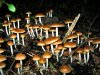
What The Heck Kind Of Wild Mushroom Is This!?

Pathogens

Some Aspergillus species cause serious disease in humans and animals. The most common pathogenic species are A. fumigatus and A. flavus, which produces aflatoxin which is both a toxin and a carcinogen, and which can contaminate foods such as nuts. The most common species causing allergic disease are A. fumigatus and A. clavatus. Other species are important as agricultural pathogens. Aspergillus spp. cause disease on many grain crops, especially maize, and some variants synthesize mycotoxins, including aflatoxin. Aspergillus can cause neonatal infections.[19]
A. fumigatus (the most common species) infections are primary pulmonary infections and can potentially become a rapidly necrotizing pneumonia with a potential to disseminate. The organism can be differentiated from other common mold infections based on the fact that it takes on a mold form both in the environment and in the host (unlike Candida albicans which is a dimorphic mold in the environment and a yeast in the body)

Concerning the spores from Wikipedia.
While the above species in the thread is not Aspergillus, I'd avoid the spores like they were the plague.
 
The pods opening. Don't go back to sleep!

invasion-of-the-body-snatchers-body.jpg
 
Shaggy Mane aka Inky Cap. They deteriorate VERY fast. They are edible but people who eat them say they decompose so fast after picking that you have to literally have the pan hot on the stove when you pick for best results.

Of course, don't eat them based on our ID.
 
On the bright side, now that they've opened, you don't have to worry about driving through a spore cloud if you hit them with the mower. I had some here that were about the same size, but rounder, and I swear, that cloud was following me for days ...

Rule of thumb, if it's not brightly colored, go ahead and eat it, then post back with the results. If you don't post back, we'll take up a collection and send flowers to the funeral ... <G>
 
Rule of thumb, if it's not brightly colored, go ahead and eat it, then post back with the results. If you don't post back, we'll take up a collection and send flowers to the funeral ... <G>

Take careful note of the <G> folks. Don't want anyone dying from humor. :D

This brings to mind the 'little brown mushroom' class (LBM) which are generally avoided by even mushroom hunters even though some of them are edible. There are just to damn many and they are too hard to sort out. :dunno:
 
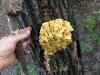
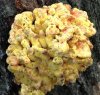
As long as we have a 'what is this mushroom' thread, a friend sent me this one the other day.

Carls Mac and Cheese Fungus_River_10_2016.jpg Carls Mac and Cheese Fungus_River_10_2016xx.jpg

It was growing on a dead or dying Northern Red Oak tree in the river bottoms on his property. I couldn't find anything to match it exactly, but it may be a variety known as the Sulfur Shelf aka Chicken of the Woods. Which is an edible type but normally doesn't look so branchy. It usually looks more like layers or flaps.

235px-Laetiporus_sulphureus_JPG01.jpg


chicken-of-the-woods.jpeg


It's the right habitat including the tree it's growing on, and the time of year, but I'd want to do some more investigating including a spore print before trying even a bite.

Very cool fungus though. We called it Macaroni and Cheese as a working title.
 
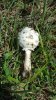
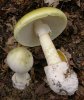
kno1.jpg kno2.jpg

Amantia phalloides is the most dangerous killer the woods have ever seen. King Karl's VI. last meal. The mushroom is so tempting because it smells fine (I tried that out) and tastes very nice, I did not try THAT out, but toxicologists did, of course they did not swallow the tiny sample.
 
Last edited:
One of the Amanitas ( muscaria?) is referred to as the "destroying angel".
What a nickname.

...Good name for a death metal band...
 
Most likely a strobilomyces strobilaceus species. We call them "Strubbelkopfröhrling" (literally shaggy head boletus).

Thank you, Chris. Edible?

Off topic, but my german friend Maggie told me that in Germany, turtles are called schildekreute (sp? Feel free to help out, Chris) and that it translated to "shield toad" which cracked me up.
You Germans are a clever, interesting group. :thumbsup:
 
It is not edible, James, it is too bitter, but not toxic.

Schildkröte is the correct spelling.

The German language is very interesting, even if there are languages which sound nicer, like Italian, it is worth the effort to get at least to some extent familiar with it.
 
Back
Top Bottom